Page 2
ASOCIAL HISTORY OF
ENGLISH RUGBY UNION
From the myth of William Webb Ellis to the glory of the 2003 World Cup
win, this book explores the social history of rugby union in England.
Ever since Tom Brown’s Schooldays the sport has seen itself as the
guardian of traditional English middle-class values. In this fascinating new
history, leading rugby historian Tony Collins demonstrates how these values
have shaped the English game, from the public schools to mass spectator
sport, from strict amateurism to global professionalism.
Based on unprecedented access to the official archives of the Rugby
Football Union, and drawing on an impressive array of sources from club
minutes to personal memoirs and contemporary literature, the book explores
in vivid detail the key events, personalities and players that have made
English rugby.
From an era of rapid growth at the end of the nineteenth century, through
the terrible losses suffered during the First World War and the subsequent
‘rush to rugby’ in the public and grammar schools, and into the periods of
disorientation and commercialisation in the 1960s through to the present
day, the story of English rugby union is also the story of the making of
modern England.
Like all the very best writers on sport, Tony Collins uses sport as a prism
through which to better understand both culture and society. A ground-
breaking work of both social history and sport history, A Social History of
English Rugby Union tells a fascinating story of sporting endeavour,
masculine identity, imperial ideology, social consciousness and the nature of
Englishness.
Tony Collins is Professor of the Social History of Sport at Leeds
Metropolitan University, a founding editor of the journal Sport in History
and a member of the executive committee of the British Society of Sports
History. He is twice winner of the Lord Aberdare Literary Prize for Sports
History (1999 and 2006).
Page 4
ASOCIAL HISTORY
OF ENGLISH
RUGBY UNION
Tony Collins
Page 5
First published 2009
by Routledge
2Park Square, Milton Park, Abingdon, Oxon, OX14 4RN
Simultaneously published in the USA and Canada
by Routledge
270 Madison Avenue, New York, NY 10016
Routledge is an imprint of the Taylor & Francis Group, an informa business
This edition published in the Taylor & Francis e-Library, 2009.
“To purchase your own copy of this or any of Taylor & Francis or Routledge’s
collection of thousands of eBooks please go to www.eBookstore.tandf.co.uk.”
All rights reserved. No part of this book may be reprinted or reproduced
or utilised in any form or by any electronic, mechanical, or other means,
now known or hereafter invented, including photocopying and
recording, or in any information storage or retrieval system, without
permission in writing from the publishers.
British Library Cataloguing in Publication Data
Acatalogue record for this book is available from the British Library
Library of Congress Cataloging in Publication Data
Collins, Tony, 1961–
Asocial history of English Rugby Union / Tony Collins.
p. cm.
Includes bibliographical references.
1. Rugby League football–Social aspects–England–History. 2. Rugby Union
football–Social aspects–England–History. 3. Working class–Recreation–
England–History. I. Title.
GV946.C65 2009
796.3330942–dc222008040541
ISBN 0-203-88544-9 Master e-book ISBN
ISBN10: 0–415–47660–7 (hbk)
ISBN10: 0–203–88544–9 (ebk)
ISBN13: 978–0–415–47660–7 (hbk)
ISBN13: 978–0–203–88544–4 (ebk)
Page 6
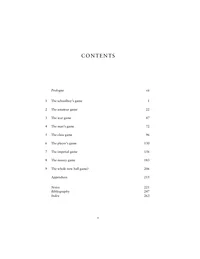
CONTENTS
Prologue vii
1 The schoolboy’s game 1
2 The amateur game 22
3 The war game 47
4 The man’s game 72
5 The class game 96
6 The player’s game 130
7 The imperial game 156
8 The money game 183
9 The whole new ball game? 206
Appendices 215
Notes 221
Bibliography 247
Index 263
v
Page 7
First published 2009
by Routledge
2Park Square, Milton Park, Abingdon, Oxon, OX14 4RN
Simultaneously published in the USA and Canada
by Routledge
270 Madison Avenue, New York, NY 10016
Routledge is an imprint of the Taylor & Francis Group, an informa business
This edition published in the Taylor & Francis e-Library, 2008.
“To purchase your own copy of this or any of Taylor & Francis or Routledge’s
collection of thousands of eBooks please go to www.eBookstore.tandf.co.uk.”
All rights reserved. No part of this book may be reprinted or reproduced
or utilised in any form or by any electronic, mechanical, or other means,
now known or hereafter invented, including photocopying and
recording, or in any information storage or retrieval system, without
permission in writing from the publishers.
British Library Cataloguing in Publication Data
Acatalogue record for this book is available from the British Library
Library of Congress Cataloging in Publication Data
Collins, Tony, 1961–
Asocial history of English Rugby Union / Tony Collins.
p. cm.
Includes bibliographical references.
1. Rugby League football–Social aspects–England–History. 2. Rugby Union
football–Social aspects–England–History. 3. Working class–Recreation–
England–History. I. Title.
GV946.C65 2009
796.3330942–dc22 2008040541
ISBN 0-203-88934-7 Master e-book ISBN
ISBN10: 0–415–47660–7 (hbk)
ISBN10: 0–203–88544–9 (ebk)
ISBN13: 978–0–415–47660–7 (hbk)
ISBN13: 978–0–203–88544–4 (ebk)
Page 8
PROLOGUE
Of the little that is known about William Webb Ellis, we can be certain of
one thing: he did not invent the game of rugby football.
An unremarkable schoolboy, he lived his life in dutiful obscurity as an
Anglican clergyman until his death in 1872. Four years later, however, a
second life began for him when Rugby School old boy and benefactor
Matthew Bloxam suddenly named Ellis as the boy who in 1823 first picked
up the ball and ran with it. Bloxam offered no evidence for his claim. Nor
did he provide any in 1880 when he reiterated his view.
At the height of the war that split rugby apart in 1895, the Old Rugbeian
Society set up a committee to investigate the true origins of the Rugby foot-
ball. Despite considerable efforts, not one person came forward to support
Bloxam. The committee found not a single eyewitness, not a solitary written
word, not even a syllable of hearsay evidence to support the William Webb
Ellis story.
Nevertheless, the committee decided ‘in all probability’ that Ellis was the
‘innovator’ of running with the ball. In 1900 a plaque was erected at the
school that proclaimed unhesitatingly that Ellis ‘with a fine disregard of the
rules of football as played in his time, first took the ball in his arms and ran
with it’ in 1823.
Not for the first time in the history of rugby, evidence had been out-
weighed by expedience.
vii
Page 10
1
THE SCHOOLBOY’S GAME
t is a sunny, brisk afternoon in November, with a slender breeze blowing
Iacross the pitch. In a few moments School House will face School in a
match that would change the face of British sport.
Thwack! The ball is kicked off, far into the distance but no more than
fifteen feet in the air at its highest. It is caught and taken back bravely by a
School House player into the oncoming School forwards. As the two packs
meet, the ball temporarily disappears. As struggle for possession seems to get
increasingly desperate, the ball suddenly appears on the House side of the
scrum.
Their forwards hesitate momentarily and in a flash the ball is taken up by
the onrushing School breakaways and kicked down field, threatening to
breach the House defence. But a covering House three-quarter cleans the ball
up, sidesteps a couple of oncoming forwards and drop-kicks the ball deep
into School’s half. House forwards flood into School territory and the two
packs pile into each other, desperate to regain the ball. House pile on the
pressure and seem to have School penned into their own quarter.
The ball squirts free again but as soon as it appears in open play, it is once
again entombed by a mass of scrummaging forwards. Two take their life into
their hands and fight their way to middle of the scrum, determined to drive
the ball through their School pack and out the other side. But the experi-
enced School forwards get the better of them and they lose track of the ball,
forcing them to fight their way back out of the wrong side of the scrum
before re-entering it back on their own side.
Then Brooke, the House captain, takes charge, crouching low and driving
the ball forward through the legs of the opposing school forwards. His skill
and strength get it so far but he too is driven back. Slowly School begins to
get the upper hand and House are driven back inch by inch, each step
contested as if the forwards had the backs towards a precipice. The ball
1
Page 11
THE SCHOOLBOY’S GAME
suddenly appears on the wrong side of the House goal line but the danger is
averted by a sharp kick into touch.
As the line-out is formed, both sides jostle for position but Brooke takes
the ball and throws into the hands of his brother, who scorches through the
School line to take it deep into School territory. He beats one tackler, then
another, kicks the ball forward and, just as the defenders rush in to kill the
threat, throws himself on the ball as it bounces over the goal line and
between the posts. Try! Try to House and the Brooke brothers’ combination.
But the try counts for nothing if it is not converted into a goal. Crab Jones,
the coolest player on the field, steps forward and amidst a swarming mass of
defenders hoping to charge down his kick, calmly steers the ball over the
crossbar and between the posts. First blood to House.
The two sides change ends and, following a brief break for refreshments,
School kick off high into the air, giving their forwards time to advance deep
into House’s half. Their tactics are to keep the ball near the House goal
through sheer weight of numbers but the House forwards meet them blow
for blow. Each time the ball emerges from the scrum, it is a House player
who retrieves it and takes it back up the field. Those loose balls they miss are
cleared up by Crab Jones and his fellow backs, who drop-kick the ball out
to safety, momentarily relieving the onslaught.
But the pressure refuses to go away and as the end of the match approaches,
School forwards get the ball at their feet and drive it forward again towards
the House goal. Brooke throws himself into the centre of the rush but fails to
get the ball. As it heads towards the posts, Crab Jones manages to get his
hands on it but before he can set himself for the relieving kick the School
forwards bring him down and the ball slips from his hands and rolls behind
the House goal posts.
As the rest of the House team hold their breath and School is about to
salute the try that could tie the game, a slight and inexperienced boy playing
in his first match rushes headlong towards the ball, a fraction ahead of the
incoming School forwards. As the rampaging pack push him over, he
manages to fall on the ball a fraction before they collapse in a mass on top
of him. As his teammates rush up to congratulate him, the match ends and
House celebrate a glorious victory.
The schoolboy was Tom Brown. The game was Rugby football.
And this was the match that would take the game and its values out of the
school, across Britain and around the world.
2
Page 12
THE SCHOOLBOY’S GAME
Tom Brown and Rugby School
Of course, the School versus School House match described in Thomas
1
Hughes’ Tom Brown’s Schooldays was entirely fictional. And Tom Brown
never existed. But the future popularity of the Rugby School code of football
arose in large part to the remarkable impact of this fictional pupil of the
school.
In contrast, the fictional exploits of William Webb Ellis, a real pupil at the
school, had no bearing on the development of the sport. His tale belonged
to a later time, when the story brought comfort to those concerned at the
direction rugby had taken in the 1880s and 1890s. Thomas Hughes himself,
a pupil at the school in the 1830s, knew nothing of him. ‘“The Webb Ellis
2
tradition” had not survived to my day,’ he told the Old Rugbeian Society.
There can be no doubt that if the Webb Ellis story had contained a shred of
truth, Hughes would have woven it into Tom Brown’s Schooldays,a
veritable compendium of folklore about Rugby School.
First published by Macmillan in April 1857, Tom Brown’s Schooldays
became an instant best seller, almost single-handedly establishing a new
3 In
literary genre of the ‘school story’, and creating the first schoolboy hero.
it, young Tom Brown, the son of a country squire, is sent to Rugby School,
where, through a series of moral lessons, including the importance of playing
football and cricket, he matures into a model Victorian gentleman. Tom
Brownwas an attempt to describe public school life for young boys (Hughes
originally wrote it for his eight-year-old son Maurice, who died just two
years after its publication) and to bring the teachings of Rugby’s most
famous headmaster, Thomas Arnold, to a wider audience. Sentimental and
sanctimonious in equal doses, it proved popular with boys and men alike,
selling 11,000 copies in its first year and being reprinted almost fifty times
by the end of the century. It was, said The Times, a book that ‘every English
4
father might well wish to see in the hands of his son’.
In its tone and outlook it epitomised all the self-confidence that the
middle classes felt during the decades that followed the 1832 Reform Act,
which finally brought them the franchise. The final collapse of the threat of
Chartism after 1848 guaranteed an unprecedented period of relative social
and industrial peace that lasted for almost thirty years. The Great Exhibition
of 1851 symbolised Britain’s triumphant global ascendancy, and the years
that followed saw exceptional economic growth both at home and overseas.
New markets continued to be opened up to British trade and manufactures,
profits and rents carried on rising, and the size of the middle class itself grew
rapidly, thanks to the expansion of clerical, administrative and managerial
3
Page 13
THE SCHOOLBOY’S GAME
work. The number of people employed in ‘white collar’ occupations grew by
69 per cent in the three decades after 1851 to over 900,000. Clerks, bankers
and accountants multiplied fourfold over the period, while those employed
in education almost doubled. It was also a period in which the professions
began to consolidate organisationally, raising their social status and prestige.
For example, the British Medical Association was established in 1856, the
1860 Solicitors’ Act allowed the Law Society to organise entrance examina-
tions, and the Royal Institution of Chartered Surveyors was founded in
5
1868.
For the more adventurous, the discovery of gold in Australia and California
offered opportunities to amass considerable fortunes. Industrial capitalism
was now accepted, if not necessarily universally embraced, by the middle
classes as an engine of their prosperity now and in the future. This was a
world in which all sections of the middle classes – businessmen, churchmen,
military men and country gentry – could feel that they, above all other classes,
had made the decisive contribution to the success of their nation. Britain’s
position at the apex of world power, they confidently believed, was a result
of ordinary middle-class families like theirs and, for Thomas Hughes, that of
Tom Brown:
much has yet to be written and said before the British nation will be
properly sensible of how much of its greatness it owes to the
Browns. For centuries, in their quiet, dogged, homespun way, they
have been subduing the earth in most English counties, and leaving
their mark in American forests and Australian uplands. . . . noble
families would be somewhat astounded – if the accounts ever came
to be fairly taken – to find how small their work for England has
6
been by the side of that of the Browns.
This sense of Britishness also encompassed an increased awareness of
military responsibilities overseas. This was partly because of the growing
newspaper coverage of Britain’s frequent wars, most notably in William
Russell’s despatches from the Crimean War in The Times, but also because
Britain’s increasing international influence necessarily meant increased
vigilance as its reach extended across the world.7 The frustrations of the
inconclusive Crimean adventure were followed in 1857 by the outbreak of
rebellion in India, which was not only shocking in its violence but also in the
way that it questioned Britain’s right to rule. But such challenges to British
authority became occasions not for doubt but for the reassertion of national
and racial superiority. It was an age of self-satisfaction and moral certitude.
4
Page 14
THE SCHOOLBOY’S GAME
And it was the age that shaped and moulded rugby football, indelibly
marking it with features and attitudes that remain with it to this day.
The game’s birthplace, Rugby School, self-consciously expressed and
promoted the spirit of mid-Victorian England. It had been founded in 1567
by a London grocer, Laurence Sheriff, to ‘teach grammar freely’ to boys from
the midlands town of Rugby and surrounding area. By 1818 the school
had become the second largest public school in England, with almost 400
pupils. By this time there was very little that was either free or public about
it, although Sheriff’s legacy of land in London’s Gray’s Inn Fields had
ensured its prosperity. While it had attracted some boys from aristocratic
families in the late eighteenth century, and continued to do so throughout
the nineteenth, the majority of its pupils came from the upper middle classes,
especially the clergy and the rural gentry. This tendency intensified under
the headship of Thomas Arnold, partly because he appears to have dis-
couraged the recruitment of aristocratic boys, but mainly because he himself
was the archetype of the social layer from which the school drew most of its
8
boys.
He had been appointed headmaster of the school in 1828 and set about
reforming it according to his belief that Christian principles were an
inseparable part of everyday living. He changed the school’s prefect system
so that much of the responsibility for the social and moral welfare of pupils
rested on the shoulders of sixth form prefects, or praeposters as they were
know in the school. He also raised the importance of mathematics, science
and modern languages in the curriculum, deepening a process that had
started before his arrival, moving the school slightly away from the public
schools’ traditional exclusive concentration on Greek and Latin. In 1844 a
poem entitled The Masters of Science won the school poetry prize, marking
9
the small but significant shift in the curriculum.
But Arnold’s overriding concern was to create boys who had ‘character’,
whose education would enable them to provide leadership to British society
and the Empire. ‘What we must look for here is, first, religious and moral
principle; secondly, gentlemanly conduct; thirdly, intellectual ability’ he
explained.10 Although not a term used by Arnold, this philosophy became
known as Muscular Christianity. Under him, Rugby became distinguished
by a sense of moral certainty hitherto unknown in public schools. He saw
life as a continuous battle between righteousness and evil and the school’s
role was to produce young men who would pursue this struggle in every
11
aspect of their lives. He argued that the cause of evil was the ‘natural but
our business is to preserve and not to improve. It is the ruin of us all alike,
5
Page 15
THE SCHOOLBOY’S GAME
individuals, schools, and nations’.12 Shaped by his response to the French
Revolution, Arnold’s philosophy was a mixture of anti-aristocratic senti-
ment, Protestant self-help, political reformism and monarchism. In this, they
almost perfectly expressed the piecemeal ideology of British capitalist
society, combining as it did belief in free trade and opposition to aristocratic
excess with a sentimental loyalty to the monarchy and other trappings of
traditional authority. Rugby’s view of itself and its place in the world was
spelt out by an anonymous contributor to the school magazine in 1846, who
described the school as
the image of that most powerful element in modern English society,
spirit with Railway Kings and Cotton Lords, being equally with
them the creation of modern, burning, life-like energy. Her golden
age alluded to above, synchronises with the strong convulsions
which attended the Reform Bill. . . . Save in the one article of birth
amanufacturer may make himself an equal to a duke. In a late stage
of civilisation, like the present, the idea of trade comes prominently
and almost exclusively into notice, being able at length to connect
itself with that from which it has long been kept apart, education
and enlightenment. Even so, we feel that our power has of late
begun to be acknowledged; and that feeling shall animate us to
proceed, holding fast the birthright of moral thoughtfulness which
13
This also explains the importance that began to be placed on competitive
sports in the mid-nineteenth century. The economic dominance of British
capitalism was based on competition, both in the struggle for new markets
and colonies and, more fundamentally, in the very nature of how society
functioned. The success of the industrial factory system had been accom-
panied by the imposition of a new culture of time-work discipline that
attempted to inculcate the virtues of hard work and thrift into the working
classes. In a similar fashion, the leaders, managers and administrators of the
economy and society also had to be educated in the competitive spirit that
drove forward the engine of economic expansion.
Another aspect of that competitive outlook was the expression of English
nationalism, of which Arnold was also a passionate advocate. He believed in
the innate moral superiority of men of his own race and class: ‘a thorough
English gentleman – Christian, manly, and enlightened – is . . . a finer
specimen of human nature than any other country, I believe, could furnish’.
6
Page 16
THE SCHOOLBOY’S GAME
The same sentiments were expressed about the Rugby code of football by the
school’s pupils. ‘At football you must possess either muscular strength, or
fleetness of foot, or true British pluck (the three points on which a Rugbeian
prides himself most) to become even a tolerable player,’ wrote one enthusiast
in the school’s New Rugbeian magazine in 1860. Thomas Hughes fully
shared the nationalism of his mentor, declaring later in his life that he did not
‘like any foreign nation much from the little I know about them and I am
certainly a most thoroughly prejudiced John Bull’.14
Ultimately, however, the core of Arnold’s beliefs, and of his disciples such
as Hughes, consisted of a fervent conviction of the moral correctness of his
view of the world. ‘Perhaps ours is the only little corner of the British Empire
which is thoroughly, wisely and strongly ruled just now,’ suggests a master
with oblivious self-importance to Tom Brown towards the end of Hughes’
15 Many critics have accused Hughes of distorting or even betraying
book.
Arnold’s ideals in favour of a cult of athleticism, but Muscular Christianity
was literally the embodiment of Arnold’s struggle for righteousness against
sin. If one was to ‘fight the good fight with all thy might’, as J. S. B. Monsell’s
1863 hymn had it, it was not enough that it be fought in lectures and
sermons. It had to be fought in the industrial cities and throughout the
colonies of the empire. Although Arnold had no interest in sport, he shared
Hughes’ belief that Christianity was about action, not contemplation.
Muscular Christianity gave British middle-class men of action at home and
abroad a moral framework in which to justify their work.16 Such was the
intensity of the school’s training and the effect it had on its boys that many
former pupils came to see themselves, in the words of The Times, ‘as
17
extend the monitorial system to the world’.
Tom Brown’s Schooldayswas part of that crusade. The book portrays the
social mores and values of Rugby School in ways that would be easily
understood by its youthful audience. This leads to a highly idealised view of
school life. Contemporary accounts make it clear that Hughes underplayed
the daily brutality of the school even under Arnold. In addition to the
violence of the football field, the school was a ‘“rough and tumble” sort of
not uncommon, according to old boy Reverend Bulkeley Jones.18 Bullying
was far more common than is portrayed in the book, in which it is almost
exclusively the preserve of the cartoonish Harry Flashman character. Those
who failed to meet such physical challenges, whether at football or in school
life generally, were guilty of the grievous sin of ‘funking’. The clunking
didacticism of the book ascribes this defect to the suspect older boys, such
7
Page 17
THE SCHOOLBOY’S GAME
as Flashman – who ‘played well at games where pluck wasn’t much wanted’
– and the unpopular Snooks and Green, ‘who had never faced a good
19
scrummage at football’.
But, as was the case with the sport of rugby football itself, Hughes had an
ambiguous view of violence; it was not always condemned. At one point in
the book he even describes how Arnold strikes a boy for mis-translating a
piece of Latin. Moreover, he himself had a strong and regularly expressed
belief that ‘fighting with fists is the natural and English way for English boys
to settle their quarrels. What substitute for it is there, or ever was there,
amongst any nation under the sun? What would you like to see take its
place?’ He was also a keen pugilist throughout his life, being arrested for
brawling with a Chartist speaker in London in 1848 and personally boxing
with every recruit to the London Working Men’s College he helped found in
20
1850.
As Tom Brown makes clear, the school was a microcosm of a rigidly
hierarchical world, in which all boys were educated to expect deference and
servility from those considered to be of lower status. An escalator of rank
operated, on which even the lowest boy could expect to acquire increasing
status as he progressed up the school. But for the lower classes, Arnold’s
worldview was one in which they knew their place and kept to it. Trade
unions, he wrote in 1834, were a ‘fearful engine of mischief, ready to riot or
21
assassinate’. While his ideas of moral rectitude, hard work and leadership
by example were the embodiment of British capitalism’s self-image in the
nineteenth century, the place of the working class in his worldview belonged
to a mythical Merrie England in which masters and men (women never being
thought of as worthy of consideration) coexisted in mutual respect, each
happy to acknowledge the other’s place in the social hierarchy. This idea is
strongly expressed in the early passages of Tom Brown’s Schooldays.
Hughes idealises his own boyhood in the Berkshire Downs and fictionalises
his own father in the character of Squire Brown, who tells the young Tom
that ‘it didn’t matter a straw whether his son associated with lords’ sons or
ploughmen’s sons provided they were brave and honest’. But this apparent
equality was dependent on the lower orders’ accepting that they were, in the
words of Hughes’ father, ‘bound not only by diligence but to strict obedience
22
and deference to the wishes of master and mistress’.
Class distinction was central to the school and to Tom Brown. As he travels
to the school for the first time, young Tom is told by the coachman how boys
from Rugby use pea-shooters to fire from the coach at passers-by, including
at Irish road builders with whom they subsequently got into a fight. On
arrival he is informed by East, his initial guide to the school and his
8
Page 18
THE SCHOOLBOY’S GAME
23
subsequent best friend, that local youths are known as ‘louts’. Tom is
ludicrously ignorant about the lives of boys outside of his class. ‘All boys are
sent to a public school in England’ he tells the sensitive George Arthur late in
the book. The reality was that less than a quarter of one per cent did so
24
at that time. In 1864 the cost of a Rugby School education, including
boarding, was 90 pounds, 18 shillings and 10 pence per year, almost exactly
the same as a skilled manual worker’s annual wage. Not all those who
attended the school survived its stifling social snobbery either. The Clarendon
Commission noted that foundationers, local boys who paid minimal fees to
be educated at the school according to the terms of Laurence Sheriff’s original
endowment, usually left after their first two or three years. This was because
they were ‘the sons of persons of the town who happen to belong to a class
bred in an inferior position’.25
This was also a world in which conformity was encouraged and intel-
lectual curiosity frowned upon. As Walter Bagehot pointed out, intellectual
dullness among the middle classes, and deference, especially on the part of
the lower classes, were two of the defining qualities of the period and
26
essential guarantors of political stability. ‘I don’t care a straw for Greek
particles, or the digamma; no more does his mother,’ confesses Tom’s father
as the boy leaves to go to Rugby. ‘What is he sent to school for? . . . If he’ll
only turn out a brave, helpful, truth-telling Englishman, and a gentleman,
27
and a Christian, that’s all I want.’ On arrival at the school one of the first
lessons that the new boy Tom is taught by East is that it is the boy who has
‘nothing odd about him’ who most easily fits in with school life.
The book’s most famous, or infamous, declaration of conformist phili-
stinism is that of the praeposter Brooke who, during a speech after he has
led his side to victory in a football match, asserts ‘I’d rather win two School-
house matches running than get the Balliol scholarship any day’, about
which Isabel Quigley memorably remarked ‘qualifies him as either a liar or
an idiot’. This sentiment is echoed when Tom is asked what his ambitions
are at the school: ‘I want to be A1 at cricket and football, and all the other
games, and to make my hands keep my head against any fellow, lout or
gentleman. I want to get into the sixth before I leave, and to please the
Doctor; and I want to carry away just as much Latin and Greek as will take
28
me through Oxford respectably’. Even after he leaves the school the same
attitude is highlighted, approvingly by Hughes, in a conversation with his
holiday companions: ‘What a bother they are making about these wretched
Corn-laws! Here’s three or four columns full of nothing but sliding-scales
9
Page 19
THE SCHOOLBOY’S GAME
and fixed duties. . . . Ah, here’s something better – a splendid match between
Kent and England, Brown! Kent winning by three wickets. Felix fifty-six runs
without a chance, and not out!’ This dialogue was memorably echoed eighty
years later by the characters Caldicott and Charters in Alfred Hitchcock’s
1938 The Lady Vanishes as they attempt to ignore the onward rush of the
Second World War around them by burbling about cricket scores through-
29
out the film.
The promotion of sport over intellectual pursuits did not go unnoticed by
contemporaries. ‘Scholarship throughout this little volume is kept quite in
the background,’ noted a reviewer in The Times drily, who in an otherwise
very positive review also took the opportunity to ‘protest’ at the growing
30
tendency of public schools to make games compulsory. This was a debate
that was to rage over the next fifty years among public school educators. The
phrase that was most commonly used to encapsulate the philosophy of
Muscular Christianity was Juvenal’s ‘Mens sana in corpore sano’: ‘a healthy
mind in healthy body’. This has been subsequently interpreted by many
historians to suggest that Muscular Christians believed in a balance between
an athletic body and a studious mind. But for Hughes and similar thinkers,
ahealthy mind did not mean one that was scholarly but one that was morally
pure. ‘Healthy’ meant that one was observant of Christian obligation and
free of sexual corruption, which for schoolboys meant the avoidance of
masturbation and homosexuality.31 Other Muscular Christians were more
outspoken in their advocacy of brawn over brain. Loretto headmaster and
rugby football evangelist H.H. Almond argued that ‘from fourteen to
seventeen, long hours of brain work are unnatural and injurious,’ that there
was ‘an overdone system of examinations’ and that boys should spend
32
‘two to three hours daily’ engaged in physical training. Whilst there were
undoubtedly examples of scholar-athletes who excelled in both worlds, they
were few and far between.
The tendency for athletics to take precedence over academic work was
also an issue that troubled the Clarendon Commission. Established in 1861
to examine the state of public school education in England, its main concern
was to investigate the extent to which the public schools’ stodgy curriculum
of Greek and Latin met the needs of an increasingly scientific age. As part of
its review, it also spent considerable time investigating the precise details of
student activities and the place of games in school life. Perhaps in recognition
of the passions that the debate stirred, the commission trod carefully, finding
no direct evidence to support the view that games overshadowed study but,
with a subtlety that suggested that its sympathies were not wholly in favour
of sport’s growing prevalence, noted that it was possible that there might be
10
Page 20
THE SCHOOLBOY’S GAME
some danger of sport being taken too seriously. Football was compulsory at
Harrow, Shrewsbury, Winchester, where younger boys were required to
fag for seniors, and Rugby, at which failure to play meant 300 lines followed
by a beating for a repeat offence, but not at Eton. The commission also
enquired whether boys regarded sporting success as a substitute for scholarly
excellence. It found that at Harrow, ‘the importance assigned to games in
the estimation of the boys is somewhat greater than it should be’, but at
Rugby the philosophy of the school meant that sport ‘distinguishes the
33
strong, strengthens the studious and spares the weak’. If the commission
was circumspect in its assessment of the other public schools, it was effusive
in its praise for Rugby and its philosophy. The school, it declared, had
‘become in fact a national institution, as being a place of education and a
source of influence for the whole Kingdom. . . . It instructs everywhere, is
34
known everywhere, and exercises an influence everywhere.’
Rugby football and its rivals
The Clarendon Commission’s unqualified endorsement of the school and its
principles was crucial to the success of the Rugby code of football. It
effectively gave an official seal of approval to Tom Brown’s Schooldays. The
huge sales of the book had brought Arnold’s principles to a new and wider
audience. Not only did its description of football make the game exciting
and attractive but, crucially, and for almost the first time, the book also gave
the sport a ‘meaning’, above and beyond the intrinsic enjoyment of chasing
aball around a field. Today it is a commonplace to talk about the ‘meaning’
of sport and its broader cultural importance. But, aside from the occasional
references to boxing being part of the British character by early nineteenth
century writers such as Pierce Egan, no one before Hughes had ascribed a
set of moral values to a sport. Even cricket, which had been seen since the
late eighteenth century as the signifier of pastoral England and its romanti-
cised rural past, did not yet carry the same assumptions of individual moral
35
purpose. ‘This is worth living for; the whole sum of school-boy existence
gathered up into one straining, struggling half-hour, a half-hour worth a year
of common life,’ says Hughes during one of his descriptions of a game.36
Rugby football now had an explicit social purpose. It was a way of imple-
menting Arnold’s teachings. To play it was to build on his moral tradition.
The values of Tom Brown’s Schooldays became the moral foundation for
what would become rugby union football wherever the game was played.
Put broadly, these values – which will be discussed as they recur through-
out this book – were a commitment to a masculine and anti-effeminate
11
Page 21
THE SCHOOLBOY’S GAME
worldview; a defence of social hierarchy and order; a belief in British
national superiority, with England as ‘first amongst British equals’; and
an absolute certainty in one’s own moral purpose. The success of Hughes’
book and the evangelical fervour of the school’s former pupils with ‘their
nervous anxiety to look after other people’s moral welfare’, combined with
the ringing endorsement of the Clarendon Commission, meant that Rugby
School, its methods and its football code achieved a prominence far beyond
37
its origins in a small English country town. As much as it was a recreation,
Rugby football had also become an idea, an ideology even.
Following the publication of the Clarendon Commission report, Arnold’s
Rugby became the model for the mid-Victorian public school. Older schools
such as Harrow reformed the curriculum along Arnoldian lines and new
schools such as Haileybury and Clifton, two of a burgeoning number of
public schools founded during the mid-century, adopted Rugby’s philosophy
completely. Indeed, middle-class expectations of public school life came to
be shaped in a large part by reading Hughes’ book, causing many schools
38
to adopt its principles in order to attract new pupils. For a large number
of schools, this meant that Tom Brown’s game became their football code
of choice. The authority which Rugby School commanded can be gauged
by the fact that at Wellington College, which took up rugby football in
1860, the first rule of football was ‘in case of any dispute arising during a
match, the rules are the same as those used at Rugby’. Moreover, such was
the fervour for the game that, upon leaving school, many of its adherents
formed clubs in order to play the game as adults. The two oldest clubs in
England – Liverpool, formed in 1857, and Blackheath, formed in 1858 –
were both organised by boys who had learnt the game at Rugby School and
39
Blackheath Proprietary School respectively.
The book’s influence also extended far beyond the narrow strata of the
upper middle classes that could afford to send their sons to a public school.
The expansion of the middle classes during the mid-Victorian years had led
to a corresponding rise in the demand and opportunities for leisure. This was
intertwined with a recognition that, for middle-class males at least, an urban
and sedentary lifestyle often had a detrimental effect on their health. ‘In an
age like the present’, wrote the anonymous ‘Stonehenge’ in 1857, ‘when in
the struggle for precedence in the senate, the bar, or the haunts of commerce,
time is considered as of equal value with money, it can scarcely be wondered
at that many of the competitors in the race lose health, both of body and
mind. Nothing enfeebles and lowers the bodily and mental tone more than
an entire giving up of all the energies in one single pursuit.’40 The rapid
urbanisation of society was also a major course for concern. ‘The tendency
12
Page 22
THE SCHOOLBOY’S GAME
of the population to congregate in large towns, the multiplication of artificial
means of transit, the increased strain and competition of modern life, the
calamitousness of change, by which business hours have begun and ended
later, till crowds of sallow clerks are now released from offices after the
expiry of daylight for many months in the years, are all causes antagonistic
to this prime necessity of a nation which is to be long vigorous,’ argued H.H.
41
Almond.
For many middle-class men the Rifle Volunteer movement, which had
been created in 1859 in response to an increase in Anglo-French tensions,
offered the opportunity for the necessary physical exercise through military
training. Gymnasia also started to appear in major towns and cities, as did
42
athletic clubs, most notably London’s Amateur Athletic Club in 1866. By
the mid-1860s it was common for football clubs to be formed by members
of the local middle classes who had not been to public school. For example,
in Leeds a local cap manufacturer, J.G. Hudson, helped to found the city’s
first football club in 1864. One of its unfulfilled ambitions was to play a
match against Rugby School. And common to all these initiatives was a firm
belief in the Arnoldian philosophy of ‘Mens sana in corpore sano’.
Of course, the Rugby School code of football was not the only set of rules
played by these new football clubs. Most played a modified or hybrid version
of a public school code of football, although clubs in the Sheffield area
played their own independent form of dribbling-style football. Even those
who looked to Rugby rarely followed the school’s rules exactly. Many did
not allow hacking for example. But as the number of clubs grew the desire
to play matches against other sides – rather than between members of the
same club, as tended to be the case initially – also increased. Although
matches were organised where the teams would use the rules played by the
home side, this was not seen as a satisfactory solution and ideas about
developing a ‘universal’ set of rules started to emerge. Similar discussions
had started to take place in the public schools, as the increasingly high public
profile of football stimulated inter-school rivalry and opportunities for
matches increased as a result of the growth of the railways.43 It was the desire
to find an answer to this problem that led a number of clubs in London to
meet in October 1863 to discuss the formation of an association of football
clubs with a common agreed set of rules.
Although hindsight has led some historians to make the formation of the
Football Association (FA) the decisive act in the creation of the soccer and
rugby codes of football, the reality was not so simple. The FA took six
meetings and a not inconsiderable amount of political manoeuvring before
it arrived at a final version of its rules. By the end of the fourth meeting on
13
Page 23
THE SCHOOLBOY’S GAME
24 November 1863 the nineteen delegates, representing just ten clubs, had
voted to accept a set rules that included:
9. A player shall be entitled to run with the ball towards his
adversaries’ goal if he makes a fair catch, or catches the ball on the
first bound; but in the case of a fair catch, he makes his mark, he
shall not run.
10. If any player shall run with the ball towards his adversaries’
goal, any player in the opposite side shall be at liberty to charge,
hold, trip or hack him, or wrest the ball from him; but no player
44
shall be held and hacked at the same time.
To all intents and purposes, the FA’s proposed rules were to be based on
those of Rugby School. It is worth noting that hacking, or ‘shinning’ as it
was known elsewhere, was not confined to Rugby School football at this
time. ‘Shinning’, noted an Etonian in 1859, ‘is carried out to such an extent
at our public schools that it would be greatly increased’ if inter-school
45
football matches took place. However, the secretary of the FA, Ebenezer
Morley, was not a supporter of Rugby’s rules and proposed a motion to
endorse the football rules of Cambridge University, which forbade carrying
the ball and hacking. This was not put to a formal vote, possibly because on
a show of hands only eight delegates indicated their support, but a commit-
tee was set up to discuss with the Cambridge footballers. Confusingly, the
delegates also decided that hacking was a non-negotiable principle in the
discussions with Cambridge, but that running with the ball in hand was
negotiable. The meeting was adjourned amid controversy over exactly what
had been decided.
When the delegates reconvened the following week, procedural wrangling
broke out when Morley failed to read correctly the previous meeting’s
minutes and left out the motion that was passed in favour of hacking.
Despite there being four fewer delegates and two less clubs than at the
previous meeting, C.W. Alcock successfully proposed a motion to strike out
the previously agreed rules allowing hacking and running with the ball. From
the discussion that followed, it is quite clear that Morley and Alcock were
46
determined to adopt the Cambridge rules come what may. Unsurprisingly,
most of the clubs supporting the Rugby School game did not even bother to
turn up at the following week’s meeting that rubber-stamped the non-
hacking and non-handling rules. Although the founding clubs of the FA
numbered eighteen, it appears that at least six of them, such as Blackheath,
47
subsequently left because of their adherence to Rugby rules.
14
Page 24
THE SCHOOLBOY’S GAME
Even after the break with the adherents of the Rugby code, FA rules still
allowed handling the ball. A ball could be caught with the hands before it
bounced and the catcher allowed to take an unimpeded kick, similar to the
‘mark’ in rugby or Australian rules football. Even the Royal Engineers, who
were to appear in four of the first seven FA Cup finals, still played their own
code of football that allowed running with the ball. Such apparent anomalies
demonstrate not only the fluid state of the various rules of football at this
time but also how little difference the FA’s formation made to the game.
Most football clubs were not members and even those that were members
did not rigorously follow its rules. In fact, the formation of the FA had little
impact on immediate direction of football. The FA’s minute book records
that ‘no business was conducted’ at its meeting of 28 October and it did not
assemble again until February 1866 when it met to revise its rules. Twelve
months later it had just ten member clubs, nine in London and Sheffield FC,
which played its own rules anyway.
By January 1871, such was the dominance of the Rugby code of football
that Bell’s Life, the premier sporting weekly of the time, pointed out that
since the formation of the FA, ‘every year has increased the superiority in
point of numbers and popularity of the Rugby clubs over those who are
subject to the rule of the Association’. This is confirmed by Adrian Harvey’s
painstaking research into football clubs of the time. In the period 1868–73
he estimates that twenty-five of the thirty-eight major British football clubs
played a version of football based on Rugby rules. This is confirmed by the
first issue of what became C.W. Alcock’s Football Annual, published in
1868, which records eighty-eight football clubs in existence at the time, of
which forty-five played according to the Rugby tradition with thirty
Association clubs and thirteen Sheffield Association clubs. It was only once
the FA Cup became popular in the mid-1870s that differentiation between
the various sets of football rules began to harden – and the FA began to grow
– as the increased rivalry and competitiveness of the cup forced clubs to
choose a code in which to specialise and thus increase their chances of
48
success in the competition.
Yet, alone of all the public school codes of football, it was the Rugby
School code that survived and flourished among adult clubs. Despite the
considerable social prestige attached to Eton, Winchester and Harrow, their
codes of football did not become adult sports. Apart from one or two
isolated instances, for example at Oxford and Cambridge universities, clubs
playing the Eton or Harrow football rules did not exist. To some extent this
was because the FA incorporated some of the features of these schools’
football codes. The FA rulebook was a conglomeration of football rules and
15
Page 25
THE SCHOOLBOY’S GAME
preferences, with no direct link to any one public school. But the willingness
of Etonians and Harrovians to sink their differences over football rules
stands in marked contrast to the Rugbeians’ belief in the superiority of their
own code. This was despite the fact that, as could be seen in the discus-
sions leading to the formation of the FA, a compromise was by no means
impossible – indeed, former pupils of Rugby had participated in drawing up
1848 Cambridge rules.49 But the adherents of Rugby rules had both the
certainty of Arnoldian self-belief and the public profile generated by the
success of Tom Brown’s Schooldays. They had no reason to compromise
with the FA or anyone else.
The close identification of Rugby School football and Muscular
Christianity also gave the code a resonance beyond the British Isles. Whereas
the FA’s version of football never took hold in the English-speaking world
beyond Britain, Rugby rules provided the basis for the development of
football in the white settler colonies of the British Empire and the United
States. In 1860, the Melbourne press noted that ‘the advocates of Muscular
50
Tom Brown’s Schooldays are among the most popular works of fiction.’
Although born in Australia, Tom Wills, the organiser of the first football
club in Melbourne in 1858, had been educated at Rugby and based the club’s
form of football on the rules he had played at school. As with many football
clubs in England, the new club adapted the rules, most notably by aban-
doning the off-side rule and restricting how the ball could be carried, but it
retained the oval ball and eventually came to regard the ‘mark’ as one of
the Australian game’s most prized features. In a similar way to which the
formation of the FA in 1863 has been retrospectively vested with an impor-
tance contemporaries would not have recognised, the rules of Melbourne’s
first football club have been elevated to the status of a proto-nationalist
impulse to create ‘a game of our own’. In fact, the founders of football
in Melbourne saw themselves as being no less British than those living in
Britain. They were merely engaging in the same discussions about how
football should be played that were taking place among British footballers
at the same time. They fully shared the belief that football of whatever rules
was a mark of Britishness and of the superiority of the British race. In
Sydney, Rugby rules were adopted unchanged, and the governing body of
the sport named itself the ‘Southern Rugby Union’ to indicate its relation to
the Empire, thus establishing a sporting divide in the country which persists
51
with great passion to the present day.
In South Africa, initially among English speakers, the Arnoldian model of
public school life was adopted completely by white middle-class educators
16
Page 26
THE SCHOOLBOY’S GAME
and sports enthusiasts. Although the Winchester School code of football had
been originally played in Cape Town, seen as the cradle of rugby, this was
abandoned in the 1870s and rugby quickly came to dominate white sporting
culture. It was through elite schools such as Old Diocesans, Bishops and
Hilton College that rugby acquired a social significance and the means to
spread throughout white South African society. By the mid-1880s support for
the Rugby game had spread to Afrikaaner settlements such as Stellenbosch
and by 1891 the sport was sufficiently important to host a tour from a side
representing Britain, a visit that was entirely underwritten by Cecil Rhodes,
thus highlighting the imperial impulse that also now stimulated the growth
of the sport.52
In North America, the Rugby code was taken to the United States by
students from the elite McGill University in Montreal, who had begun
playing the game in 1865 when it had been introduced by officers of the local
British army garrison. In May 1874 the McGill captain challenged Harvard
University footballers to two matches, one under Harvard’s soccer-style rules
and another under McGill’s version of rugby. Despite a 0–0 draw, the
Harvard players were sufficiently impressed with the visitors’ game that they
abandoned their own rules and took up the Canadians’. As with Victorian
Rules football, the variations on the Rugby School game that had been
introduced by the Canadians and embraced by the Americans – which at this
point revolved around the organisation of the scrum as two single lines of
forwards opposing each other – were not viewed by contemporaries as
expressions of national identity but as natural adaptations within the general
rules of Rugby. Even as late as 1888, the American magazine Outing could
note that, the scrum notwithstanding, ‘there is very little in which the
53
American has varied from the English Rugby’.
More importantly, the Rugby-style game flourished in an environment
where sport was closely interwoven with the popularity of a specifically
American form of Muscular Christianity, best exemplified by the Young
Men’s Christian Association. Amos Alonzo Stagg, after Walter Camp
probably the most influential figure in the formative period of American
football, embodied the tight interlocking of the Christian ideal and sport,
being a graduate of divinity school and a seminal coach with the University
of Chicago. Teddy Roosevelt, whose boundless physical energy embodied
the spirit of America’s imperialist appetites, thought that Tom Brown’s
Schooldays was one of two books that everyone should read. As historian
Robin Lester has pointed out, the American handling code ‘was greatly
aided when football was linked with evangelical purposes by believer and
54
secularist alike’.
17
Page 27
THE SCHOOLBOY’S GAME
The sharpest example of the importance of ideology in rugby’s spread
beyond Britain can be found in France. Following the defeat in the Franco-
Prussian war in 1870 a crisis of confidence wracked the French upper classes
and many looked across the channel to learn from the British Empire.
Anumber, most notably Pierre de Coubertin, believed that sports were a
vital factor in the success of the British model and sought to introduce them
into France to promote social coherence within the French upper and middle
classes. De Coubertin visited Rugby School in 1886 and, standing in the
school chapel, ‘dreamed that I saw before me the cornerstone of the British
55
Empire’. Thus inspired, he returned to France to campaign for a modern
Olympic Games and to play a key role in the founding of the Union des
Sociétés Françaises des Sports Athlétiques, which oversaw the organisation
of ‘English’ sports in France. Based firmly on Arnoldian principles and an
absolute belief in amateurism, rugby became the most important of the
sports promoted by the USFSA and rapidly gained the premier position in
the elite lycées and universities. De Coubertin himself refereed the first
56
French rugby championship final in 1892. As with the English-speaking
world, it was what rugby represented, as much as the intrinsic enjoyment of
playing the sport, that enabled it to take root among the French governing
classes.
Most of these overseas developments took place outside the control of
or without the encouragement of the RFU. The initial international spread
of Rugby rules and their variations took place before the formation of
the RFU in 1871, emphasising the extent to which the spread of rugby
football was based on shared cultural values, rather than organisational
ambition. Most rugby-playing clubs had little use for a governing body, as
their dis-dain for the FA demonstrated. The sport was played and organised
according to a common set of values and assumptions among young men
who had a shared social and moral outlook. They had learnt a code of
behaviour at school that meant they could govern themselves without
formal organisation. It was therefore only when confronted with external
threats that the rugby clubs began to consider the creation of a governing
body.
The issues that stimulated the formation of the RFU were two that were
to be integral to its future development: the violence of the game and the
sport’s prominence in national sporting life. The debate on the violent nature
of rugby, and particularly hacking, had continued to be an issue following
the FA’s rejection of it in 1863. In London, a number of clubs who played
under Rugby School rules had abandoned ‘unnecessary’ hacking by 1866.
Led by Richmond and supported by Blackheath, two of London’s most
18
Page 28
THE SCHOOLBOY’S GAME
prestigious clubs, the young men who played the game found that bloodied
and bruised shins acquired on a Saturday afternoon were not ideal pre-
57
paration for a day’s work in the office the following Monday morning. But
the practice still continued in schools. Concerns over hacking came to a head
in November 1870 when The Times published a letter from ‘A Surgeon’
complaining about the number of injuries he had dealt with that had
occurred during games of football at Rugby School and ascribing the cause
58
of them all to hacking. The seriousness of his complaint could be gauged
by the fact that the letter openly called into the question the competency of
the school’s administration for allowing hacking to continue.
Pupils and old boys leapt to Rugby football’s defence, either by disputing
the facts of the surgeon’s claims or by defending hacking as ‘entirely legi-
59
timate’, in the words of an old boy now at Trinity College, Oxford. This
old boy went on to claim that hacking had been dying out but that ‘a new
evil has arisen, and to prevent this evil, known as that of “mauling”
controversy grew to such heights that the school’s medical officer, Dr Robert
Farquharson, felt it necessary to write to The Times in early December 1870
admitting that a boy had in fact been killed playing the game but that it was
as a result of an abdominal injury caused by a collision rather than hacking,
which he claimed was not responsible for any major injuries. Nevertheless,
the disrepute that such publicity brought to the game was clearly beginning
to undermine its legitimacy.
The second challenge to rugby football’s position came from its rivals in
the FA. For most of the 1860s the FA had remained a moribund body, but
in March 1870 and then again in November it had organised matches
between sides representing England and Scotland. Piqued by the fact that
Association footballers were claiming to represent the English and Scottish
nations, five Scottish rugby players issued a challenge to their English
counterparts to meet them in a match under rugby rules, noting that ‘the
football power of the old country was not properly represented in the late
least to ensure that the soccer matches – in which few of the Scotland side
actually lived in Scotland – would be eclipsed as being truly representative
of the nation.
As these two confluences drew together, a letter was issued in December
1870 under the names of Blackheath secretary Benjamin Burns and his
Richmond counterpart Edwin Ash, which explained that
19
Page 29
THE SCHOOLBOY’S GAME
an opinion has for some time prevailed among the supporters of
Rugby Football that some fixed code of rules should be adopted by
all clubs who profess to play the Rugby game, as at present the
majority have altered in some slight way the rules as played at
Rugby School by introducing fresh rules of their own. Each club
plays according to its own rules on its own ground, and conse-
quently the strangers in each match, finding themselves at once at a
disadvantage through not knowing the rules of the ground, con-
fusion and disputes are generally the result. We therefore hope that
all clubs playing the rugby game will join with us in framing a code
of rules to be generally adopted.
The letter called for all those in agreement to contact the authors to take
61
part in a meeting to establish such a code.
In contrast to the drawn-out manoeuvres that led to the creation of the
FA, the meeting that established the Rugby Football Union on 26 January
1871 lasted a mere two hours and was conducted in an atmosphere of
agreeable unanimity. Ash opened the meeting by declaring that its aim was
to ‘frame a code of football based upon the Rugby system of play’ and the
thirty-two delegates representing twenty-one clubs quickly agreed a
constitution and appointed a sub-committee of three, all Rugbeians, to draw
up the grandiosely titled ‘Laws of the Game’.62 When the new code was
agreed the following June, law 57 outlawed hacking in all its forms. It was,
however, generally understood that clubs playing each other could make
their own arrangements about its enforcement during matches. Law 58,
outlawing the use of ‘projecting nails, iron plates or gutta percha’ on boots,
underlined the new body’s opposition to the more extreme manifestations of
manly ‘pluck’.63 The ban on hacking was not the only difference with the
game played at Rugby School. The school’s convoluted manner of convert-
ing tries into goals was abandoned and other minor variations to the offside
and line-out rules were codified. Indeed, the school was not to join the body
bearing its name for another two decades.
The men who formed the RFU came from a very narrow and close-knit
stratum of the professional upper middle classes. Of the fourteen officers and
committee members elected at the first meeting, all those for whom we have
data had attended public school. Six had been to Rugby and the others to
Wellington, Tonbridge, Lancing and Marlborough. Of the twelve whose
occupations are known, seven were solicitors, two were brokers and the
others were a doctor, accountant and military instructor. All lived in central
or south London, except the Wellington College representative who lived at
20
Page 30
THE SCHOOLBOY’S GAME
the school in Wokingham. And of the nine whose date of birth is known, the
eldest was twenty-nine and the youngest twenty. This was, in every sense, a
young gentleman’s club, one of many examples of organised middle-class
sociability that emerged in the mid-Victorian period.
The new body made rapid progress. Eight weeks later, at 3.30 pm on
Monday 27 March, an English side met a Scots side under rugby rules at the
Academy Ground at Raeburn Place, just a mile and half north-west of
Edinburgh city centre. In front of an unexpectedly large crowd of 8,000
people, England, playing in white shirts with a red rose, played with thirteen
forwards, three half-backs, three full-backs and just one three-quarter.
The Scots, starting a tradition of forward play that would last for the
next century, dispensed with the three-quarter and played with fourteen
forwards. The extra man in the pack paid dividends when the Scots, after a
scoreless first-half, scored and converted a pushover try. England responded
when Reginald Birkett went over for a try in the corner but as full time
approached, the Scots made sure of victory with a try to one of their three
half-backs, William Cross. As a portent of what the fixture would produce
in the future, controversy was created by a dispute over one of the Scottish
tries and by the English claim that the Scots had violated a pre-match
agreement forbidding hacking by resolutely kicking the shins of any English
64
player who managed to run with the ball.
Nevertheless, the match was a resounding success for the rugby fraternity,
emphasising their pre-eminence over the soccer code and demonstrating
the sport’s geographical reach through the inclusion in the England side of
seven northern players from the Manchester and Liverpool clubs. By 1875
the RFU’s strength was such that it staged regular internationals against
Scotland and Ireland, held an annual North versus South match and
increased its membership fivefold to 113 clubs, twenty-one of them in the
North of England.65 As with the school from which its sport derived, the
RFU was now exerting an influence throughout the ‘whole Kingdom’.
Yet it was this very popularity that was about to bring forth problems that
would eventually tear the game apart.
21
Page 31
2
THE AMATEUR GAME
ince the 1880s the Welsh had dazzled their opponents through the
Sbrilliance of their backs and the innovation of their four three-quarters
system. While England and the other nations still played with nine forwards
and three three-quarters, Welsh clubs had moved a man out of the pack and
into the three-quarter line, opening up play to create sweeping back line
moves across the width of the pitch.
But now in January 1894, after years of debate and hesitation, England
had decided to use the four three-quarters system. And the team they would
use it against for the first time was none other than Wales.
This was no ordinary Welsh side. Captained by Arthur Gould, arguably
the greatest Welsh centre of his or any other age, the side featured seven
players from the Newport club, four of whom made up a mighty pack. Wales
had carried off the Triple Crown in 1893 and were tipped to do the same
this year. Even English reporters described them as ‘a side whose combi-
1
nation was never more perfect’.
The match was England’s first and only international ever to be played on
Merseyside, at the ground of Birkenhead Park. It had snowed on the
Thursday before the match, necessitating straw being spread over the pitch
to protect it from the elements. The temperature was approaching freezing
when Bradford’s Jack Toothill kicked off at half past two, but the weather
was quickly forgotten.
Despite intense forward pressure from the Welsh, it was England who
scored first. Fly-half Cyril Wells made a break from his own quarter, got the
ball to Geordie scrum-half Billy Taylor who passed back inside to West
Hartlepool centre Sammy Morfitt to score between the posts on his debut.
Captain Dicky Lockwood converted and England had the initiative. Just
before half-time Charles Hooper caught a Welsh clearing kick on the full and
made a mark, allowing Taylor to successfully kick for goal and record a rare
22
Page 32
THE AMATEUR GAME
four point ‘goal from a mark’. When the whistle blew for half-time England
were surprisingly 9–0 ahead.
If the Welsh supporters, who had travelled up for the match in large
numbers, expected their side to turn the tables, they were to be disappointed.
After the break, Taylor and Wells combined again to put Halifax’s Fred Firth
in the clear. As he approached Wales full-back Billy Bancroft, he deftly
chipped the ball over the Welshman, where it was regathered by Lockwood
to score England’s second try. Lockwood again converted to make 14–0.
Afew minutes later, Bramley forward Harry Bradshaw picked a loose ball
from a scrum and barrelled his way over the line for another Lockwood-
converted try. Then from a scrum Wells slipped the ball to Lockwood who
broke through tired defenders before being brought down on the Welsh
twenty-five, where Billy Taylor picked up the ball and scored in the corner,
converting his own try from the touchline. Complete embarrassment was
partially avoided when Newport scrum-half Fred Parfitt scored a consolation
try just before the final whistle but at 24–3 the match, in the words of the
Liverpool Mercury, ‘was not a beating, it was an annihilation’.2 It was
England’s biggest win against the Welsh since their first meeting in 1881,
when they had run in thirteen tries against a neophyte Welsh team.
More importantly, this was a very different sort of England team from that
of 1881. Nine of the side came from clubs in the north of England. At least
eight were manual workers. Only four players came from the traditional
public-school based sides in the south. The captain, Dicky Lockwood, was
an unskilled manual labourer from Heckmondwike. In this, the team was a
vivid illustration of the way in which rugby had become a sport of the
masses. No longer the preserve of the upper middle classes, it was vigorously
played and keenly watched by all sections of society, from the doctor at
Harlequins to the docker at Hull Kingston Rovers.
But it was not to last.
One and all enthusiasts at the game
The enormous change that rugby had undergone was a result of the way in
which the influence of Tom Brown’s Schooldays had spread far beyond
the narrow strata of the upper middle classes who could afford to send
their sons to public school. The novel had almost become a handbook
for anyone who wanted to set up a football club. For example, in Leeds,
J.G. Hudson helped to found the city’s first football club in 1864, which
immediately decided to write to Rugby’s headmaster, Frederick Temple,
seeking a match but the letter arrived in the school’s holidays and Temple
23
Page 33
THE AMATEUR GAME
was able to decline the offer graciously. Similar enthusiasm for the game
was repeated across England. By the end of the RFU’s first decade of
existence it had 117 clubs in membership plus as many as three times that
number playing rugby but which were not members. Ten years later, it had
3
331 member clubs.
Almost half of these clubs were based in the north of England. This
enthusiasm of northerners for the game was to become a recurrent and
increasingly ominous theme in the last quarter of the nineteenth century. The
first adult games of rugby in the north had been organised by former Rugby
School pupils who had returned home and wanted to continue to play their
code. The inaugural rugby match played in the region appears to have been
the grandiosely titled ‘Rugby versus the World’, organised by Rugbeians F.A.
Mather and Richard Sykes in Liverpool just before Christmas 1857. A club
seems to have been formed in the city following the match. In 1860 Sykes
became the founding captain of the newly formed Manchester Football
Club, where he was joined by old boys of rugby-playing Cheltenham
College. Five years later the Hull club was formed by Old Rugbeians led by
W.H.H. Hutchinson.
These clubs were formed to provide physical recreation and social
opportunities for middle-class young men who spent their working lives
indoors. The fact that these first clubs played the rugby version of football
meant that anyone in the region wishing to play football usually chose
rugby, soccer at this time being restricted to eastern Lancashire and south
Yorkshire. Additionally, the high social status of the founders of local rugby
clubs meant that a certain social prestige surrounded the game, adding to the
incentives to play it. Rugby grew rapidly. The organisation of inter-county
matches between clubs and especially the first rugby ‘Roses Match’ between
Lancashire and Yorkshire in 1870 brought additional publicity to the game.
The game was given a further boost in 1874 when, in recognition of the
flourishing state of rugby in the north, the first North versus South match
was played, which, until the advent of the county championship in 1888,
became the most important representative match of the season after inter-
nationals.
But it was the industrial economy that shaped the life of the north of
England that provided the impetus for the spread of the game. The intense
competitive spirit of capitalism that fuelled the northern economy was also
expressed through middle-class civic pride in their towns. From the 1850s
towns across the north vied with each other to have the most elaborate town
hall, the biggest and best laid-out park or the grandest concert hall and
theatre. Football, of both codes, became part of that municipal rivalry. In
24
Page 34
THE AMATEUR GAME
the early 1870s rugby teams started to be formed by members of the lower
middle classes who felt the need to express their local pride on the football
field. Typical of this aspiration were those who founded the Halifax club:
‘We saw reports in the papers of football matches being played at Leeds,
Bradford and elsewhere, and we thought that Halifax ought to have a club’
was how the founder of the Halifax club, Sam Duckitt, described his
4
motivation for forming the club in 1873.
In 1877 the leadership of Yorkshire rugby decided to bring a structure to
local rivalry by organising a knock-out tournament, the Yorkshire Cup.
Crowds flocked to the cup-ties. At Halifax, where four years previously there
had been no club, 8,000 people flocked to see the team play Wakefield. The
following season 12,000 people watched Wakefield Trinity win the cup. ‘The
operatives turn out in their thousands to witness the decision of an important
club match or a County Challenge Cup match, partisanship running very
5
high in the north,’ noted Bell’s Life in 1879. From sixteen teams in its first
year, the cup attracted sixty-four by 1881, a figure that would more than
double over the next decade. Crowds grew in a similarly explosive way. By
the early 1880s, cup-ties regularly attracted five-figure gates and the final
6
itself consistently drew higher attendances than the FA Cup final.
This pattern was repeated across England. A county cup competition
began in Cheshire in 1877, in Durham and Northumberland in 1881 and
in Cumberland in 1882. In Cornwall in 1877 Penryn were proclaimed as
county champions after losing only one match all season, a Devon cup began
in 1887 and a cup competition was organised by the Midland Counties
Rugby Union in 1882. In 1888, some 14,000 watched the Midland Counties
cup final between Coventry and Burton. Even in the south, cup tournaments
began in 1889 in Hampshire and in 1891 in Kent. More often than not, the
organisation of a cup competition coincided with the formation of county
rugby unions. By 1885 there were over a dozen county unions affiliated to
7
the RFU. Almost uniquely in the north, the Lancashire rugby union turned
its back on a county-wide cup competition, but a network of local cup com-
petitions sprang up across the north-west, stimulating attendances and
rousing others to play the game. Rugby, as The Times pointed out in 1880,
was on the crest of a wave: ‘the players of the rugby union game are probably
twice as numerous as those of the Association. . . . In the North, the Leeds,
Wakefield and Manchester clubs are prominent among a people who are one
8
and all enthusiasts at the game’.
As Bell’s Life had intimated, the success of the cup competitions brought
a new, mass public interest to the game. Clubs were formed by churches,
pubs and employers to capitalise on this new enthusiasm. The overwhelming
25
Page 35
THE AMATEUR GAME
majority of the new players and spectators who came into the game were
from the working classes who lived in the industrial towns and cities of the
north of England. This was welcomed at first by the leaders of the RFU as
being an opportunity for moral lessons of rugby to be passed on to these new
adherents of the game, but it rapidly became apparent that the working class
had a sporting culture and practices of its own and did not necessarily accept
the leadership of the middle classes. First and foremost among these practices
was an expectation of reward for results. The first rumours of payments to
players in rugby emerged in the late 1870s. The leaders of Yorkshire rugby
initially attempted to outlaw payments to players in 1879. This proved to be
ineffectual, as leading players received, at the very least, payments in kind
for playing or for time taken off work for training and playing. Generous
travelling expenses, legs of mutton, suits, watches, bottles of port and offers
of employment were the more common forms of remuneration. ‘Poaching’,
or offering players inducements to change clubs, became commonplace.
The first paid player for whom records survive was C.E. ‘Teddy’ Bartram,
atalented three-quarter, who in 1881 was appointed as assistant secretary of
negligible – the provision of such sinecure being a common way for amateur
county cricketers to be paid for playing while retaining their amateur status.
His status was an open secret within the game, as Oxford full-back Harry
Tristam remarked, ‘his position was not entirely that of an amateur and the
9
rugby union did not want to raise the question of professionalism’. The
middle-class leaders of Lancashire and Yorkshire clubs were similarly toler-
ant. Many even encouraged similar practices to attract and retain the best
players to increase the local prestige that a successful rugby team brought.
Those that attempted to resist working-class involvement and maintain
middle-class exclusivity, such as the Leeds-based Yorkshire Wanderers and
the original Hull, York and St Helens clubs, found themselves forced to
disband or merge with less socially prestigious clubs.
The popularity of the sport was now viewed with some concern by
officials. ‘It is an open question whether this interest has not been attained
at the expense of our noble sport,’ pondered RFU secretary Rowland Hill in
the Football Annual for 1882. By the mid-1880s, there was a widespread
fear that working-class participation was driving out the middle classes:
‘those who have worked hard to make the game an honourable pastime –
one which gentlemen can indulge in and ladies patronise – will either have
10
sport to its fate,’ wrote the Yorkshire Post in early 1886. Moreover, the
growing number of clubs in the north gave rise to the fear that they would
26
Page 36
THE AMATEUR GAME
eventually outnumber those in the south and outvote the supporters of the
RFU. Indeed, by 1895 clubs in Lancashire and Yorkshire made up almost
48 per cent of the RFU’s adult membership. Unlike clubs with working-
class followings in the midlands or south-west, the clubs in Yorkshire and
Lancashire presented a serious numerical challenge to rugby’s traditional
leadership.
It was at this point that the RFU began to promote amateurism for
the first time. In March 1886 it appointed a committee to draft its first
anti-professional rules. In addition to the huge influx into the game of
working-class players and spectators in the north of England, the leaders
of the RFU had been chastened by the experience of the Football
Association, whose legalisation of professionalism in 1885 had resulted in
the rapid eclipse of the amateur teams of former public schoolboys that had
hitherto dominated the FA Cup. ‘Professionalism’ became a shorthand
method of expressing concern about the growing influence of working-class
players. That this was seen as a class rather than a north–south issue is
highlighted by the fact that five of the eight committeemen were from the
north of England, including three from Yorkshire.
At its October 1886 general meeting, the RFU officially banned all forms
of payment and inducements, monetary or otherwise. The aim was explicitly
to curtail the influence of the working-class player. Arthur Budd, a future
president of the RFU, argued that professionalism would inevitably mean the
subordination of the middle-class amateur to the working-class professional.
He argued that this had happened in soccer when the FA legalised pro-
fessionalism two years earlier, and called for ‘no mercy, but iron rigour’ in
order to ‘throttle the hydra’. Harry Garnett of the Bradford club declared,
‘if working men desired to play football, they should pay for it themselves’.
Thus motivated, the RFU voted to become an amateur body with just four
dissenting votes.
But the game in Lancashire and Yorkshire was now dominated by
working-class players and supporters. It was also one of the most important
forms of mass entertainment in the region, much to the concern of sup-
porters of amateurism, such as the editor of boys’ magazine Chums: ‘it seems
to me that the ball is often a superfluous element in a northern game of
football, and the mob would enjoy the thing far more if the opposing fifteens
simply took off their sweaters and enjoyed a free fight. And I do not doubt
that a professional rugby match would in the end frequently amount to this.’
N.L. Jackson’s Pastime, the voice of unvarnished amateurism, contended
that ‘in Yorkshire football enthusiasm has reached such a pitch that it
has increased the incomes of local clubs to such an extent that the difficulty
27
Page 37
THE AMATEUR GAME
is to satisfactorily expend the money so easily gained. Slowly but surely,
11
professionalism . . . is creeping amongst us.’
The implementation of the RFU’s 1886 amateur rules ignited a civil war
in rugby. Between October 1888 and January 1890 Brighouse Rangers,
Cleckheaton, Heckmondwike, Leeds Parish Church, Leeds St John’s (the
future Leeds club) and Wakefield Trinity were all suspended for periods
ranging up to fourteen weeks for violating the amateur code. Ten players
were also put on trial by the Yorkshire committee for receiving money,
testimonial gifts and, in one case, an unauthorised wedding present from his
club. The financial and organisational chaos caused by these suspensions
gave rise to significant opposition towards the amateur purity of the RFU.
In 1889 the Halifax club proposed to the Yorkshire Rugby Union that
working-class players who had to take time off work to play the game should
be compensated with ‘broken-time payments’. Unalloyed amateurism, it
was argued, would ‘deprive the pastime of its ablest and most numerous
exponents, who are essentially the working men of the North, and of its most
12
enthusiastic supporters, who are undoubtedly the wage-earning classes’. At
the same time, demands for the formation of a league system, which had
successfully been introduced by the Football League in 1888, began to be
voiced. Both proposals were rejected by the supporters of amateurism and
relations between clubs in the north and the RFU leadership became increas-
ingly adversarial.
The success of northern teams and players became an increasingly
important factor fuelling the RFU’s fear of working-class domination of the
game. ‘The majority of Yorkshire fifteens are composed of working men who
have only adopted football in recent years, and have received no school
education in the art,’ wrote a London commentator in 1892. ‘The majority
of members of London clubs have played it all their lives, yet when the two
13 This was demonstrated
meet there is only one in it – the Yorkshiremen’.
with remorseless regularity by the success of the Yorkshire side in the County
Championship which started in 1888. The white rose powerhouse won the
title seven times in the first eight seasons of the championship. Of no con-
solation to the south was the fact that in the only year that Yorkshire did not
prevail, the trophy went to Lancashire.
The debate over payments for play came to a head at the 1893 annual
general meeting of the union. James Miller, president of the Yorkshire Rugby
Union, proposed that ‘players be allowed compensation for bona-fide loss of
14
time’. He argued that having made the game popular among the working
were constantly called upon to lose their wages in order to play for their
28
Page 38
THE AMATEUR GAME
county or their club and at the same time they were debarred from recom-
pense for the loss of time involved. Why should not the working man be able
to play the game on level terms with the gentleman?’15 The subsequent
debate did not affect the decision of the meeting, which voted against
broken-time payments by 282 to 136. Congratulating the RFU on the result,
Baily’s Magazine of Sports and Pastimes identified the key issue at stake: ‘in
some of the Northern clubs, which have so many mechanics and working
men in their teams, the passing of this compensation clause would have
meant increased strength’.16 The RFU tightened its laws immediately after
the meeting, so that henceforth the first by-law of the Union allowed
membership only to those clubs ‘entirely composed of amateurs’.
Two months later the RFU charged Huddersfield, one of the oldest and
most senior clubs in the north, with providing money and jobs to two players
from Cumberland. Found guilty, the club was banned from playing until
the end of 1893. The rest of the season became a ‘phoney war’ in which each
side waited for the other to make a decisive move. It came at the start of
the following season, when the Lancashire Rugby Union decided to strike
against ‘veiled professionalism’ among its leading clubs. After suspending
Leigh, the witch-hunt escalated and the union soon found itself investigating
all but three of the county’s senior sides. It was now clear that the end was
nigh, as the RFU and the northern clubs sought to organise their forces for
a final showdown. In early August 1895 the RFU leadership announced, as
it had threatened the previous December, that it would introduce tighter
amateur regulations at the September general meeting, including a new
requirement that any club accused of professionalism would be suspended
until it proved itself innocent. Faced with this reversal of the principles of
natural justice, the leading clubs in the north decided that enough was
enough.
On29 August at the George Hotel in Huddersfield, officials of Brighouse
Rangers, Halifax, Leeds, Bradford, Hull, Huddersfield, Hunslet, Wakefield
Trinity, Manningham, Liversedge, Dewsbury, Batley, Oldham, Broughton
Rangers, Rochdale Hornets, Leigh, Warrington, Tyldesley, Wigan, St Helens
and Widnes assembled. They proceeded to unanimously adopt the resolution
‘That the clubs here represented decide to form a Northern Rugby Football
Union, and pledge themselves to push forward, without delay, its estab-
lishment on the principle of payment for bona-fide broken-time only.’
Broken-time payments were set at six shillings per day – the same amount
allowed to injured players under RFU insurance laws. The clubs announced
their intention to resign from the RFU en bloc, with the exception of
Dewsbury, who suddenly balked and made their peace with the RFU.
29
Page 39
THE AMATEUR GAME
Stockport was also invited to join, which they did immediately, and Runcorn
was drafted in for Dewsbury a few days later. The rebels were quickly joined
by the clubs of the Hull and District Rugby Union, the first of more than
two hundred other clubs and organisations in Yorkshire, Lancashire and
Cumberland that would go over to the new body in the next decade.
Among the supporters of amateurism, inside and outside of rugby, the
split produced an almost audible sigh of relief. Punch characteristically
captured the mood in verse:
Rowland Hill, and gentlemen all,
Thanks to your efforts to ‘keep up the ball’
Out of Moneygrub’s sordid slime!
‘Professionalism’ and ‘Broken Time’
...
Keep it up gentlemen! Let not the shame
of money-greed mar one more grand English game!
The invention of amateurism
As can be seen from the events leading to the split, amateurism was not
an original, intrinsic part of the game but a reaction to what the RFU saw as
an increasing threat to its authority from working-class players and
spectators in the game. The FA’s legalisation of professionalism and the
almost immediate eclipse of the elite amateur clubs by professional teams
was a prospect they wished to avert in rugby. A similar impulse animated
both cricket and rowing in the 1860s, when both the MCC and Amateur
Rowing Association formulated their amateur regulations in reaction to the
power of the professional All England XI touring circuit in cricket and, in
rowing, working-class rowers who were employed to work on the water.
Furthermore, the RFU’s amateurism was formulated during a period of
renewed working-class self-confidence and organisation. The late 1880s saw
the rise of ‘new unionism’ and militant strike action, which intensified in the
early 1890s. In 1893 the Independent Labour Party was formed. Middle-
class alarm about the potential political threat of the working class was
deepening.
The amateur ideology in rugby evolved as a reaction to the influence of
working-class players, both on and off the field, and articulated a worldview
based very firmly on the ethos of the Arnoldian public school. Thomas
Hughes himself had argued strongly against professionalism in cricket,
contending that ‘the romance of the game is fast disappearing . . . we cannot
30
Page 40
THE AMATEUR GAME
make sports into the serious business of men’s lives without injuring them
and spoiling the sports’.17 Central to amateurism were three inter-linked
components. A belief that sport should not be played for material reward;
the idea that ‘fair play’ should govern the conduct of games; and the rather
more nebulous notion that games should be played with a certain effortless
‘style’, which itself was connected to the ideal of the ‘amateur body’, tall,
18
slim and graceful.
Many of these ideas were non-contentious reiterations of common sense.
The simple economics of sport meant that the vast majority of games were
played as unremunerated recreation. Nor could any type of sport be played
without a mutual recognition by its participants of the underlying and
unwritten laws of on-field behaviour. But the repackaging of these ideas
under the rubric of ‘amateurism’ meant that they could also be used as an
ideology of control and exclusion, dressed up as a moral imperative for sport
in general and rugby in particular.
Amateurism also became the norm for middle-class rugby players because
it was largely an articulation of the way they
believed they played the game.
Most players had no desire for monetary reward, partly because there were
very few matches that generated enough gate money to pay players but
mainly because they had no need to be paid. They could afford to take time
off work to play the game if necessary. Their idea of fair play was shaped by
an environment in which young men played the game with those of similar
social backgrounds and shared norms of etiquette and behaviour. And the
aesthetic of ‘style’ was, and is still, deeply rooted in the social and intellectual
values of the British upper and middle classes. To achieve success with the
appearance of minimal effort was as important to the century-maker at
Lords as it was to the student with a first from Balliol.
But the reality of how they played the game was often quite different to
the ideal. Although direct monetary reward for playing the game was rare,
it did occur. For example, when England cricket and rugby captain Andrew
Stoddart took over the captaincy of Arthur Shrewsbury and Alfred Shaw’s
The Welsh international and Cambridge rugby blue W.H. Thomas was paid
Expenses, sarcastically dubbed the most ‘beautiful word in modern
English’ by V.S. Pritchett, allowed many middle-class players to enjoy meals
and accommodation while travelling to matches that was unattainable for
most working-class players. Oxford blue and Tadcaster player William
31
Page 41
THE AMATEUR GAME
of the RFU and its policies such as E.H.D. Sewell was forced to admit that
the payment of travel expenses was a well-known means of providing
This was not something unique to rugby football – the Corinthians, the self-
proclaimed defenders of the amateur spirit, charged their soccer opponents
19
he earned in expenses as a supposedly amateur cricketer.
The offering of inducements to switch clubs, often cited by supporters
of the RFU as a primary evil in the north before the split and a focus for
numerous investigations, was no less an issue among the socially elite clubs
in London than it was for those lower down the social ladder. As early as
1890, complaints had surfaced about the recruitment activities of Blackheath,
who had managed to recruit an array of talented players from their rivals in
London. The issue had arisen again at the annual general meeting of the
Middlesex RFU in 1898, when some of the smaller clubs had expressed
concerns at the regularity with which their most talented players left to play
20
for the leading London clubs. Of course, in contrast to practices in the
north, the difference was that money rarely, if ever, changed hands because a
move to a more prestigious London club brought with it intangible social,
employment and business benefits to the fortunate player.
Similar observations can be made about the commitment to ‘fair play’.
Even if we leave aside the question of violence on the rugby pitch, there is
ample evidence to suggest that gamesmanship and cheating were rife in the
game from its earliest years. Neutral referees were not obligatory in matches
until 1885 and the captains of the teams were the arbiters of contested
decisions. Far from encouraging disinterested gentlemanly discussion of the
finer points of the rules, it led to constant disputes. Harry Beardsall of the
Huddersfield club remarked that in his playing days in the 1870s, ‘the
captains were the referees and if any disputes occurred they squabbled until
one or the other gave way’. In the 1880s a match between Richmond and
Oxford University was abandoned after Richmond complained about an
Oxford knock-on and Edinburgh Academicals had two matches abandoned
because of disputes about the rules.21 Time spent arguing over disputed
points was added on to the end of the match, in a similar way that injury
time was added.
Gamesmanship – using the letter of the law to undermine its spirit – was
also common. During the 1878 Roses match, A.N. Hornby, who later
captained England at cricket and was also an outstanding rugby and soccer
player, told his team to kick the ball out of play as soon as it came out of the
32
Page 42
THE AMATEUR GAME
scrum to waste time and protect Lancashire’s narrow lead. Most notorious
were the events during the 1889 match between England and the touring
New Zealand Native team at Blackheath. Andrew Stoddart’s shorts were
torn in a tackle and players from both teams formed a circle around him
while he changed into a new pair. However, while this was happening,
England’s Frank Evershed picked up the ball and touched down for a try.
The New Zealanders protested against this ungentlemanly act, but referee
Rowland Hill, one of the leading spokesmen for amateurism, allowed the try
22
to stand.
Intimidation of opponents through violent play was also common, as will
be explored in Chapter 4. Indeed, this was one of the sport’s appealing
features. Hacking retained its popularity for many, even after the RFU
outlawed it in 1871. Leeds’ J.G. Hudson looked back fondly at a Leeds
versus Manchester match of 1865, which consisted largely of ‘a good set-to
at each other’s shins in mid-field’. The Clifton versus Marlborough school
match of 1868 was so violent that the fixture was not played again for
another twenty-three years. The first Roses rugby match in 1870 was marked
by the Lancashire players’ keenness to indulge in hacking their opponents.
Even the inaugural England versus Scotland match saw outbreaks of deter-
mined hacking.23 When York played a game against the local teacher
training college in the mid-1870s, they were surprised to see their opponents
wearing shinguards and, thus provoked, hacked away at the shins of their
adversaries throughout the match.24 On their 1885 tour of Scotland,
Bradford’s game against Edinburgh Academicals witnessed ‘some of the
foulest play ever perpetrated’ by the Scotsmen, which sent four Bradford
players to hospital. Blackheath’s C.B. Grundy described his side’s tactics
against a visiting Yorkshire team in 1881: ‘Their idea evidently was,
“There’s a team of southern amateurs, let’s frighten them by playing rough”.
And they did play rough! But they never made a greater mistake in their lives.
At half-time Blackheath had thirteen men left and the others eleven. The rest
25
had been take in cabs to the nearest hospital.’
Examples such as these would also tend to suggest that the effortless style
of the amateur was more of an aspiration than an achievement. Clearly it was
harder for a rugby player than it was for a batsman in cricket to display such
style, but the ability to play in this way was no more an attribute of the
amateur than it was of the professional. Although amateurs disapproved of
specialised training for sport, boys who went to public schools, or to grammar
schools that based themselves on the public school model, spent considerable
time playing sport. The Clarendon Commission found that boys at Harrow
spent an average of fifteen hours a week playing or practising cricket during
33
Page 43
THE AMATEUR GAME
summer. And most leading public schools also employed former cricket pro-
fessionals as coaches for the boys, giving them a level of training inaccessible
to most other youths. The length of schooling for such boys could be four or
five years longer than that of those from the working class. With the addition
of time possibly spent later at university, sportsmen from a public school
background served a far longer ‘apprenticeship’ playing sport than less
privileged young men, for whom schooling rarely lasted beyond the age of
thirteen.26
The quest for effortlessness was also a feature of public school education.
To be a ‘casual man’, someone who appeared not to work while accruing
accomplishment, was the ultimate indicator of status, whether academically
or athletically. The epitome of this style was Oxford University and England
centre three-quarter H.H. Vassall, who was described in a 1908 match report
in Isis as ‘strolling on to the field with his hands stuck deep in his pockets,
and a supreme look of boredom on his face’.27 Not working distinguished the
gentleman from the labourer or tradesman, an aristocratic impulse derived
from classical Greek culture and something that would be commonplace to
boys whose lessons were dominated by the classics. The gentleman amateur
was usually made, not born, no less than the working-class professional.28
Effortlessness of course implied a natural ability, and thus superiority over
those who had to expend effort. The idea that there was a natural distinction
between the tall, slender yet muscular amateur ‘body’ and that of the shorter,
stockier professional was also widespread in the decades before the First
World War. The ‘amateur body’ was an idealisation of the existing middle-
class male physique, and by definition meant that the generally shorter
working-class body could not be that of an amateur. The reality was that
middle-class bodies were healthier than those of the working class. In the
1870s boys aged eleven and twelve at public schools were on average five
inches taller than their counterparts at local industrial schools, as a results
of diet, opportunities to exercise and different working conditions. Teenage
29
public school boys were three inches taller than artisans’ sons. This asso-
ciation of body type with social class, and by implication with the notion
that working-class players could not possess the natural gifts of the gentle-
man, was constantly reaffirmed in the years following 1895. Many of the
narratives about pre-split rugby revolved around the idea that the northern
sides’ great contribution to the England team was the provision of hard-
working and physically strong forwards, who would win the ball for the
public school educated backs. In fact, of the forty-four northern working-
class players to appear for England in the decade before the split, twenty-one
30
were backs, including the incomparable Dicky Lockwood.
34
Page 44
THE AMATEUR GAME
The acceptance and longevity of the Webb Ellis myth was part of this
creation of the amateur ideology. Matthew Bloxam’s assertions would have
remained an antiquarian’s eccentric belief, on a par with the idea that Francis
Bacon was the author of Shakespeare’s plays, had it not been for the battle
for rugby’s soul that raged from the mid-1880s. By providing a narrative that
claimed the sport exclusively for the public schools and separated it from the
early plebian forms of football, and thus denying the legitimacy of the
northern clubs’ claim to leadership of the sport, the Webb Ellis story
provided a comfort for those troubled by the development of rugby and a
31
story with which to justify their beliefs.
The components of the amateur ideology therefore offered a framework
within which players could be categorised, judged and, if necessary, ostra-
cised. Fundamentally, amateurism’s underlying purpose was to provide a
means of imposing social distinction. This can be seen most clearly in the
definition of ‘amateur’ of the Amateur Athletic Club, forerunner of the
Amateur Athletic Association, and the Amateur Rowing Association, both of
which explicitly excluded artisans, labourers and mechanics from their ranks,
with the ARA also barring tradesmen for good measure.32 But such a move
would have been impossible for the RFU, given the huge numbers of artisans,
labourers and mechanics playing the game in the 1880s. And because of its
belief that it had a moral mission, the leadership of the RFU was not opposed
in principle to the working class playing the game. Its concern was to protect
its own control of the sport and prevent it from becoming dominated by the
lower orders. Thus its codification of amateurism was slow and piecemeal,
driven by its reaction to the changing internal politics of rugby before the
1895 split and by what it saw as external threats following the split.
What is perhaps most striking about the RFU’s amateurism is that it never
actually defined what amateurism was. The term was defined only in the
negative, as being the opposite of professionalism. The amateur regulations
were known as the ‘Rules as to Professionalism’ and expended considerable
energy identifying and categorising what constituted an act of profes-
sionalism. It was very clear what amateurism was not, but what it was
proved to be somewhat more ambiguous. Such vagueness and imprecision
in the definition of social distinction was characteristic of British upper- and
middle-class society. For example, the Clarendon Commission had avoided
defining the term ‘public school education’ but justified its use because it was
‘a phrase which is popular and sufficiently intelligible’ to its audience.33
More famously, few people were prepared to offer a precise definition of
‘gentleman’ – as Philip Mason remarks in his history of the English
gentleman, ‘what was meant by this word is not at all easy to explain’.
35
Page 45
THE AMATEUR GAME
Writing shortly after the end of the First World War the rugby journalist
Philip Trevor linked amateurism to the ‘public school spirit’ but acknow-
ledged that, ‘of course, we cannot define the term “public school spirit” any
more than we can define, by any amount of elaboration, the term “gentle-
34
man”. But we all know exactly what we mean by both.’
As Trevor implied, the crucial definition was not that of amateurism, but
that of the ‘we’ who knew ‘exactly what we mean’ by amateurism. Thus,
despite the labyrinthine maze of laws regulating professionalism, the RFU
always abrogated to itself the ultimate decision of what constituted ama-
teurism. ‘The Union shall have the power to deal with all acts which it may
consider as acts of professionalism and which are not specifically provided
1895 annual general meeting. This ability to define its terms – above and
beyond the formal, written regulations – allowed the RFU the power to
decide who was and who was not an amateur, often in the face of plainly
contrary evidence. In 1888, following the return of the unofficial side that
had toured Australia and New Zealand under the auspices of the cricket
entrepreneurs Alfred Shaw and Arthur Shrewsbury, the RFU took no action
against Andrew Stoddart despite it being common knowledge that he had
been paid handsomely for his efforts and the fact that Halifax’s Jack Clowes
This same flexibility helped to avert a split with Wales in 1897 over the
Arthur Gould affair, when the RFU eventually decided to overlook a testi-
monial organised for him by the Welsh rugby union authorities, something
the rules specifically defined as an act of professionalism in the rules. As well
as the political exigencies of the situation, the compromise was made easier
because it was felt, in the words of Surrey county union president George
Berney, that Gould ‘was in type, at heart and in fact, an amateur’. A similar
dispensation was granted to Sidney Gedge, a Scottish international who as
curate at Leeds Parish Church found himself administering the church’s
professional rugby league side, an offence that would normally warrant a life-
time ban. However, after discussing the situation with RFU secretary
Rowland Hill, it was decided that the rules ‘were not intended to apply to
cases’ such as his.35 The refusal of the RFU to consistently apply the letter of
its own laws was a source of outrage for its opponents in the Northern Union
and of irritation to many of its own members. Ultimately the RFU adoption
of amateurism demonstrated the truth of the assertion of one of the characters
in Toni Morrison’s Beloved that ‘definitions belong to the definers, not the
defined’.36
36
Page 46
THE AMATEUR GAME
Exorcism and beyond
As soon as the northern clubs announced the formation of the Northern
Union on 29 August 1895, the RFU immediately sought to create an impreg-
nable barrier between itself and the rebels. At its September 1895 annual
general meeting, held four weeks after the split, it defined professionalism as:
asking, receiving, or replying to a promise, direct or implied, to
receive any money consideration whatever, actual or prospective;
any employment or advancement; any establishment in business; or
37
The new professionalism rules carried on through twenty-seven clauses
and a further twelve sub-clauses. As well as forbidding the acceptance or
provision of any form of payment or inducement to play the game, the rules
categorised as ‘acts of professionalism’ testimonial funds, playing in a benefit
match of any type, officiating in a match taking place on the ground of an
expelled club, and refusing to give evidence to the RFU committee. The
provisions relating to clubs were just as stringent. As well as this mesh of
regulation, the RFU also adopted a codicil that declared all members of NU
clubs, whether paid or not, to be professionals, and barred rugby union
teams and players from playing on NU grounds. Those unfortunates who
were members of NU clubs but wished to retain their amateur status were
given until 1 November 1895 to resign from their clubs.
Despite the RFU’s desire for an airtight seal against the professional
virus, the new regulations carried inherent problems. Although it forbade
compensation for ‘time lost to football or in travelling in connection with
football’, in the very next clause it explicitly allowed the payment of
‘reasonable hotel or travelling expenses’, offering the potential of practical
ambiguity to those seeking a way around the regulations. More importantly,
the rules seemed to violate logic by condemning as professionals even those
members of NU clubs who were not paid to play the game. Like original sin,
professionalism was now a stain that could mark those whose lives had been
exemplary – indeed, the rugby union player who received travelling expenses
was deemed to be more ‘amateur’ than the NU player who received no
expenses.
The main concern of the rugby union authorities, both nationally and
locally, came to focus not so much on whether a player had been paid to play
rugby but the extent of his contact with the NU. After the split it was hoped
37
Page 47
THE AMATEUR GAME
by RFU loyalists in the north that players who had played as amateurs with
NU clubs might be eligible to play for rugby union clubs, provided they had
severed their connections with the NU. This quickly proved to be a vain hope
and the RFU insisted that playing rugby for an NU club was itself an act of
professionalism, regardless of whether money had changed hands. Players
who merely signed a Northern Union registration form were banned for life
from playing rugby union. The sinner had to be cast out. This draconian
stance served to underline the fact that the RFU no longer defined ama-
teurism in relation to payments for play; it was simply whatever the NU was
not. The NU was now officially and unshakably the ‘Other’.
The policy caused considerable heartache for the RFU’s loyal supporters
among the northern middle classes. From East Yorkshire A.R. Meek pro-
tested that the RFU’s banishment of ‘genuine amateurs’ who had played
amateur NU because there were no local RFU clubs ‘is fast bringing the
historic pastime into ridicule’. The Sugden brothers, scions of one of
Brighouse’s leading families and ‘amateurs in the strictest sense of the word’,
resigned from Brighouse Rangers in protest against the NU’s legalisation of
full professionalism in 1898. Yet they too were banned from rugby union
because they had ‘professionalised’ themselves. In Lancashire the Vale of
Lune club committee protested to the RFU in 1902 about the refusal to
allow two players who ‘are landed proprietors, and may figure in Burke’s
amateur NU side, the only rugby club in their locality. But the RFU insisted
38
on the letter of its law being obeyed.
Despite the seeming illogicality of purging players who shared the sporting
ideals and social status of its leaders, there was a logic to the mania. The RFU
leadership was determined to carry out a scorched earth policy to prevent
the possibility of professionalism arising anew in the north. In order to
remove once and for all the threat of working-class dominance, compromise
could not be countenanced. Moreover, many in the central leadership of the
RFU blamed the rise of professionalism in the north on the inability or
unwillingness of the local middle classes to provide firm leadership to
working-class players. So, for example, at the 1895 general meeting, RFU
secretary Rowland Hill hoped forlornly that ‘those who have real social
influence amongst the working classes of this country will use it to point out
the evils which I am convinced are before them’ and the Reverend Frank
Marshall denounced ‘men of superior intelligence’ who ‘pandered to the
claims of their clubs and their working-men players’.39 For many in the RFU,
the loss of the sport’s industrial working-class support came as a relief, as
Frank Mitchell, dual cricket and rugby international, explained:
38
Page 48
THE AMATEUR GAME
the working-man player has not taught us anything in the way of
style or skill in playing the game. Physique and stamina above the
average he undoubtedly has, but to say that he knows more about
the game than one who has been brought up in the best traditions
of the public schools and the universities is absurd. If in any way the
game has improved his physical and mental capacity, we are more
than repaid; but at the same time, if he cannot play the game for the
game itself, he can have no true interest in it, and it were better that
40
he left us.
That the RFU’s strategy was highly successful in changing the balance
of forces in favour of the middle classes can be seen in the shifting class
composition of the England team. Between 1890 and 1894 the percentage
of England players whose occupations can be traced and who came from a
manual labouring background had steadily risen to 36.1 per cent. But in the
last five years of the Edwardian period, 1906–10, that percentage had fallen
41
to 13.8 per cent. By 1914, what working-class participation that remained
in English rugby union was deferential, non-threatening and strictly
controlled.
On the pitch, the effect of the purge was calamitous. Between 1890 and
1895 England won eleven of eighteen matches against Ireland, Scotland and
Wales. With the exception of the 1895 matches, when pre-split manoeuvr-
ings led the RFU to select only two players from future NU clubs, there were
never less than four players in the England side from clubs that would break
away in 1895. The 1892 team, which did the ‘Grand Slam’ to win the
international championship for the first time since 1884, never had less than
eight such players in the side. The team that defeated Scotland in the
championship’s final match of the championship had ten. Almost 43 per cent
of the players who played for England between 1890 and 1894 came from
clubs, or would join clubs, that went on to form the NU. But in the five
seasons after the split, England won just four, and drew two, out of fifteen
matches, as clubs in the north quit the RFU for the NU. Even worse, from
1901 to 1909 England won just six, and drew one, of twenty-seven matches
with the three home nations.
The split had a similar effect on the RFU’s membership. In 1895 the RFU
had 416 adult clubs in membership, excluding schools, colleges and uni-
versities. Of these, 147 were in Yorkshire and 51 in Lancashire, almost 48
per cent of the total. But ten years later the number of adult clubs in England
that belonged to the RFU had plummeted to just 155, of which a mere five
were in Yorkshire and fourteen in Lancashire. By 1910 the total had inched
39
Page 49
THE AMATEUR GAME
up to 176, with the former stronghold of Yorkshire adding just one more
42
club to its total.
The decline would have been even greater were it not for the RFU’s new-
found flexibility of principle in the second half of the 1900s. In 1907 the RFU
established a ‘Commission on Veiled Professionalism’ to investigate Moseley
official and former England full-back J.F. Byrne’s allegations of payments to
players made by midlands clubs. Leicester, Coventry and Northampton had
long been suspected of paying players and offering inducements of jobs to
players they wished to recruit. Leicester had first been investigated for pro-
fessionalism in 1896 and its local league structure was awash with alle-
43
gations of players receiving gifts and remuneration. When it reported back,
the commission found extensive evidence of unaudited accounts, vague
balance sheets, expenses being paid without receipts, ‘unnecessary refresh-
ments’ for players and one case of a player being offered money to remain
at a club. Yet, despite Leicester and Northampton players being told to
refund payments that they had received from their clubs, the report con-
cluded that there was no ‘veiled professionalism’ in the region. Byrne and his
supporters were outraged and their motion condemning the commission was
defeated by a mere nine votes. In response the RFU set up a committee to
investigate the findings of the commission. Despite suspending four players
for having played for Northern Union clubs, the committee cleared Leicester
of all charges. Disgusted, Charles Crane became the first and only president
of the RFU to resign the position. A motion to expel Leicester was voted
down after a speech by Rowland Hill in which he argued that to expel
44
Leicester ‘would be to practically break up the union’.
The RFU was prepared to ignore the evidence because implementing its
own amateur rules would undermine its authority. As Hill warned, a literal
reading of its regulations would have meant the expulsion of Leicester and
the prospect of the Northern Union establishing a serious bridgehead in the
midlands. This pragmatism was well illustrated by the events surrounding
the Coventry club. Perhaps even more so than Leicester, rugby union in
Coventry had a significant working-class following.45 But the club lacked the
size and the social cachet of its east midlands rival, and, possibly as a
concession to its critics over the Leicester affair, in late September 1909 the
RFU began an investigation into claims that the club had covertly made
payments to its players. On 6 October Coventry was found guilty of pro-
fessionalism and suspended until the beginning of 1910. The following
week rumours emerged that club officials had met the Northern Union with
a view to switching codes. The pro-NU faction in the club called a meeting
for 29 November to establish Coventry NU club. Faced with the prospect of
40
Page 50
THE AMATEUR GAME
the NU club capturing public attention while the union side was still sus-
pended, the RFU suddenly declared on 6 December that the sanctions against
the union club had been lifted and that it was free to start playing again, once
46
again demonstrating the flexibility of its principles.
The most famous example of the RFU suspending its ethics when its
interests were threatened by their implementation was the 1896 Arthur Gould
affair. Gould had received a testimonial from the Welsh rugby union and the
money was used to buy the deeds to his house in Newport. According to the
RFU’s rules, this constituted an act of professionalism. In February 1897 this
was endorsed by the International Rugby Football Board (IB) and the Welsh
47
withdrew in protest. It seemed to be only a matter of time before a split took
place. But at the start of the 1897–98 season the RFU changed its mind, citing
‘exceptional circumstances’. Rowland Hill explained that the decision ‘was a
question of expediency’ because it would put ‘a serious strain on the loyalty
were prohibited’.48 To head-off the possibility that the Welsh would join the
Northern Union and eventually take clubs in the south-west of England with
them, the RFU had chosen to ignore its own principles.
Actions such as this fed accusations of hypocrisy against the RFU. More
fundamentally, they offered no support for the belief that amateurism
was morally superior to sports that allowed payments to players. Not
only were amateur principles changeable to suit the particular needs of the
RFU, but when they were implemented, they forced many players into a
dishonesty which they would not countenance in other areas of their lives.
A.W. Robinson, a former Keighley and Hull KR player who had moved to
Stourbridge to take up a job as a teacher, played under a pseudonym for his
local rugby union club until a zealous RFU supporter unmasked him. When
confronted with evidence that they had played for Hull Marlborough NU
club, some members of the Hull and East Riding rugby union side simply
denied any knowledge of NU rugby at all. Manchester Free Wanderers were
suspended for fielding an NU player by the Lancashire county rugby union
despite being told to ‘play him and say nothing’ by a prominent member of
49
the county committee. And there was also the generous expenses paid to
RFU officials. Members of the Yorkshire Rugby Union committee travelled
to meetings by first-class rail, a privilege refused to those who merely played
the game. A testimonial match for Lancashire and RFU president Roger
Westray was organised to reward his long service to the game, something
that was explicitly forbidden to players.50 The RFU, claimed a critic in
1909, believed that ‘what is professionalism in a working man is evidently
51
something very different in a player of slightly superior social status’.
41
Page 51
THE AMATEUR GAME
It was not simply a matter of dishonesty and double standards. The pur-
suit of amateurism necessarily produced a culture of cynicism in which
expediency triumphed over principle. This was not immediately apparent
during times of social harmony within English rugby, such as the inter-war
period and the two decades after the Second World War when the middle-
class traditions of the game were relatively undisturbed. As England captain
and RFU president J.E. Greenwood noted, before and after the First World
War the RFU was ‘very strict about expenses and not only was it a case of
no sleepers but third-class and no taxis’. But at certain flashpoints in rugby
history, such as the 1895 split, the Gould affair and the much later disputes
over South Africa and the moves to professionalism in the 1980s and 1990s,
the essential hollowness of amateurism came to predominate. It would take
a century to do so, but ultimately the cynicism that amateurism fostered
would be its downfall.
Soccer wins the code war
However, the winner of the battle for rugby’s soul was neither the fifteen-a-
side nor the thirteen-a-side code, but the eleven-a-side round ball game. As
we have seen, until the early 1880s soccer trailed rugby for popularity.
Ironically, given the future social division of the codes, it was believed by
some in the early 1880s that ‘it is quite possible that the lower classes prefer
watching a Rugby Union game, but that the Association rules find more
favour in the eyes of the middle and upper classes is made amply evident by
52
even in apathetic London’.
Although this was not an accurate assessment of the two codes nationally,
to find itself in such a position was uncomfortable for the RFU. Its fear of
mass, commercial spectator sport had led it to consistently oppose calls for
a national rugby knock-out cup, along the lines of the FA Cup. In 1876 the
Royal Military Academy at Woolwich had offered a cup to the RFU for such
a competition but had been turned down. More famously in 1878 the RFU
had been given ‘a challenge cup to be annually competed for by all rugby
union clubs’ by the recently disbanded Calcutta rugby club. The RFU wrote
back explaining the ‘difficulties of all clubs playing together’ and instead the
trophy found fame as the Calcutta Cup for the England versus Scotland
match. RFU secretary Rowland Hill argued against cup contests on the
grounds that ‘we again venture to enter our earnest protest against challenge
cup competitions. Why are they continued? It is said that they aid materially
in increasing an interest in the game. Football requires no such unhealthy
42
Page 52
THE AMATEUR GAME
53
stimulants.’ In fact, cup competitions were common in public school foot-
ball. The 1871 Football Annual recorded six schools in which sides played
for a trophy, including Rugby, Marlborough, Cheltenham and Haileybury.
But the RFU and many of its adult clubs disliked the idea of not being able
to choose one’s opponents, as would be the case in a cup competition. This
lack of a national focus for rugby clubs gave soccer an incalculable advant-
age as the two codes battled for new supporters. Noting the growing popu-
larity of the round ball code, a letter writer to The Field in 1884 argued with
remarkable foresight that ‘unless a Rugby Union Challenge Cup be speedily
established, in a few years the Association clubs throughout the Kingdom
54
will outnumber those of their rivals by at least ten to one’.
The failure of the RFU to organise a national cup or league competition
was felt most strongly in Lancashire. Here, with the exception of some of the
East Lancashire mill towns, soccer had played second fiddle to rugby until
the start of the 1880s. But the success of local soccer cups and leagues in
providing an arena for civic rivalries had eroded rugby’s hegemony. The
refusal of the Lancashire rugby authorities to organise a county-wide cup
tournament along the lines of the Yorkshire Cup meant that cities such as
Liverpool and Manchester, strongholds of the rugby code, were gradually
colonised by soccer. This process was given a huge fillip in the mid-1880s by
the success of Lancashire clubs in the FA Cup, bringing a level of national
prestige to towns such as Blackburn, whose Blackburn Olympic club became
the first northern professional side to win the cup in 1883, which rugby
could not match. The swing towards soccer from rugby can be gauged by
the fact that Burnley and Preston North End, two of Lancashire’s greatest
soccer clubs, both switched from rugby in the early 1880s. The subsequent
legalisation of professionalism by the FA in 1885 and the formation of the
Football League in 1888 gave soccer a national prominence and competitive
structure that further undermined rugby’s appeal. In 1889 England inter-
national winger John Sutcliffe switched to soccer and won five England caps
as a goalkeeper in his new code.
Despite many warnings and determined efforts to force the Lancashire
union to organise a Lancashire cup competition, most notably at the county’s
1886 annual general meeting, there existed within the game a significant
body of opinion that welcomed the rise of professional soccer. ‘The loss of
followers to the grand old game is regrettable,’ wrote an RFU supporter in
the 1889 Football Annual, ‘yet looking at the present state of all professional
sports we cannot but think that this possible loss is far preferable to legalising
professionalism’.55 The prospects for soccer were also helped by the civil war
that broke out over the implementation of the RFU’s 1886 amateur rules.
43
Page 53
THE AMATEUR GAME
Sutcliffe himself had been banned by the RFU for accepting money to play
rugby and the increasingly chaotic organisation of rugby contrasted sharply
with the commercial efficiency of the Football League. Public perceptions of
rugby as a fractured sport at war with itself did nothing to help it win new
supporters or players.
Even after the 1895 split, the RFU recognised the threat from soccer yet
consciously refused to make any move to increase rugby’s popularity. In the
north-east, where a decade previously rugby had been the dominant code,
the sport became increasingly marginalised by the success of Newcastle
United, Sunderland and the like. The Durham rugby union proposed in 1897
forming a league to offer an alternative to the immense popularity of the
round ball game in the region. The RFU discussed the proposal the following
year and refused to sanction it. A similar response was given to Cornwall,
56
although they had actually already formed their own league. In 1902 the
Northumberland union proposed that the RFU should introduce a national
rugby cup competition, to no avail.57 Two years later at the RFU’s annual
general meeting Northumberland’s Rockcliff – which had produced one of
the architects of England’s 1894 mauling of the Welsh scrum-half Billy Taylor
–suggested awarding more points for tries than goals to make the game more
exciting for spectators, but found no support.58 For some clubs, the struggle
with soccer was simply too unequal. In 1904 Tudhoe, a largely working-class
club in County Durham, folded after a ‘financially disastrous’ season and its
ground was taken over by Spennymoor United AFC. Two years later Blaydon
Wanderers, one of the county’s oldest clubs, collapsed. In 1906 Sunderland
RFC, alarmed that ‘gates at the rugby matches have been of the most meagre
character and, outside the members of the club, very few people seem to have
been taking any interest in the fixtures’, discussed giving up and going over
59
to soccer. The relentless rise of soccer culminated in 1908 when West
Hartlepool, arguably the most successful side in the north-east, gave up rugby
completely and transformed itself into Hartlepool United AFC.60
In the south-west, where rugby union retained working-class support, the
game found itself fighting for its life against the soccer tidal wave. In 1900,
the Bristol and District union told the RFU that it ‘was being killed’ by round
ball game and that if league competitions were not allowed, the ‘younger
portion of players would go over to the association code’. The RFU refused
to give permission but, as in Cornwall and Devon, the district union decided
that defiance was better than death and formed the Bristol Combination
league.61 Further to the south, Plymouth, a ‘veritable hotbed’ of rugby where
soccer was ‘practically unknown’ according to the 1906 Book of Football,
became a target for soccer expansionists and evangelical visits by Aston
44
Page 54
THE AMATEUR GAME
Villa, Sheffield Wednesday and Arsenal led in 1903 to the formation of a
62
professional soccer club in the city, Plymouth Argyle. ‘Soccer Mania’ even
started to encroach on rugby’s middle-class heartlands. Frank Potter-Irwin
of the Ilford Wanderers club and a future vice-president of the RFU, pleaded
in 1904 for the RFU to ‘do something to popularise the game’, explaining
that although the RFU numbered around 250 clubs nationally, ‘in his own
63
district there were 247 association clubs’.
But the majority of rugby’s leaders did not want to popularise the game.
Many were horrified by mass spectator sport and wanted no part of it. For
them rugby was a sport for the moral and physical recreation of its players.
The commercialism and crowds of soccer and the Northern Union were an
abomination. ‘The football players of the future will be compelled to forget
the honorable traditions of this great English game, and to pander to the
howling mob that crowd the circular stands of some Yorkshire coliseum,’
wrote Bertram Fletcher Robinson a few months after the split. Not to be
outdone, the journalist Glyn Roberts explained that ‘I visit a soccer match
once a season to keep my disgust fresh’, a sentiment that appears to have
been widespread in the sport, if rarely expressed quite so sharply.64 Little
more than a decade after the 1895 split, the FA had over 7,500 affiliated
clubs, roughly fifteen times the number of rugby clubs playing under either
65
the RFU or Northern Union banner.
Despite the devastation it had brought to rugby, RFU had got what it
desired. The danger that the game might go the way of soccer and become
dominated by working-class professionals had been vanquished. It was once
more a sport in which middle-class gentleman could mix freely without fear.
What working-class participation there now was in rugby was controlled
and subordinate. Throughout the game, the RFU’s principles were accepted
by all and challenged by none. It therefore seemed appropriate that, as the
purges and forced ‘amateurisation’ of the game came to an end in the late
1900s, the England team should once again emerge as the sport’s premier
force. Under Adrian Stoop, Harlequins’ captain and old boy of Rugby
School, England became a side noted for dashing backs and adventurous
play. In 1910 the side left behind the previous two decades of turmoil and
torment to lift the Five Nations title for the first time since 1892, when it still
comprised the four home nations. In the same year Twickenham hosted its
first international, an event rich in symbolic importance, as W.J. Morgan and
Geoffrey Nicholson explained:
After Twickenham had been built there was no need to worry about
any similar threat from the provinces. London was in control of the
45
Page 55
THE AMATEUR GAME
game in England, with all which that implies in the way of attitudes
and influences. In the second place, Twickenham was an assertion
that English Rugby had not been impoverished for all time by the
loss of the Northern clubs. It was a well-timed gesture of self-
66
confidence.
Twickenham, as J.G. Ballard later described it, was to become the
Maginot Line of the British class system. This self-confidence increased as
the success on the field continued. The Five Nations title was regained in
1912 and then in 1913 the Grand Slam was finally achieved. The brightest
star of the side was another Old Rugbeian, Ronald Poulton-Palmer, a three-
quarter blessed with an almost supernatural turn of speed and body swerve.
In 1914 he was appointed England captain, and led them to an unpre-
cedented second successive Grand Slam. After almost three decades of
discord and upheaval, the future of English rugby union had never looked
brighter.
46
Page 56
3
THE WAR GAME
t was a clear, crisp Edinburgh afternoon in early spring. Blustery wind had
Idried away the rain that had swept over the city earlier, leaving a sharp
bite of anticipation in the air. It was Calcutta Cup day and England were in
town. As the crowd made its way to Scotland’s Inverleith ground in the
northern suburbs of the city, the streets echoed to the talk of England’s
unbeaten run of two seasons, of the brilliance of its captain Ronald Poulton-
Palmer, and of the chances of the underdog Scots that afternoon. It was
March 1914.
The match was a classic. In the first half the Scots failed to take full
advantage of the wind blowing behind them but, realising that a kicking
game was impossible, the English backs relied on a passing game. For once
it was not Poulton-Palmer who carved up the opposition with slashing runs
but his centre partner ‘Bungy’ Watson. However, it was the Scots who took
the lead midway through the first half when Scottish forward Fred Turner
got a pass out to winger John Will who touched down with defenders still
hanging on to him. But English pressure told and just before half-time
Watson beat two defenders and threw an inside pass to his winger Cyril
Lowe who tied the game up at three-all.
Scottish hopes of an upset rose even higher when their forwards over-ran
the English pack a minute into the second half and Turner again laid on the
final pass for debutant James Huggan to go over in the corner. This seemed
to bring out the steel in the English: Watson and Poulton-Palmer took
charge. Watson again opened the Scots’ defence to send Lowe in for his
second try, which Harrison converted to put England ahead for the first time.
Apassing movement involving four players put Lowe in for his hat-trick in
the corner, which Harrison magnificently converted from the touch-line.
Watson then stepped through a clutch of defenders to send Poulton-Palmer
over by the posts, which Harrison inexplicably failed to convert.
47
Page 57
THE WAR GAME
Twenty minutes to go and England were ahead 16–6. The Calcutta Cup
and a second successive Grand Slam were on their way back to Twickenham.
But the Scots found their second wind. First an adventurous cross-kick from
Huggan gave the fly-half Bowie the chance to score a drop-goal. 16–10.
Afew minutes later, Bowie gave a short pass to Will on the half-way line.
He shrugged off Lowe and set off with Poulton-Palmer and full-back
William Johnston in vain pursuit. Just as Lowe got back and tackled him, he
touched down under the posts. Turner converted and it was 16–15 with
minutes to play. As the clock ticked down, the action became more frantic.
England forward Cherry Pillman suffered a broken leg as he was hacked
down dribbling the ball towards the Scottish line. But the fourteen remaining
England players hung on to win by a solitary point. The victory sealed
England’s second successive Grand Slam and their fourth championship in
five years.
This was indeed a match to remember. No one at Inverleith that day could
know that or anything of the fate which awaited them over the next four
years. Bungy Watson would be dead within six months, drowned when his
ship HMS Hawke was sunk by a German torpedo. Poulton-Palmer, the
greatest player of his generation, was to be cut down by a sniper’s bullet on
the Western Front in 1915. Poulton-Palmer’s winger, Arthur Dingle, was lost
at Gallipolli, his body never recovered. Scrum-half Frank Oakeley went
down with his submarine in December 1914. Front-rower Arthur Maynard
was one of the tens of thousands who died on the Somme. And Harold
Harrison and Cherry Pillman were both to lose their brothers, who were also
England internationals. In all, twenty-seven England internationals died
during the war
Of the Scottish side that came within a hair’s breadth of defeating the
champions, John Will, the double try-scorer, was killed in March 1917 while
in the Royal Flying Corps. His opposite winger and fellow try-scorer James
Huggan died less than a year after the match while serving in the Royal Army
Medical Corps. Fred Turner, who converted Will’s last try to bring Scotland
within a point of England, met his end less than ten months later in Belgium.
Full-back William Wallace died shortly after transferring to the Royal Flying
Corps, while Eric Young, another debutant in the match, was killed in the
summer of 1915. Scrum-half Eric Milroy was to become yet another victim
of the carnage on the Somme. Twenty-five other Scottish internationals
would also not return home from the war.
Yet it is doubtful whether a single one of them would have had a moment’s
hesitation in accepting their fate. In August 1914 they would rush to the
colours with unbridled enthusiasm. They followed, and gave, orders that
48
Page 58
THE WAR GAME
would lead to death without a moment’s doubt. In this, they were only
among the most prominent of a whole generation of young men who were
willing to sacrifice themselves for the Imperial principles by which they had
been raised and in whose spirit they played the game.
‘We have come into our heritage’
The response of rugby union to the outbreak of the First World War was
1
conditioned by its role in late Victorian and Edwardian society. The RFU
believed that rugby union had a higher moral purpose than mere recreation.
Its goal was to train young men to be leaders of the Empire, to demonstrate
the superiority of the Anglo-Saxon race in peace and in war. The link
between rugby and military duty was woven into the narrative of Tom
Brown’s Schooldays, most notably to describe the face of the School House
captain before a match as being ‘full of pluck and hope, the sort of look
2
I hope to see in my general when I go out to fight’. In the late nineteenth
century the game was seen as a form of military training. Without it, mused
Bertram Fletcher Robinson in 1896, Britain would lose its place as Europe’s
leading nation to those countries that practised conscription. With his usual
directness, H.H. Almond argued that rugby’s purpose was to produce ‘a race
of robust men, with active habits, brisk circulations, manly sympathies and
exuberant spirits’ who were ready to lead and to follow in defence of the
3
Empire.
Rugby union saw itself as the very embodiment of the public school
imperial ideal: vigorous, masculine, militaristic and patriotic. In boys’ school
stories of the later 1900s, there was an increasing tendency for the sporting
hero to be a ‘rugger’ player and for the violence inherent in the game to be
presented in a cathartic, character-forming way. Hugh Walpole’s 1912 novel
Prelude to Adventureis perhaps the most literarily accomplished example of
this genre. His hero, Olva Dune, plays poorly in a game until almost knocked
unconscious. The impact renews his enthusiasm:
Now there was no hesitation or confusion. A vigour like wine filled
his body. . . . he was amazing. He was everywhere. . . . For such a
man as he there should only be air, love, motion, the begetting of
children, the surprising splendour of a sudden death.
The link between violent death and rugby was expressed in an even more
zealous fashion by the Dulwich College school song: ‘fifteen fellows fighting
4
full out for death or glory.’ As David Cannadine and others have noted, this
49
Page 59
THE WAR GAME
belief in the glory of death in battle was widespread in public school liter-
5
ature of the period. Henry Newbolt’s Vitai Lampada, with its rallying call
to ‘Play up! Play up! and play the game’ and Poet Laureate Alfred Austin’s
cry of ‘who would not die for England! . . . Duty and Death that evermore
6
were twin’ set the tone for the era. The importance of the warrior hero in
the Greek classics was transplanted to an England that felt threatened
abroad and was troubled by self-doubt at home. Military death for young
males was viewed as ennobling, something to be welcomed in the service of
one’s country. H.A. Vachell’s 1905 The Hill presented this in the starkest
possible way: ‘To die young, clean, ardent; to die swiftly in perfect health;
to die saving others from death, or worse – disgrace – to die scaling heights
7
. . . is not that cause for joy rather than sorrow?’
In the decade before the war, as it sought to re-establish the original
meaning of the game, the leadership of the RFU attempted to place itself
in the forefront of this militaristic, patriotic ideology. It embarked on a
campaign to increase the number of public schools playing its sport and
launched a determined effort to establish itself as a major sport with the
armed services. Initially, however, the Army did not share the RFU’s belief
in the military importance of rugby. Soccer was the Services’ game and such
was its popularity that in 1906 there were 578 soccer teams in the Army and
8
180 in the Royal Navy, against a mere handful of rugby union sides. It was
only in that year that the RFU began to make headway in the armed forces,
with the organisation of an Army challenge cup tournament for regimental
teams and the first inter-service match between the Army and the Royal
Navy, although participation was restricted to officers. The growth of rugby
in the forces was also helped by the creation, again in 1906, of the Amateur
Football Association, which split the ranks of middle-class soccer clubs.
Although the Army FA stayed loyal to the FA, the rupture allowed the RFU
to stake a claim to be the one national football body truly committed to the
9
amateur ethos and it steadily grew in strength in the forces up to 1914.
Paradoxically, the impact of international tours to Britain by New Zealand
in 1905 and South Africa in 1906 added weight to rugby’s claims of imperial
importance, despite the heavy defeats usually experienced by the home
10
nations. In the midst of much concern over the physical fitness of Britain
following the Boer War, the failures of the England team appeared to add
weight to the widespread belief that the nation was in physical decline.
In contrast, the skills, athleticism and success of the colonial tourists seemed
to demonstrate how rugby could help to develop a healthy, masculine nation.
In a comment typical of the time, P.A. Vaile, writing a year after the publica-
tion of the 1904 Report of the Interdepartmental Committee on Physical
50
Page 60
THE WAR GAME
Deterioration, went so far as to claim that rugby was the ‘best trial of the
relative vigour and virility of any two or more opposing countries’.11
Such sentiments were not mere observations; as fears of a European war
grew in the years immediately before 1914, many rugby union clubs such as
Harlequins, Blackheath and London Scottish developed close links with the
Territorial Army. Indeed, one of the reasons many English rugby union
players joined the Army so quickly in August 1914 was that they were
already in the Territorial Army or had been trained in the Officer Training
Corps at school or university. Both Adrian Stoop and Ronald Poulton-
Palmer were keen Territorial officers. Poulton had joined the Officer
Training Corps in his first year at Oxford in 1908 and declared himself to
12
be ‘frightfully keen on soldiering’. In Ulster the link between the sport and
the military was even more apparent; the 1913–14 season had been aban-
doned because the vast majority of players had joined Edward Carson’s
Ulster Volunteer Force. When the war finally came, it was regarded, in the
words of a follower of rugby union writing in 1919, as ‘the game for which
13
they had been preparing for so many years’.
It is therefore perhaps not accidental that the war poet who best captured
the emotions of that generation of middle-class youth who rushed to the
colours was Rupert Brooke. An old boy of Rugby School, where he had
partnered Ronald Poulton-Palmer in the three-quarter line, he had remained
a keen follower of the game. His poem 1914 was redolent with relief that
war was finally upon England and anticipation of the personal challenge to
come:
Honour has come back, as a king, to earth,
And paid his subjects a royal wage;
And Nobleness walks in our ways again;
14
And we have come into our heritage.
War-time rugby
The declaration of war caught the RFU by surprise and it initially believed
that the season should continue. But within hours, it found itself inundated
with requests for guidance from members and on 13 August its secretary,
C.J.B. Marriott, instructed clubs to carry on playing where possible:
I have consulted my emergency committee, and they feel that they
must leave it to those clubs that have sufficient players left to do as
they think best with regard to carrying out their programme, but are
51
Page 61
THE WAR GAME
of the opinion that it will be advisable to do so where clubs can. The
committee of the Prince of Wales Fund expressed a hope that a
portion of the gates may be devoted to that fund, and the English
15
Rugby Union hopes clubs will approve the suggestion.
But hopes of a continuation of the season rapidly melted away as players
flocked to the colours. Ronald Poulton-Palmer seemed to speak for most
players when he wrote to his parents in August 1914 that ‘Germany has to
be smashed, i.e. I mean the military party, and everybody realises, and
everybody is volunteering. And those who are best trained are most wanted,
16
and so I should be a skunk to hold back.’ Clubs with strong military links
found themselves unable to raise teams within the first week of the crisis. Old
boys’ clubs such as Haileyburians and Leysians announced they were
cancelling all fixtures because ‘practically every’ player had enlisted.17
Despite an initial belief that they could continue because ‘their membership
is scholastic rather than military’, London Irish cancelled their season in mid-
18
September. Moseley voted to cancel all fixtures and offered their ground
to the military authorities.19 At Harlequins’ annual general meeting most
members turned up in khaki to demonstrate their commitment to the greater
20
Old Alleynians club, comprised of former pupils of Dulwich College, the
school magazine reported that ‘all are serving in H.M. Forces, with the
exception of twenty-one, of whom eight are Government servants, three are
under seventeen years of age, two have defective eyesight, three are not
British subjects, and the remaining five are prevented from joining owing to
21
special circumstances’.
In the north, Birkenhead Park reported that they would not be able to fulfil
any fixtures because ‘our entire first XV, and practically all the remainder of
our playing members, are in some service or another, and our ground is also
22
being used’. Liverpool declared that seventy members had joined up; New
Brighton seventy-five, Sunderland eighty-nine and the Vale of Lune ‘fifty or
sixty’. The Cumberland county committee’s belief that county representative
games could continue was undermined within days by mass enlistment.23
Walter Roberts of Harrogate Old Boys club commented that ‘the feeling is
very strong that football should be suspended for the season. Most of our
24
missions’.
However, in Devon, where the game retained a significant following among
the working class, especially in Plymouth and Torquay, a special conference
of the county’s rugby union had initially decided to follow the example of the
52
Page 62
THE WAR GAME
Football League and the Northern Union and continue playing after the
declaration of war. Despite this willingness to continue, clubs in the region
quickly found that the clamour to volunteer and the increase in working
hours for dockyard workers meant that organising fixtures became virtually
impossible and the season was abandoned.25 By the beginning of September,
club rugby union throughout England was at an end.
On 4 September, in recognition of this accomplished fact, the RFU
Committee formally cancelled all club, county and international matches,
and called upon all players aged between nineteen and thirty-five to enlist. It
also proposed the formation of a rugby players’ battalion. However, after
discussions with the War Office, C.J.B. Marriott told the clubs that ‘it is not
feasible to form a separate battalion of Rugby men’, but that ‘various
commanding officers . . . will gladly accept for their Regiments a company
(about 120) of Rugby men who could be enlisted together’. He then asked
26
volunteers to send their particulars directly to him. In fact, the prospect of
a national battalion had already been scuppered by the rush to join local
regiments. Former RFU secretary Rowland Hill was one of many rugby
administrators who reflected this trend when, a few days before Marriott’s
circular, he appealed to clubs in Kent to ‘encourage their members to
join the Second Battalion now being formed of the Twentieth London
(Blackheath). Clubs and leagues coming forward in sufficient numbers will
form a company, or section, which will allow friends to soldier with one
27
another.’ The enlistment of players in local regiments was part of the same
process that led to the formation of Pals’ Battalions from late August
onwards. Credited as being the brainchild of Lord Derby, the Pals’ Battalions
were initially formed by members of local middle classes as a way of serving
28
together with their social equals.
But for many in rugby union, enlisting was not enough. The imperial
mission that the sport ascribed to itself led some in the game to appoint
themselves as unofficial recruiters. The Yorkshire Rugby Union (YRU) called
on its clubs to approach non-enlisted youths under nineteen and men over
thirty-five ‘with the object of forming a company in connection with your
club, for the purposes of drilling and training in rifle practice’, and warning
that ‘no excuse ought to be tolerated for his non-compliance’. This was too
much even for some of the YRU’s supporters, one of whom complained that
the creation ‘of various corps of “armed civilians” all over the place . . . are
of more real danger to their country than they could ever be worth’ and the
29
plan was quietly forgotten. Others devoted considerable energy to recruit
volunteers, notably Leicester secretary Tom Crumbie who used his club’s
Welford Road ground as an enlistment centre to recruit 3,500 men in the East
53
Page 63
THE WAR GAME
Midlands to the forces.30 Perhaps the most famous example was that of RFU
committee member Edgar Mobbs. Mobbs had been a dashing three-quarter
for Northampton and England and when war was declared he immediately
volunteered but was unable to enlist as an officer because at thirty-two he was
considered too old. Undeterred, he enlisted as a private and set about raising
his own corps in Northamptonshire. In three days he recruited 250 men who
became the Seventh (Service) Battalion of the Northamptonshire Regiment.31
Rugby union spokesmen were also at the forefront of those who
clamoured for all sport to cease for the duration of the war. Rowland Hill
claimed that by allowing soccer to continue, the FA Council ‘had allowed
one of the greatest sports in the world to be solely and entirely governed by
commercial principles’.32 In Yorkshire, James Miller – who had long ago
made his peace with the RFU – felt that ‘playing fields were being desecrated
at the present time’ and that ‘it was necessary to compel those who idled
33
around the streets – those shirkers and bullet-funkers – to join the ranks’.
The references to shirkers indicated the underlying class prejudice that lay
beneath much of this criticism and Miller had little hesitation in pointing an
responded in a like manner. It seems to me that a hot blush of crimson must
come into the faces of those footballers who remained at play when others
34
went abroad to fight their battles for them.’
Nevertheless, despite its suspension at a club level, rugby union quickly
reappeared in a military guise. Matches began to be organised almost as soon
as the first volunteers arrived in training camps: a typical example being the
Eighth Battalion of the East Surrey Regiment whose team met the Seventh
Battalion of the West Kent Regiment while undergoing basic training at
Purfleet. The Surreys won 37–3 thanks to a side that included five Welsh
internationals and a Cambridge Blue. Inter-platoon tournaments played by
battalions in training camp were commonplace. Games were also regularly
arranged between battalions and nearby schools; for example, in late
September 1914 Lancaster Royal Grammar School played host to a team
35
from the Fifth (Reserve) Battalion of the Royal Lancasters. On 31 October
1914 a match advertised as being between England and Wales was played
between soldiers at Shoreham Camp in Sussex. In the north of England, a
match was arranged at Doncaster between two regimental teams in the
presence of the town’s mayor; the sides included two internationals and
seven county players. In early November, Leicester saw a Northern
36
Command team defeated 38–3 by a team selected by Tom Crumbie.
Despite its leaders condemning professional football, military rugby union
itself became a significant wartime spectator sport. In early December, in
54
Page 64
THE WAR GAME
what was to establish a pattern of regular matches in London, the Public
Schools and Universities Battalion narrowly defeated a Canadian military
side in front of 3,000 spectators at the Richmond Athletic ground. The sizes
of the crowds that were being attracted to such games were potentially
embarrassing to rugby union. The national campaign against ‘shirkers’ who
preferred to watch football rather than enlist was at a hysterical pitch and
there was a certain coyness in newspaper reports about the success of such
games. The Times’ reporter did not mention the size of the crowd but
focused on ‘the ring seats along the touchline presented the appearance of
being almost solidly military – rows and rows of khaki caps and khaki
figures leaning forward with hands on knees, rows of canes waving in time
37
to the tunes or war cries that rose and fell’. The contrast with the supposed
crowds of ‘loafers’ attending soccer matches could not be made clearer –
even a year later, when much of the hysteria had died down, rugby union
correspondents were still seeking to emphasise the difference: ‘the “shirker”
does not patronise rugby union matches. He is not wanted at them’, declared
38
W.L.S. in Athletic News.
Even so, major matches continued to attract significant attendances.
On New Year’s Day 1915, 20,000 saw the Canadians play at Leicester, one
of four games played there over the Christmas and New Year’s holidays.
An August 1915 tournament at Northampton between English and Scots
military sides attracted over 8,000 spectators. As well as sizeable atten-
dances, the first few weeks of 1915 also saw something like a structured
season develop. Athletic News noted that there were at least ten military
sides in London looking for regular fixtures, together with a number of
public schools keen to arrange matches. One such team was ‘the Third
Battalion of the Honourable Artillery Company, who are pleasantly
arrange Rugby matches with regimental teams on Saturdays at home or
39
away’.
However, the war effort’s ceaseless appetite for men meant that by
September 1915 the new domestic season had fewer teams and less players,
although the game was now being played by the services overseas. The first
reported overseas game seems to have been that played by teams from an
interned Naval Brigade at Groningen in Holland, which included the Oxford
half-back A.C. Williamson. Rochdale’s international Northern Union
winger Jack Robinson, who was badly wounded at Neuve Chappelle in
March 1915, reported playing rugby during the battle, saying that ‘our boys
out yonder will have their game of football under all sorts of conditions. It
comes as a tonic and a relaxation from trench duty and I cannot understand
55
Page 65
THE WAR GAME
anybody in England ever questioning the advisability of the game’. Before
the Battle of Loos in September 1915, the Gordons played the Queen’s Own
Cameron Highlanders, while in the following year the commanding officer
of the Thirteenth Battalion of the Rifle Brigade broke his collar bone in an
Officers versus Other Ranks rugby match the day before the Battle of the
Somme. Ronald Poulton-Palmer’s last rugby match was played in Belgium
in 1915 when he captained the South Midland Division (Forty-Eighth)
versus the Fourth Division. The poet Robert Graves also turned out as a full-
back for the First Battalion of the Royal Welch Fusiliers in a match in
40
France. However, these games were organised on an ad-hoc basis. There
were no formal inter-regimental or battalion rugby competitions in the field,
as was the case for soccer later in the war.
Rugby occupied a distant second place compared to the popularity of
soccer with troops on active service. As a correspondent of The Times later
lamented, ‘it is strange that the game was so little played in France during
the war. There was never any difficulty raising sides to play Association,
and there was scarcely a squadron, cavalry, engineers or signallers, or a
platoon that did not possess its own team and its own wonderfully coloured
jersey. Yet Rugby games were few and far between.’41 The war diary of
Huddersfield and England Northern Union rugby forward Douglas Clark
for 1917 describes a number of soccer matches of varying degrees of for-
mality in which he played while in France but only one game of rugby.42 The
danger of injury and the difficulty of playing rugby on an improvised pitch
naturally gave the round ball game an inbuilt advantage.
But soccer’s popularity was based on more than its playing. As J.G. Fuller
has noted, army soccer was a ‘practical exercise in class collaboration’, a sport
which men of all ranks could play and which helped to cement esprit de corps
among the troops.43 Outside of those from rugby-playing regions in northern
England, south Wales or to a lesser extent the Scottish borders, rugby was
generally viewed by officers and men alike as a game almost exclusively for
officers. Soccer was the sport of the ranks. Paul Jones, the former captain of
the Dulwich College first XV, wrote home from France in October 1915 that
‘the Tommies – the English ones, at least – think soccer the only game, so one
44
must cut one’s cloth to one’s opportunities’. Indeed, such was soccer’s
overwhelming popularity among soldiers that in winter 1917 every platoon
45
was issued with a ball. It is noticeable that in R.C. Sheriff’s 1927 play
Journey’s End the protagonists play soccer at the front, despite being rugby
players at home. Nor was it an accident that it was soccer balls which were
kicked by rugby-playing officers into no-man’s land for troops to follow when
going ‘over the top’. Although it was later claimed that both Edgar Mobbs’
56
Page 66
THE WAR GAME
brigade and the 16th Battalion of the Northumberland Fusiliers had kicked
a rugby ball out of the trenches, there is no contemporary evidence to show
that either of these events occurred.46
The beginning of 1916 saw rugby union enter what, were it not for the
circumstances of its playing, could be termed a golden age of domestic
competition. The introduction of backdoor conscription by the ‘Derby
Scheme’ in 1916 – which brought in many professional Northern Union
rugby players who had not already volunteered – and the huge influx of
troops from Australia, New Zealand and South Africa greatly expanded the
pool of players available to military rugby union sides. The number of games
played rose dramatically. For example, between March and April 1916, The
Times carried results from twenty-two matches, mainly played between
teams from the Dominions and the south of England, including services
teams such as the Royal Military Academy, the Royal Flying Corps, the
Welsh Guards and the Artists’ Rifles. Many of the London hospital teams
continued to play regularly too. Crowds of seven or eight thousand people
were not exceptional for matches involving the Dominions teams. The
enthusiasm for quasi-international matches was so great that in February
1917 it was announced that a crack team of New Zealanders serving on the
Western Front was to tour southern England as the New Zealand Trench
Team. The Times reported that ticket applications for their matches were
already being taken, but within days of its announcement the tour was
cancelled, no doubt because of disquiet about soldiers being withdrawn from
the front merely to play rugby.47 The spirit in which these games were played
was never less than competitive, so much so that in 1918 the London Society
of Referees refused to officiate in any further matches involving the Welsh
Guards because of their ‘foul play’ – such was the scandal that the regiment
immediately disbanded the team. Nor was it free of monetary consideration.
48
Yorkshire county side.
The year 1916 also saw a revival of rugby union in the north of England,
spurred by the recruitment of top professional Northern Union rugby players
into the Army. The first major match in the north since 1914 took place
between a ‘North of England Military Team’ and an Australasian repre-
sentative side in Leeds in April 1916, with the sides boasting four leading
professional NU players each. Although this was not the first time NU players
had played rugby union during the war – Wigan’s Gwyn Thomas had turned
out for the Barbarians against South Africa in November 1915 – the
prominence of the players involved called into question the RFU’s policy
of forbidding NU players from playing rugby union. The ban was further
57
Page 67
THE WAR GAME
undermined in 1916 when Major R.V. Stanley, the Oxford University repre-
sentative on the RFU committee, unveiled his Army Service Corps (Motor
Transport) team at Grove Park in south London.49 It included Huddersfield’s
international NU players Harold Wagstaff, Douglas Clark, Ben Gronow and
Albert Rosenfeld, together with three other star NU players, and was defeated
once in twenty-six games that season.50 The Devonport Royal Navy depot
assembled a similar side, which eventually included nine NU players, of
whom four were internationals. The fact that so many rugby union officials
had included NU men in their sides meant that the RFU had to act simply to
maintain control of the situation. On 4 October 1916 it issued a statement to
clarify its position:
Northern Union players can only play with Rugby Union players in
bona-fide naval and military teams. Rugby Union teams can play
against naval and military teams in which there are Northern Union
players. Munitions workers cannot be regarded as naval and mili-
51
tary players. These rulings only obtain during the war.
This was not so much a concession as a recognition of reality. The exclu-
sion of munitions workers from the edict was not surprising. E.H.D. Sewell
undoubtedly spoke for many in the sport when in 1915 he hoped that soccer
would ‘remain the exercise of the munitions workers who suffer so much
from varicose veins, weak knees, cod-eyed toes, fowl’s livers and a general
52
dislike for a man’s duty’.
Indeed, the central leadership of the RFU pulled up the gangway between
the two codes of rugby as soon as the opportunity arose. On 14 January
1919, at its first committee meeting since September 1914, the RFU declared
that NU players could only play rugby union in the services if they did not
53
also play NU rugby. There was some opposition to the re-implementation
of the RFU’s draconian policies. Welsh rugby union president Horace Lyne
had written to the RFU suggesting that ‘Northern Union players who had
been on active service’ should be eligible for reinstatement as amateurs but
his proposal found no support at the meeting.54 The RFU tightened its
restrictions again in April 1919 when it announced that ‘civilian clubs are
not permitted to play against Service teams containing NU players’.55 The
May 1919 Committee meeting saw a series of appeals for reinstatement from
players in Devon who had been banned for professionalism in 1913, all of
56
which were met with the laconic response: ‘Declined’. The prestige that it
had gained during the war and its close identification with the war effort
easily allowed the RFU to brush aside the reformers in its ranks.
58
Page 68
THE WAR GAME
The blood sacrifice
The RFU’s authority had been secured with blood. The England side con-
tributed the lives of twenty-seven internationals. Bristol, with a broader
social base than most teams, lost 300 members. Forty-five of the sixty
players in London Scottish’s four pre-war XVs were killed. Richmond lost
seventy-three members, Rosslyn Park seventy-two, Liverpool fifty-seven and
Hartlepool thirty-three. Of the Old Merchant Taylors’ 1914 first team
thirteen were killed and two permanently disabled; these are just some of the
more prominent examples. Surveying the carnage that had been visited upon
English rugby a few weeks after the armistice, a correspondent in The Times
wrote without a hint of irony that ‘of the English fifteen which played before
the King at Twickenham early in 1914, scarcely one is left; they might indeed
on that occasion have hailed their distinguished spectator, only too appro-
57
priately, with the ancient gladiators’ cry, “Morituri te salutant”’.
This harrowing toll of lost lives flowed directly from the conception that
rugby was a preparation for war. The violent, physical nature of the game
meant that it was the sport that lent itself most naturally to the vocabulary
of war. Lord Jellicoe, Admiral and First Sea Lord during the war, wrote that
‘Rugby football, to my mind, above all games is one which develops the
qualities which go to make good fighting men. It teaches unselfishness, esprit
de corps, quickness of decision, and keeps fit those engaged in it.’58 In
January 1915 the Spectator used rugby to explain the subtleties of trench
warfare:
The situation is not unlike that in the ‘scrum’ in Rugby football.
Looked at superficially, almost total immobility seems to have been
secured by the contending forces. If, however, one looks closer, there
is seen to be a trend in one direction, and if this trend is not checked
one knows that the unstable equilibrium will break up, with advant-
age to the side which is pushing just a little harder than the other.59
Nor did the use of rugby as a metaphor disappear when the full horror of
the war became apparent. The return to England of two of the soccer balls
kicked into no-man’s land by the Eighth Battalion of the East Surrey
Regiment was greeted by the depot’s commanding officer, Colonel Treeby,
in the language of rugby: ‘our men have played and are playing the game.
We are still in the scrum, it is true, but the ball is being carried forward, and
we doubt not that in God’s good providence the goal for which we are
60
fighting – the goal of freedom, justice and lasting peace – will soon be won.’
59
Page 69
THE WAR GAME
The most overwrought use of rugby as military metaphor was to be found
in a speech of Major-General Sir C.H. Harrington given in April 1919 after
a New Zealand services side had defeated a French XV at Twickenham, in
which he ascribed the Allies’ victory to:
the captaincy of that great soldier Marshall Foch, who developed
his attacks so splendidly by means of those loyal and unselfish three-
quarter backs, Sir Douglas Haig, General Pershing and the King of
the Belgians, and those grand attacking forwards, our respective
army commanders. Nor must we forget those wing three-quarters
in distant theatres – namely our commanders in Egypt, Macedonia,
Mesopotamia, Italy and Russia, where our forces all helped so much
to increase the score. Behind all we had that sound full-back, repre-
61
sented by the men and women of the allied nations.
The response of those in the front line was more ambiguous. Some soldiers
quickly realised that the war was not at all a ‘great game’. In December 1914
Leicester forward W. Dalby wrote home describing an attack on his trench:
and he came on shouting, “Me no done for,” but he was a second later. It is
nice to read of these things, but not so nice to be in it. We had this sort of
thing for four nights and lost half the men in that time.’62 Ted Butcher,
a Devon county representative player and long-serving RFU committee
member who was one of a handful of surviving officers in Edgar Mobbs’
Brigade of the Northamptonshire Regiment, suffered from nightmares for
63
the rest of his life. There is also evidence that some soldiers actively disliked
the use of sporting metaphors: ‘we didn’t dribble footballs, neither did we
say “This way to Berlin, boys” nor any of the phrases employed weekly in
the News of the World’, wrote Roland Mountfort, a survivor of the first day
of the Somme. The same dismissals can be found in the magazines produced
at the front such as the Wipers Times. 64
Even so, many other soldiers did believe in the rhetoric of their generals
and the propagandists on the Home Front. The letters of Billie Nevill, a keen
rugby player at Dover College who helped organise and lead the East Surrey
Regiment’s football-led attack on German lines at the Somme, are full of the
gung-ho spirit to be found in the boy’s stories of the Edwardian age: ‘war is
65
the greatest fun imaginable’, he wrote home at one point. England inter-
national Jack King wrote in his last letter home before being killed in August
1916 that ‘so long as I don’t disgrace the old Rugby game, I don’t think
66
I mind’. Eleven months before he was killed in action, rugger-loving Paul
60
Page 70
THE WAR GAME
Jones of Dulwich wrote that ‘in my heart and soul I have always longed for
67
the rough and tumble of war as for a football match’.
Indeed, this was where the true value of rugby union lay. Its real claim to
occupy a special position in British sporting culture was not attributable to
the military brilliance or the tactical astuteness of rugby-playing officers – it
lay in their spirit of sacrifice, their willingness to die for their country. Within
days of war being declared, Blackheath announced that they were ‘immensely
proud of the fact that in the list of wounded in the first engagement of the war
in which the British Army was concerned’ was one of their players, Lieutenant
68
A.A.M. Durand of the Royal Field Artillery. As the war drew on, the
continuous recital of rugby union players who had been killed in combat
became a source of pride and it became an accepted truth within the game
that it had lost a higher proportion of its players than any other sport.69
When the available records are analysed, however, the validity of this claim
is not so clear. Of the 160 England internationals who are known to have
served in the forces in the First World War, twenty-seven were killed and
another died shortly after partly as a results of wounds received during the
war (16.9 per cent of the total) and twenty-eight (17.5 per cent) were awarded
the Military Cross. Based on the not unreasonable assumption that the
overwhelming majority of those England players serving were officers, we can
compare these figures with those for officers in all services as a whole, of
whom 13.6 per cent were killed and 16 per cent were awarded the Military
Cross. Given such a small sample, it could be argued that the difference of
less than three percentage points is statistically insignificant. These mortality
figures are also lower than those of Oxford and Cambridge graduates, who
recorded death rates of 19.2 per cent and 18 per cent respectively.70
How do rugby union’s figures compare with the other football codes?
Here the data are even less reliable, making any meaningful comparison
impossible. Neither the Football League nor the Northern Union kept or
produced comprehensive lists of players’ war records or decorations. The
only information available is that relating to fifteen of the twenty-five
professional NU clubs published by Athletic News in 1919. Of 760 players
who served in the armed forces, 103 lost their lives, 13.5 per cent of the
71 The limited statistical evidence available means that it is difficult to
total.
draw any firm conclusions. It is possible that rugby union players as a whole
did suffer a higher casualty rate than other footballers but, given the over-
whelmingly middle-class composition of the sport, this was as a result of
social and demographic factors rather than the intrinsic nature of the game.
Enlistment rates for the middle classes were higher than those for working-
class males, many of whom failed military fitness tests or were engaged in
61
Page 71
THE WAR GAME
munitions work. Casualty rates for officers were significantly higher than for
the lower ranks, which, because entry to the officer class was restricted to
those with a public school or university background until the latter stages of
the war, meant a higher proportion of middle-class soldiers were killed. And
the fact that many rugby union players were junior officers also meant that
they were more likely to play a front-line role leading men into battle – in
the first year of the war one in seven junior army officers were killed in
72
contrast to one in seventeen of the ranks. Given such factors, it does not
seem unreasonable to claim, as did one the sport’s supporters in 1918, that
‘those who loved the game were just the type of men to be the first to
volunteer, the earliest to be trained, and, from their very keenness and fitness,
73
the quickest “over the top” – the most likely to be killed’.
The huge toll of young lives lost does not appear to have caused anyone
in the sport to question the war, with the sole exception of former Scotland
captain John MacCallum, a doctor who in 1916 refused to serve and
74
attempted to register as a conscientious objector. Indeed, the opposite is
true. Its blood sacrifice strengthened rugby’s belief in its mission. RFU
president Arthur Hartley led the way with his declaration that ‘we are proud
of the race that give us Rugby football at its best, and we would hold to the
fine traditions now handed down to us by the fallen . . . Their supreme
sacrifice will not have been in vain if we live nobly and carry into the game
75
their spirit.’ It is possible to argue that such statements are merely enthu-
siastic expressions of imperial loyalty. However, the end of the war also saw
RFU spokesmen freely using the rhetoric of the pre-war glorification of the
warrior’s death and enthusiastically helping to create what George Mosse
76
has described as a ‘cult of the fallen soldier’. Writing in The Rugby Football
Internationals’ Roll of Honour, E.H.D. Sewell declared of the dead: ‘there is
not one among us who does not envy them for their glorious deaths for
King, for Empire and for the Right.’ Army chaplain and vice-president of
Yorkshire Rugby Union Richard Huggard, who had lost two sons in the war,
stated that ‘we fathers miss our sons, but we thrill with pride, aye, and joy,
when we remember the cause for which our boys died’. Future RFU presi-
dent Bob Oakes, who organised many of the wartime matches in the north
of England, shared similar sentiments: ‘We now know how splendidly the
Rugby footballer, in common with every British soldier, fought – aye, and
how magnificently he died!’
Nor can it be argued that those making such statements were ignorant of
the realities of war, as can be seen in the most chilling of eulogies to rugby
union players, delivered by James Miller, now president of the Headingley
club, in 1919:
62
Page 72
THE WAR GAME
And then, in the rotation of trenches and bullets, came the moment
when they had to take their chance ‘over the top’. With pulses
quickened they waited through the night, their minds filled with the
hidden fear, but no regret. For the same spirit possessed them,
uplifted them, until, as the dawn rose and the signal was given, it
carried them over and on through the blinding showers of lead, until
one, then another, and another, and more and yet more then, called
77
to the sacrifice, passed over into the shadows of the ‘Beyond’.
Jay Winter has suggested that such rhetoric was largely produced by those
too old to fight, yet these sentiments were prevalent throughout rugby
78
union. Far from being ‘devastatingly destroyed by the first experience of
bombardment in the trenches’ as has been claimed by David Cannadine, the
comments of officials such as Miller and players such as Paul Jones demon-
strate how deep and resilient was the belief that war was a variant of sport.
In the Boy’s Own Paper in 1919, Welsh international three-quarter George
Hirst wrote of those rugby players killed in the conflict, ‘they paid the
greatest sacrifice of all; they scored for England, for the world, in the greatest
contest the earth has ever known’.79 Far from viewing the conflict as ‘the war
to end all wars’, the leaders of the RFU emphasised their sport’s war record
as a demonstration of its willingness to go to war again. Sewell declared in
will be the first to line out; bending forward eager for the moment the fight
begins, and ready to “stick it”, come what may’. Former RFU secretary
Rowland Hill was similarly keen when unveiling Blackheath’s war memorial
in 1921: ‘Generations yet unborn will enter with spirit into the great games
of England and will regard their country with such reverence and keen
affection that should she ever again need the services of her young men they
80
will be prepared to follow in the footsteps of the illustrious dead.’
This view of the war adds much weight to the observation by Jeffrey
Richards and many others that middle-class disillusionment immediately after
the war, exemplified by writers such as Wilfred Owen and Robert Graves,
81
was atypical and confined to small circles of the intelligensia. The impor-
tance of sport to political or social discourse is that it provides an emotional
framework based on the simple categories of victory and defeat. Rugby union
provided a cultural vehicle through which to express conservative (both in
political terms and through its re-assertion of traditional values) patriotic
middle-class opinion. It articulated the feelings of those sections of the middle
classes for whom victory in the war meant confirmation of the continuing
validity of the values of the Edwardian era. The fact that it was a sporting
63
Page 73
THE WAR GAME
body allowed it to express such thoughts in ostensibly non-political, cultural
language.
Its writers tapped into the emotional resonance of the game by mining the
same sources as mainstream middle-class opinion, especially through the use
of poetry in the traditional styles that had been established by writers such
as Newbolt. Rather than being the birth of ‘modern memory’, as Fussell has
argued for high art, the memory of war fashioned by popular middle-class
culture was solidly rooted in the past. August 1914 witnessed an explosion
of patriotic doggerel and for rugby union the use of this ‘heroic’ style of
poetry became almost de rigueur when writing about its experience of war.
Both Sewell’s Roll of Honour and the similar Yorkshire Rugby Union
Commemoration Bookwere replete with patriotic poetry ranging in quality
from schoolboy musings to Rupert Brooke. Sewell’s book began with a call
to arms:
Sound, sound the clarion, fill the fife
Toall the sensual world proclaim
One crowded hour of glorious life
Is worth an age without a name!
The Yorkshire book was more extensive in its use of poetry. Bob Oakes,
Yorkshire Rugby Union secretary, quoted Canadian poet R.W. Service, ‘For
all our beauty, and hope, and joy/We will owe to our lads like you.’ Rowland
Hill began his article with the words ‘And us they trusted; we the task
inherit,/The unfinished task for which their lives were spent.’ Arthur Hartley
ended his appreciation of the fallen with the words ‘In grateful love I bow
the knee/For nameless men who died for me.’ Perhaps inevitably the portraits
of the dead Yorkshire players was prefaced with extracts from Brooke’s
1914, starting with the famous words ‘If I should die, think only this of
me:/That’s there’s some corner of a foreign field/That is for ever England.’
The phrase ‘happy warrior’, taken from Wordsworth’s 1806 poem, was one
of the most over-used phrases in writings about players killed in action,
especially when referring to Ronald Poulton-Palmer. ‘Amid his peers, a
happy warrior sleeps’ ended Alfred Ollivant’s poem R.W.P.P., Killed in the
Trenches.82 Clifton, a club that lost forty-five members, commemorated its
lost players with faux Rupert Brooke poetry:
Go search ye o’er the battlefields,
These names will be found again,
Each one inscribed on a cross
64
Page 74
THE WAR GAME
To show how they played the game.
They died; a handful of a mighty host
Who gave their lives that you and I
Might live. They died like men in foreign lands,
3
8
In the Club they will never die.
Even as late as 1925 Brooke was being quoted by Leonard Tosswill in his
article on the war for the revised edition of Frank Marshall’s Football: The
Rugby Union Game.Martin Pugh’s observation that ‘the Great War proved
to be spiritually rewarding for British Conservatives’ applies equally to rugby
84
union and its supporters.
Indeed, the most remarkable feature of rugby’s use of poetry is not simply
the way in which it used to convey a sense of debt and consequent duty, but
also its linking of that debt to the greater glory of rugby union itself. It
resembles, perhaps unsurprisingly, the way in which the histories of mili-
tary regiments or biographies of saints are written. In much of the poetry
and prose written, ‘England’ and ‘rugby’ are virtually interchangeable; the
sport itself is the carrier of the imperial message. ‘All’s well with England;
Poulton’s on his game’ was a key line in Ollivant’s poem. No other sport
abrogated to itself such a position. Soccer and rugby league certainly did not
see themselves in this role and it is patently absurd to imagine a golf or tennis
club with similar pretensions. Even cricket, the Imperial sport par excellence,
85
was far more restrained and circumspect when discussing the war.
The memorials, poetry, commemorations and the cult of its fallen were
the means by which rugby union paid homage to itself as the embodiment
of middle-class tradition and stability in a post-war world in which these
certainties were being challenged. Fussell has pointed out how the literature
of the immediate post-war period highlighted ‘the persistence of the binary
sense and the prevalence of the conception of “the enemy”’ in British society
during this period and this is very strongly reflected in rugby union writings
of the time. One only has to look at the alacrity with which the ban on
NU players was reinstated in January 1919 to see that the pre-war social
divisions were not only preserved intact by the sport but were pursued with
86
equal, if not greater, vigour.
The ‘rush to rugby’ and beyond
It was this wartime record as a defender of Edwardian imperial ideals that
laid the basis for rugby’s ousting of soccer as the dominant sport in the
public and grammar schools in the 1920s. In February 1919 an unnamed
headmaster wrote to The Times to claim that:
65
Page 75
THE WAR GAME
it was a common experience before 1914 to read attacks upon the
excessive athleticism of the country in general, and of the public
schools in particular. Since then the war has come and gone, and the
youth of the country has passed through the furnace of trial. In the
test of that experience one game at any rate has been justified
triumphantly, not only as a pastime, but as an instrument of true
education, and that is Rugby football.
He went on to suggest that rugby
has proved itself to be unequalled by any other game as a school of
true manhood and leadership. . . . It is all the greater pity that there
should still be some great schools that follow the less inspiring and
less severe discipline of Association, and a very few that play an
esoteric game of their own. Now that all the world is devoting itself
to reconstruction, and all institutions are making a new start, is it
too much to hope that all schools will consider seriously the
adoption of Rugby football as the winter game for all the youth of
87
the nation.
The following week another correspondent pointed to another source of
its appeal: ‘the way in which all Rugby clubs, aided very fully by the Rugby
Union, almost ordered all players to the colours in August 1914, realising
that the game for which they had been preparing for so many years had
88
begun, made a deep impression on the country’.
Before the war, soccer had been prominent in the public schools, although
the efforts of the RFU, together with disquiet about the link between soccer
and working-class professionalism, had helped to increase rugby’s popularity.
By the mid-1900s a number of previously non-rugger schools had begun to
take up the game. Eton, for example, first started to play the game in 1908.89
But rugby’s prominence during and after the war provided the impetus for a
major shift in the sporting geography of elite schools. Ampleforth, Rossall,
City of London, Radley and Malvern schools, followed by many others, all
took up the sport during or immediately after the war. In January 1919 a
campaign began for Winchester to take up rugby led by old boy Brigadier-
General Godfrey Meynell, a former commanding officer on the Western
Front. Meynell took his lead from the fact that rugby was now played by
Eton, ‘our great rival and sister school with whom we have so much in
common’ but his main argument was simple. ‘Rugby is the most character-
forming sport in the world’, he argued and suggested that many other public
66
Page 76
THE WAR GAME
schools ‘from the experience of the last war, will consider now the advisability
of changing their game’.90 In 1926 a sharp debate broke out in the pages of
The Timesover the move by Harrow headmaster Cyril Norwood to abandon
soccer for rugby. Following overwhelming votes by the staff and the boys of
the school to take up rugby, an advertisement appeared in the ‘Personal’
column on the front page of the newspaper urging Old Harrovians to protest.
Norwood stood fast, not least because he claimed that the change had been
in response to requests from parents.91 A flavour of the anti-soccer sentiment
that existed within some schools can be seen in a poem published in the school
magazine of St John’s School, Hurstpierpoint, during a debate to switch to
rugby:
This Soccer has sapped the foundations,
Of honour, truth, justice and right;
Has made you traduced of the nations;
92
Has bedded and bushel’d your light.
Countless other private and grammar schools opted for rugby in the
1920s. The haemorrhaging from soccer became so severe that in 1925 the
Headmasters’ Conference (HMC) was asked by concerned soccer supporters
in the public schools for its co-operation to help ‘re-introduce Association
football to those schools where it has been discontinued, and to bring about
its introduction to those schools where hitherto it has not been played’.93 The
matter was discussed at its annual conference in December 1925 when
representatives from Shrewsbury and Malvern proposed that the HMC
should ‘view with concern the present position of amateur Association
football, and consider that a wholesale defection of Public Schools from
Association to Rugby football would be a national disaster’. Shrewsbury’s
Canon Sawyer argued that
if the stampede from Association to Rugby football continued much
longer, amateur Association would cease, a great game would be
handed over to the professional, and there would be one game for
the rich and another for the poor. The cleavage would be deepened
between the larger public schools and the smaller grammar schools
and secondary schools, which for the most part played Association.
Although a slightly watered down version of the motion was passed, no
action was taken. The HMC issued a non-committal statement to the press
which made no mention of the different codes, simply stating that it felt that
67
Page 77
THE WAR GAME
‘it would be regrettable if there were anything of a social cleavage in the
existed for boys of every social type to play games against one another, and
hoped that it might be possible to extend them’. Three months later a
concerned Football Association asked if the HMC could request that all boys
be given the chance to play soccer. The headmaster of Repton and future
Archbishop of Canterbury Geoffrey Fisher accused rugby supporters of
94
rance of those whose tastes are unlike one’s own’. It was to no avail. The
‘rush to rugby’ continued and, from twenty-seven in 1919, the number of
public and grammar schools affiliated to the RFU had more than quadrupled
95
to 133 by 1929.
By the time that the Second World War broke out in 1939 rugby union
was the dominant game both numerically and ideologically in the public
schools. But the 1939–45 war did not follow the pattern of the 1914–18
conflict. Most strikingly from a sporting perspective, the witch-hunt against
professional sport seen in 1914 did not occur in 1939. This was partly
because professionalism itself now had a higher level of acceptance in society
but also because the sporting authorities had learned their lesson from the
last war. Sport had been proved to have a positive effect on morale, in both
civilian and military life. Consequently, the leaders of the RFU did not
engage in the previous baiting of their professional counterparts and were
somewhat more circumspect about issuing orders to its clubs. In November
1939 the RFU also lifted its ban on rugby league players and allowed
them to play rugby union while serving in the armed forces. As a Mass-
Observation reporter noted ‘rugby appeals to a section of the community
which was the most likely to become war-minded, and to scrap everything
to show some spirit of sacrifice’, yet the impulse to shut down the sport was
resisted, with the result that, in the south-east alone, around one hundred
rugby matches were played each weekend. The only major victim of the
outbreak of war was the touring Wallaby side, who arrived on 2 September
and immediately made arrangements to return: ‘we had one job in front of
us now, viz., to return and get into Australian uniforms without delay’ their
tour manager told a farewell lunch at Twickenham ten days after their
arrival.96
Clubs met with mixed fortunes. Some, such as London Scottish, closed for
the duration as a result of both the loss of players to the services and the
requisitioning of their grounds by the military. Others contrived to continue
by joining forces with former rivals, the most notable example being the
Blackheath–Richmond combination, a marriage caused partially by serious
68
Page 78
THE WAR GAME
bomb damage at the former’s Rectory Field ground. Harlequins kept their
name alive by playing one match each season. But for a number the war
brought considerable success. Coventry almost went through the war
unbeaten, winning seventy-two consecutive matches before falling to St
Mary’s Hospital in January 1945. Rosslyn Park had a large number of guest
players make appearances during the war and played a key role in
maintaining public school rugby, which also flourished during the conflict.
For some, the ease of movement between clubs and the shuffling together of
players caused by service duties or other circumstances took the game back
to its gentlemanly roots. ‘War-time rugby has at last really become like club
cricket, a game solely for the player. Present conditions are such that men
are playing for any club they fancy’, commented the Evening Standard in late
97
1939.
Indeed, as The Times’ O.L. Owen believed, ‘the rugby game kept most
98
wonderfully alive’ throughout the war, especially at representative level.
In December 1939 an England/Wales side defeated Scotland/Ireland 17–3
at Richmond in aid of the Red Cross, signalling the start of a series of service-
based encounters. In addition to Army and RAF matches, 1942 saw the
beginning of regular service internationals being played between England,
Scotland and Wales, including an April 1942 8–5 Scottish win over England
at Wembley stadium. Eleven of England’s sixty-seven wartime representa-
tives were rugby league players. As in the previous war, army teams from
Australia, New Zealand and South Africa added vibrant colour to the
wartime scene. The Varsity match also continued in a different form, being
played on a two-game home and away basis, although blues were not
awarded. The fraternisation between league and union even went so far as
cross-code encounters. In 1943 Northern Command organised a repre-
sentative league versus union match at Leeds and the following year a
Combined Services league XV met its union equivalent. Both matches were
played under union rules and were won by the league players.
The playing of the matches against the league sides showed how much the
tenor of the sport during the Second World War differed from that in the
First World War. Even the memorials to players who were killed between
1939 and 1945 lacked the militaristic fervour of the earlier conflict. Fourteen
England internationals lost their lives, including Alexander Obolensky, who
died in a flying accident, and 1913 Grand Slam England captain Norman
Wodehouse, who was a vice-admiral in the Royal Navy when his ship was
torpedoed in July 1941. Six served in the RAF, five in the army and three in
the Royal Navy. The cult of sacrifice and commemoration of the First World
War was markedly absent, as it was in British society in general.
69
Page 79
THE WAR GAME
To some extent this change in attitude was as a result of the Second World
War being a ‘total war’ in which civilians were often as much at risk as
combatants and because of the strong memory of the horrors of the First
World War. But the RFU also found itself slightly out of step with the times.
The 1939–45 war was presented as a ‘People’s War’, of make do and mend
equality, of all classes being in the same boat together. The social democratic
rhetoric of the war, in contrast to the militaristic patriotism of 1914–18, was
at variance with rugby union’s worldview. This war could not be taken as a
vindication of the RFU’s principles or as proof of the correctness of its
support for amateur ideals. It was sports such as soccer and rugby league,
unashamedly mass popular games, that had a ‘good war’ and seemed to
99
represent the mood of the 1940s.
Fifty years later in the late 1990s it was the rhetoric and imagery of the
First World War that had once again come to the fore in rugby union. The
interlinking of war and rugby became commonplace. Praising England’s
Lawrence Dallaglio, The Times’ Alison Kervin commented that ‘genuinely
good leaders do emerge in the English game, men who not only understand
the game, but who would be equally at home leading businesses or men into
battle’. Such sentiments extended from sports reporters to military pro-
fessionals. ‘Rugby as a metaphor for war is quite uncanny. In rugby you
respect your opponent at all times, you can win yet still have taken a huge
physical beating’, the former commandant of Sandhurst Major General
Arthur DeNaro told a Daily Telegraph journalist. ‘Things can go badly
wrong, at some time you are definitely going to get beaten and it will hurt.
Yet you learn to deal with disappointment and defeat. You learn to bounce
back and get the job done.’100 Following the example of Australian and New
Zealand touring teams in France, two days before their first match in the
2007 Rugby World Cup, the England team were taken on a tour of the
Somme battlefield.
To some extent this revival of the earlier tradition reflected modern times.
The Falklands War in 1982 and the subsequent rise of Western military
intervention around the world in the 1990s made militarism fashionable
once more after the ignominy of Vietnam. As Sir Tasker Watkins VC, former
Welsh Rugby Union president, said in 2001, ‘patriotism, I am glad to see, is
making a comeback these days. . . . Sportsmen – rugby players and others –
101
understand patriotism better than any sector of society’. But it also played
an important role in reasserting rugby union’s sense of ethical superiority.
The abandonment of amateurism in 1995 seemed to leave the sport bereft
any moral authority in the sporting or wider world. The revitalisation of its
70
Page 80
THE WAR GAME
tradition of militaristic patriotism, blood sacrifice and nationalist duty gave
the sport, at least in its own eyes, a renewed supremacy of broader purpose
than the mere playing of a game. Rugby was war, war was rugby, and the
horror of the events that inspired such thoughts was forgotten.
71
Page 81
4
THE MAN’S GAME
wickenham, January 1925. The unbeaten All Blacks reach the climax
Tof their tour with a match against England. Queues had begun forming
at the gates of ‘HQ’ since the early hours of the morning and cars had
quickly filled every inch of spare ground around the stadium. A record
60,000 spectators were joined at this carnival of Empire solidarity by the
Prince of Wales, the future Edward VII and a keen rugger fan. Expectations
ran high.
The All Blacks had laid waste to all that British rugby union could throw
at them, recalling their historic first tour of 1905. In just twenty-seven
matches they had wracked up 637 points and conceded just 87. In eleven
matches, their opponents had failed to score a single point, Wales and
Ireland being among them. But England, led by former RAF officer William
Wavell Wakefield, were an altogether different proposition. Unbeaten for
almost three years, they were back-to-back Grand Slam champions, boasting
a fast, physical pack together with agile and intelligent backs. And they had
a plan to beat the All Blacks.
Wakefield believed the All Blacks won many matches because they were
physically ‘assertive’. In other words, they set out to intimidate their
opponents. He therefore ‘made sure that before the English team went on to
the field they had definitely made up their minds not to be so treated.’ In fact,
this determination not to be intimidated had become a hallmark of England
under Wakefield’s leadership. In 1921 they had kicked the Scots off their
Inverleith pitch to win 18–0. When one of the Scottish forwards had
complained to ‘Wakers’ that England were a little too keen to use the boot,
he replied that Scotland had done the same to them in the past and now that
the English were getting their own back ‘they must not turn and grouse’.
During the 1924 match with Wales, what Wakefield described as ‘rough-
housing’ got so out of hand in the second half that at one point England had
72
Page 82
THE MAN’S GAME
four forwards being treated for injuries. But the tactics were successful and
1
England recorded a 17–9 victory, their first in Wales since the war.
So as soon as Bristol’s Len Corbett kicked-off, the England pack tore into
the New Zealanders, asserting a dominance that was undermined only by
the English backs’ failure to turn their supremacy into points. Wakefield
euphemistically recalled that the first ten minutes were ‘very hectic’, although
The Timespreferred to talk about ‘more than one unpleasant proof that the
forwards were taking things too seriously’. Corbett was more frank, calling
the events of the early minutes ‘plain rough housing’. In fact, from the first
scrum the English forwards sought to dominate through the use of fists and
boots. Reg Edwards, an Englishman who played his club rugby for Newport,
allegedly struck the first blow and continued, in the words of England full-
back Jim Brough, to be ‘a bit free with his fists’ until warned by the referee.
The English journalist Denzil Batchelor saw an English boot land on a
prostrate All Blacks. Things became so unpleasant that Albert Freethy, the
Welsh referee, stopped the game three times to warn both sets of forwards
about their behaviour. The next player to be cautioned would be sent off, he
2
told them in the expectation that this would end the matter.
It did not.
With barely eight minutes gone, Freethy once again stopped play and
ordered Cyril Brownlie, the New Zealand ‘side-forward’ or equivalent of a
modern flanker, to leave the field of play. The referee had seen him deli-
berately stamp on an England forward. Shocked, New Zealand captain Jock
Richardson asked the referee to reconsider, who refused. Richardson then
turned to Wakefield, who as the architect of the mayhem responded with
even less sympathy. A momentary gasp seemed to echo around the stadium
as the crowd realised what had just happened: Cyril Brownlie had become
3
the first man ever to be sent off in an international.
It looked as if Wakefield’s tactics had worked. On seventeen minutes,
the England pack wheeled a scrum. Tom Voyce dribbled the ball forward,
guided it around full-back George Nepia and Ronald Cove-Smith followed
up to score in the left corner. Brough failed to convert but England seemed
to have consolidated their ascendancy against the depleted fourteen-man All
Blacks. But in the last eight minutes of the half, slick New Zealand passing
put Svenson and then Steel in for unconverted tries before a clumsy off-side
by an English forward allowed Nicholls to kick a penalty. Another two tries
in the second half extended the lead to 17–3 before England recovered their
early form. Len Corbett dropped a goal from a penalty and then Harold
Kittermaster ran from half-way to touch down under the posts on his
England debut. At 17–11 to the tourists, it had been a memorable game,
73
Page 83
THE MAN’S GAME
thrilling in its intensity but shocking to many for its violence. ‘If that is
international rugby I want nothing of it,’ English forward Ronnie Hillard
allegedly declared after the game.
4
It was to be his first and his last international match.
Being a man
Hillard was an exception. For Wakefield and rugby union in general, the
physicality of the sport was its essence. Wakefield was not only one of its
most able exponents, he was also one of its most articulate, writing in 1927
that each player:
must be ready to give and take hard knocks, but he will give and
take them with a grin. . . . It would be a poor sort of game that had
nosort of risk to be faced, and it is one of the glories of rugger that
you can put your shoulder into a man with all your strength and
bring him down with a crash, knowing that if you stave in a rib or
two of his he will bear no grudge against you, while if he knocks
your teeth out in handing you off it is merely your own fault for
5
tackling him too high.
This was true at all levels of the game, from internationals down to
schools. There was little difference between a match such as the All Blacks
game in 1925 and the schoolboy contest described by Alec Waugh in The
Loom of Youth:
‘Now lads,’ shouted Stewart, ‘fair or foul; shove the ball over the
line!’ Like a sledgehammer Gordon crashed into the scrum.
Wilkinson was in his light, but Gordon was seeing red, his feet
stamped on Wilkinson, and found the ball. His elbows swung
viciously, as he cut his way through the scrum. Then someone
caught him by the ankle. He went down hard. A boot caught him
on the side of the head. He got up blind with wrath. ‘Fight! Fight!’
6
he yelled.
The willingness to give and take violence, whether sanctioned by the
laws of the game or otherwise, was for rugby the mark of a true man. More
than any other quality, beyond even amateurism or patriotism, the game was
built on the assertion of masculinity through physicality. ‘I have never yet
known a genuine Rugby forward who was not distinctively a man,’ wrote
74
Page 84
THE MAN’S GAME
H.H. Almond in 1892. Almost eighty years later Geoffrey Nicholson and
W.J. Morgan in their Report on Rugby endorsed this view: ‘here is a world
in which a man may be a man and demonstrate manly virtues without hin-
drances’. Even in the twenty-first century, this belief was eagerly promoted
by the novelist Richard Beard. Rugby’s appeal, he argued, is based on its
‘universal masculine’ values, adding that ‘it’s not just me’ who wished to
7
belong to this ‘admirably like-minded band of men’.
The use of violence to forge ‘like-minded men’ can be traced back to the
very earliest days of the game at Rugby School. In Tom Brown’s Schooldays,
East introduces school football to Tom by proudly stressing its dangers: ‘it’s
no joke playing-up in a match, I can tell you. . . . Why, there’s been two
8
last year a fellow had his leg broken.’ Above all, it was hacking that was the
measurement of manliness at the school. ‘We all wear white trousers, to
show ‘em we don’t care for hacks,’ explains East to Tom before his first
match. White was chosen because it would highlight the blood from a boys’
hacked shins most vividly. Bloodied shins were a badge of honour, the
crimson proof of adolescent toughness. Although the wearing of white
trousers was not a tradition that survived in the sport, that of wearing caps
did. Crimson caps were worn by boys of School House to distinguish
themselves from their School opponents in the mass scrums that dominated
the game. As old boy Sydney Selfe remembered, ‘the mot d’ordre was
9 Trousers and caps were not the
only sartorial equipment that were essential to the game. Older boys would
have their boots specially fashioned for football, with thick soles added and
the toes beveled so they could more easily cut into the shins of an opponent.
Reminiscencing in 1860, an old boy described how ‘fellows did not care
a fig for the ball except inasmuch as it gave them a decent pretext for
hacking. . . . Those were the days when fellows used to roll the ball out of
touch, like sensible Christians as they then were, and bowl over the fellow
who stood next to them with a stunning good place kick. My maxim is
hack the ball on when you see it near you, and when you don’t, why then,
10
hack the fellow next to you.’ The sport’s brutal nature was attested to by
the Reverend Bulkeley Jones, a pupil at the school in the 1830s and 1840s:
‘The games at football were positively ferocious. However they were an
excellent training for the pugilistic encounters which were not uncommon.’
Similar practices were commonplace at all public schools where the rugby
code was played (and also at those where other codes prevailed). Remem-
bering his schooldays at Clifton College in the early 1870s, Arthur Budd
recalled that
75
Page 85
THE MAN’S GAME
it was an act of high treason to put down one’s head in the scrum-
mage, and if anybody did so, an opponent would probably remind
him of this breach of etiquette by raising his knee sharply against it.
Hacking was permissible and, as there were no umpires to appeal to
in the case of a breach of the rules, such as for example, off-side
play, the innocent party used to take the law into his own hands,
and with a shout of ‘Off-side, sir’ administer the orthodox punish-
11
ment by violently kicking the shins of the offender.
Opposition to the violence of rugby was generally dismissed by the sport’s
supporters as either uninformed or evidence of the softening of British
manhood. And as the ethics of the game became systematised, the impor-
tance of physicality acquired a redemptive, restorative quality. This was
expressed most plainly when justifying the value of the game for adolescent
schoolboys. The player who holds back and suffers for his hesitancy but then
throws caution to the wind and becomes invigorated was a staple of the
schoolboy story. This supposed catharsis of violence was eloquently des-
cribed in a short story, The Wing Three-Quarter, by Liam O’Flaherty:
This was the first time in his life he had gone down to a forward
rush. It was his first good bruising on a hard field, and it awoke
some element in him that nobody thought he possessed, of which he
himself was unaware. Standing now, leaning forward, waiting for
the ball, he felt that he wanted to fall upon the whole enemy team
and lay them low. His face was covered with earth. His right knee
was skinned. There was a big bruise on his left hip and his whole
body tingled with pain after the mauling he had received. But his
heart thumped with excitement and he felt fierce instead of feeling
12
afraid. Afraid! He knew he would never be afraid again.
Regan, the story’s revivified schoolboy, had previously been guilty of
‘funking’ – shrinking from a challenge – the schoolboy equivalent of
cowardice. For rugby’s advocates, the boy who funked was more likely to
be injured than one who hurled himself selflessly at the feet of on-rushing
forwards. A young player must not make ‘half-hearted grabs at the ball but
throw himself at it bodily,’ explained the Reverend R.H. Cattell, one of
many Anglican clergymen who reveled in the muscularity of Muscular
Christianity. ‘Funk is responsible for most of the accidents in football.’ The
Manual of Rugby Football for Public Schools told its readers that ‘it is
noticeable that it is always the ‘funks’ that get hurt at football, while the
76
Page 86
THE MAN’S GAME
plucky players seems to have a charmed life’, although of course it offered
13
no evidence for this assertion.
There was a clear link between this belief in physical courage and concepts
of military duty. War was a constant feature of the period in which Rugby
School codified its rules of football and ideas about masculinity were shaped
by British military history. In particular, British success in the Napoleonic
wars was the reference point for manliness. ‘What! Talk of danger to British
boys! To the descendents of those men who were at Waterloo and Trafalgar?’
wrote the New Rugbeian in 1861 in response to complaints about the
violence of hacking. ‘We are thankful to say we were never yet told by an
English man to look out for our shins.’ As Robert and Isabelle Tombs have
demonstrated, the French were often portrayed at this time as effeminate
decadents. If the critics of rugby were successful, its supporters claimed, they
would reduce British football to the level of a ‘pretty little skirmish in
the Champs Elysees’ rather than the ‘gallant bayonet charge that won the
14
field of Waterloo’. Hostility to the French was a constant thread that ran
through rugby’s narratives of masculinity up until the 1880s. At the meeting
of the Football Association that finally decided against hacking in December
1863, Blackheath’s F.M. Campbell protested against the decision on the
grounds that it would ‘do away with all the courage and pluck of the game,
and I will be bound to bring over a lot of Frenchmen, who would beat you
with a week’s practice’. The meeting which founded the Wakefield Trinity
club in 1872 heard the Reverend W.M. Madden claim that, thanks to sport,
15
Of course, rugby’s defenders were quick to emphasise that there was a
difference between the aggressive physicality that took place within the rules
and foul play that took place outside of them. But in reality, the dividing line
between legitimate and illegitimate violence was fluid and indistinct.
Although formally outlawed, punching, kicking and the use of the foot
within scrums and rucks were accepted as being part of the game, provided
they took place in the right context. Violence could be legitimated by the
heat of the game, as Wavell Wakefield intimated. It could be excused by
humour, as could be seen in club journals or commemorative brochures.
‘Hacking, hacking-over or tripping up are illegal – if you are seen,’ explained
a magazine produced by the Devon Barbarians club in 1931, before going
on to mention that ‘another writer has stressed the value of good kicking.
Ofcourse, he means the ball . . . the boot is the most important part of one’s
16
outfit. It certainly has its uses.’ Or violence could be acceptable as a form
of summary justice: ‘the only way to stop dirty work, which can seldom be
seen by the referee, is to put the fellow guilty of it out of action,’ admitted
77
Page 87
THE MAN’S GAME
E.B. Osborn in the mid-1930s. ‘Such cases very seldom occur, but every
experienced player must be able to recall the effective laying-out of a
systematic offender by means that were certainly “not very conveniently
civil”, to repeat Davenant’s polite phrase.’ Despite his claim that this was a
rare occurrence, he also suggested that a rugby referee, ‘like the successful
17
public school master . . . must take care not to see too much’.
But for many, the violence of the sport was one of its most enjoyable and
appealing aspects. The oral traditions of the game are steeped in stories of
fights, illegal tackles and worse, as anyone who has ever heard a speaker at
arugby club dinner can verify. Like the tales of ‘high jinks’ on tours, little of
this lore found its way into the public domain until the 1960s but it was a
vital part of the culture of rugby, especially among forwards who prided
themselves on being masters of the ‘black arts’ of the scrum, the ruck and
the maul. Adrian Stoop recalled a Harlequins match at Bristol in the 1920s
when some players complained about the home forwards kicking Wavell
Wakefield as he laid on the ball. Wakefield dismissed the complaint by saying
‘they didn’t kick me hard enough and I should have been penalised’. Peter
Howard, England captain in 1931, told his son that his half-time team talk
went ‘are we going to play like English gentleman or are we going to play
18
to win?’
Ultimately, the context for deciding on the legitimacy of violence was
social. Its acceptability was determined by asking who was doing what to
whom. Acts of violence between young men of similar educational and class
background on the rugby pitch were largely acceptable because both parties
shared a mutual respect and cultural code. What happened on the field had
no wider social significance. As Nicholson and Morgan explained, one could
‘recognise a gentleman by his ability to distinguish between various forms of
roughness; and in the heat of the scrummage blows struck which seem to the
casual observer to make it a wild brawl, will seem to those involved amiable
and struck without malice’.19 The subversion of this shared understand-
ing had been one of the contributory factors to the 1895 split. Physical
confrontation with, and a strong possibility of defeat by, those perceived to
be working-class social inferiors was unacceptable to the leaders of the RFU
because it appeared to undermine social hierarchy. The strict social
segregation that marked rugby union in the decades following 1895 effec-
tively removed cross-class violence as a problem for the domestic game.
But it was different at international level. In matches involving sides from
outside the British Isles, it could not be assumed that they would share the
same conceptions of violence and its relative acceptability. Even those
nations that saw themselves as unequivocally British, such as New Zealand
78
Page 88
THE MAN’S GAME
and Australia, did not entirely share the attitudes of the RFU when it came
to how to play the game. Thus the All Blacks’ vigorous style of play was seen
by many, especially the Scots, as tantamount to professionalism, while the
Wallabies’ first visit to Britain in 1908 was riven by controversy as they had
three players sent off during the tour. The belief of the Australians and New
Zealanders that they were equal members of the British family of nations
was rarely shared by the British of the Mother Country, and certainly not by
the English. Play that might be described as ‘over-vigorous’ if practised by
a London side was an affront to English sensibilities in the hands of a
deferential yet determined side from Down Under. ‘We admire the touring
teams who come from the Dominions to challenge us’, wrote Howard
20
Marshall in 1936, ‘but they do not play rugby football as I understand it’.
In the late 1920s the play of the French was viewed as irredeemably violent,
and served as one of the reasons for the expulsion from the Five Nations
championship in 1931. Matches with the Welsh, whose national side had a
much broader social mix than any of the other home nations, could also
become flashpoints for controversy, as in 1924 and 1933. For their part,
overseas opponents who expected the principles of gentlemanly fair play
from the English were often shocked at the violence of the domestic game.
Tours Down Under by British teams in 1899 and 1904 were continually
dogged by Australian and New Zealand complaints about the tourists’
aggressive style of play. Alan Valentine, an American Rhodes Scholar of the
early 1920s, tried his hand at rugby while at Oxford and looked forward to
the ‘English tradition of clean sportsmanship’. After ten minutes of his first
game he ‘found himself on the receiving end of more deliberate foul play
21
than he had met in four years of American varsity football’.
The problem became even more acute by the 1960s, as English hegemony
over international rugby began to dissolve and media coverage, especially
through television, became more inquisitive and less deferential. The visit of
South Africa in the 1960–61 season, which before the Second World War
had been the most deferential of all the rugby-playing British Dominions,
produced a match in which both sides punched and kicked their way through
eighty minutes of ‘rough housing and thuggery’. The context of the match –
the tour had begun just days after South Africa had voted to become a
republic and followed a series of disputes between the RFU and the South
African Rugby Board – illustrated the way in which broader social factors
impacted on the tenor of the sport. South African desire to show their
superiority over their former colonial masters was demonstrated the
following year when Northern Transvaal and Springbok centre ‘Mannetjies’
Roux broke the jaw of England and British Lions’ fly-half Richard Sharp in
79
Page 89
THE MAN’S GAME
a brutal head-high tackle. England’s tour to New Zealand in 1963 and the
reciprocal tour by the All Blacks in 1964 were accompanied by complaints
about the New Zealanders’ methods of play, especially at the set-pieces. The
All Blacks’ methods were summed up by Chris Laidlaw as being based on
the principle that ‘if an opponent begins to win too much possession at the
line-out, for instance, he is thumped, sometimes by his marker, sometimes
not . . . any member of the opposition who deliberately sets out to spoil All
Blacks possession in ruck and maul by fair or foul means is summarily dealt
with by knee, elbow or fist’. Again, the political context of these two tours
provided at least a backdrop for the intense violence. Harold Macmillan’s
government had declared its intention to join the European Common
Market without consulting either New Zealand or Australia, both of whom
would suffer economically by the move. Although intimidation played a
bigger role in the New Zealand and, especially, the South African approach
to rugby, similar tactics were not unknown in England. Playing in an
England trial match in 1960, Ray French found himself losing in the line-out
to the six feet, five inches tall David Marques. During a break in play he
asked British Lion number eight Alan Ashcroft if he had any advice. ‘Bloody
22
hit him’, he replied.
The prevalence and visibility of violence between national sides reached
such a level that in March 1964 the International Board felt compelled to
formally condemn, albeit in typical euphemistic language, ‘rough and over-
vigorous play’ in international matches. Its words fell on deaf cauliflower
ears, although the 1966 Wallaby tourists to the UK did see fit to send home
second-string hooker Ross Cullen after he had bitten the ear of Ireland’s
Ollie Waldron in a match against Oxford University. The IB’s concerns were
reiterated in 1969 when, more explicitly, it denounced ‘illegal and foul play,
and spoiling tactics’, which had become an almost permanent feature of the
international game. Yet, if anything, the situation became worse in the
1970s. In 1974 the British Lions literally fought their way to their first series
win in South Africa since 1896, helped by the famous – or infamous –
rallying cry of ‘99’ to signal an all-in brawl. ‘The Lions went through South
Africa like latter-day Genghis Khans’, according to the normally unshock-
behind looked as if they had been in a road accident.’ On the eve of the third
and deciding test, captain Willie John McBride told the Lions ‘there is no
escape. We will take no prisoners!’ The following year England’s tour of
Australia became notorious for the ‘Battle of Ballymore’ in Brisbane, in
which amidst generalised mayhem England prop Mike Burton was sent off
shortly after the kick-off, becoming the first Englishman to be dismissed in
80
Page 90
THE MAN’S GAME
23
an international. The nadir came in 1980 when, in a match of thirty-four
penalties, England slugged out a 9–8 victory over Wales in an ugly, brutal
match which saw Wales’ Paul Ringer became the first man since Cyril
Brownlie to be sent-off in a Twickenham international.
Bythe 1970s English club rugby had also begun to exhibit similar signs of
uncontrolled yet premeditated violence. Again, this was in part as a result of
the changing social context of the sport domestically. From the mid-1950s
the predominantly public school social composition of the English game
became diluted by an influx of lower middle- and some working-class
grammar school boys following the reforms of the 1944 Education Act. The
codes of behaviour that had bound the game together began to dissolve, most
notably in the way that overt competitiveness, hitherto regarded as a some-
what vulgar trait, became an accepted part of the sport. In 1966 and again in
1967 the RFU expressed its concern about the incidence of ‘rough and dirty
play’, especially by forwards. In the 1970s the problem became a staple
subject of RFU annual general meetings. A survey in the 1975–76 season
recorded 1,039 players sent-off, ninety more than the previous season, 82 per
cent of whom were dismissed for punching, kicking or tripping. The total
continued to rise over the following two seasons reaching 1,394 players in the
1977–78 season, an increase approaching 50 per cent of the 1974–75 total.24
Of course, the increase in dismissals could have been because referees became
more vigilant of foul play and punished it accordingly, but the problem
refused to go away. In July 1978 the RFU again warned that it ‘would not
tolerate anything but the highest standards of behaviour on the field of play’
and in December it was decided that any player sent off would automatically
be suspended for thirty days. The state to which matters had descended could
be measured by the fact the Headmasters’ Conference, historically one of the
RFU’s most loyal supporters, felt compelled to write to the RFU to express
its concern about the prevalence of violence ‘in the strongest possible terms’.
In 1980 the London Society of Referees found that 75 per cent of sendings-
25 In the late 1980s, the issue
off were for punching or kicking opponents.
declined in importance for both RFU and the wider rugby union community,
not least because the question of professionalism came to dominate politics
of the game. However, there is little evidence to suggest that on-field violence
decreased. The numbers of players sent off continued to rise, totalling 1,608
in the 1984–85 season, an increase of 70 per cent in ten years. Most notori-
ously, the Bristol versus Newport match at the start of the 1985–86 season
saw referee George Crawford walk off the pitch in protest at the behaviour
of the players. Describing the game as ‘a street brawl’, he explained, ‘I am not
a boxing referee. I was disgusted with what I have seen.’26
81
Page 91
THE MAN’S GAME
By the turn of the decade, overt violence had become less visible, partly
because the prevalence of television coverage at elite levels meant that it was
increasingly difficult to commit unseen fouls. And, as had already happened
in rugby league, the game was becoming one of impact and collision in the
tackle and the set-piece, in which strength and size were decisive, reducing
the role of open violence in the physical subordination of opponents. Most
importantly, the sport in the 1980s began to embrace the values of untram-
melled competitiveness, the spirit of the Thatcherite age. As Anthony
Sampson remarked about politics and business in the last two decades of the
twentieth century, ‘the ideal of the English gentleman had evaporated. No
one talked about what’s “not done”: now anything goes, with enough
aggression.’27 For rugby union, violence or non-violence had become a
means to an end: winning. The old values had been turned on their head, as
Brian Moore, the epitome of the machismo battle-scarred front-rower,
displayed in a Nike advertisement hoarding of the 1990s. According to the
billboard, it was no longer a matter of ‘it’s not the winning but the taking
part’. For Moore and rugby players everywhere it had become a case of ‘it’s
not the winning but the taking apart’.
It was victory, victory that was crushing and merciless, that now made a
man.
. . . and not being a woman
Rugby union was a game that sought to forge masculinity, and gender
segregation was from its earliest days one of its most appealing aspects for
the men who played and watched it. If conceptions of violence and its role
in the sport shifted over time, one definition of what it meant to be a man
remained unchanged from the sport’s origins at Rugby School. Being a man
meant not being a woman.
‘We have no dealings with women here’, the Reverend Frank Marshall
told a meeting of the Yorkshire Rugby Union in 1889. In 1923 Dr Alcock of
the Gloucestershire rugby union urged that every boy who left school should
be given ‘the opportunity of joining a rugby football club, in which he may
at once become associated with real men, and himself be developed into a
28
MAN!’ As John Tosh has noted, the latter third of the nineteenth century
saw significant changes in the relations between the sexes, not least because
of the advances made by middle-class women towards legal equality, such
as the various Married Women’s Property Acts, the growth of women’s edu-
cational opportunities and, towards the end of the century, the idea of the
‘new, emancipated women’, together with campaigns against prostitution by
82
Page 92
THE MAN’S GAME
women and moral reformers. The increasing wealth of the middle classes
provided the basis for the increased importance of joint husband and wife
collaboration in home-making and family activities. As John Stuart Mill told
the House of Commons in 1867, ‘in former days a man passed his life among
men; all of his friendships, all of his real intimacies, were with men ...the
two sexes now pass their lives together; the women of a man’s family are his
habitual society; the wife is his chief associate, his most confidential friend,
29
and often his most trusted adviser’. The growth of sports clubs and mass
spectator sport coincided exactly with these changes, providing a male
respite from this new world. For Victorian and Edwardian men, rugby
union, and later the rugby clubs that grew up rapidly in the first half of the
twentieth century, offered a refuge from women, children and the responsi-
bilities of domesticity.
This stress on male sociability was evident from the sport’s earliest days.
The initial impulse for the formation of adult rugby football clubs was for
the sport to provide a means to continue the associations of schooldays and
build up new social networks. As rugby’s popularity grew, its social side was
viewed as being almost as important as its playing. For much of the RFU’s
first decade, the minutes of its committee are heavily concerned with dinners
and other social arrangements for international matches – and by the 1920s
a special ‘Dinner’ sub-committee had been appointed to oversee all such
activities. Away matches and especially tours were occasions for often lavish
dining and jollity. This was consciously and explicitly an entirely masculine
domain, an arena where men could socialise without the presence of women,
a realm in which they could drink heavily, sing obscene songs and indulge
in what were euphemistically known as ‘high jinks’ and ‘horseplay’. Even the
growth of women’s rugby union from the 1980s did not dent the walls of
the manly citadel; other than for those women who played the game, ‘real’
rugby was men’s rugby, played by ‘real men’.
Fear of effeminacy and a drive to remove any of its vestiges from adoles-
cent boys was one of the defining features of nineteenth-century public
school life. Muscular Christians such as Charles Kingsley were inclined to
believe that their theological opponents, especially the Tractarians and those
30 Indeed, effeminacy itself
sympathetic to Rome, were by nature effeminate.
was seen as a sickness by many Arnoldian school masters. H.H. Almond
declared that ‘every school ought to regard it as part of its duty to and
mission to rid itself almost entirely of delicate complexions, narrow chests
31
and feeble limbs’. Once again, Tom Brown’s Schooldaysboth reflected the
prevailing ethos of its times and shaped subsequent attitudes. One of the
book’s central messages was the danger of effeminacy. ‘Don’t you ever talk
83
Page 93
THE MAN’S GAME
about home, or your mother and sisters’, Tom says to a boy at one point.
The book also remarks how a new boy would sometimes get ‘called Molly,
32
or Jenny, or some derogatory feminine name’. More shockingly, especially
in a book that is often held up as an anti-bullying tract, the effeminate (and
by implication homosexual) boy is portrayed as a legitimate target for
bullying. In the second part of the book Tom and East are approached by
‘one of the miserable little pretty white-handed curly-headed boys, petted
and pampered by some of the big fellows, who wrote their verses for them,
taught them to drink and use bad language, and did all they could to spoil
them for everything in this world and the next’. The anonymous boy asks
them to help with his fagging for an older boy. Without provocation they
trip him and kick him, two against one. As they leave him, Tom says ‘Thank
goodness, no big fellow ever took to petting me’ to which East replies ‘You’d
33 The section had a clear purpose. In a footnote
never have been like that.’
is portrayed as being acceptable when directed against a boy who is seen as
effeminate and homosexual.
In this, the book echoed contemporary fears of adolescent sexuality.
Indeed, the publication of Tom Brown’s Schooldays in 1857 coincided
exactly with the emergence of widespread concerns about masturbation
among schoolboys. A year later, Frederick W. Farrar’s schoolboy novel Eric,
or, Little By Little was published with the explicit intention to promote
‘inward purity and moral purpose’ among its adolescent readership. Also in
1857 saw the publication of William Acton’s The Functions and Disorders
of the Reproductive Organs, which observed that it is ‘the intellectual book-
34
ish boys who develop sexual desire before the strong athletic boy’. Acton
recommended lots of physical exercise to discourage the practice – or failing
that, tying-up the hands of a boy at night to stop it. In 1854 the Lancet had
published a series of articles by John Laws Milton on ‘spermatorrhea’ (who
recommended the use of strategically placed spiked rings to cure the problem
of boys’ sexual thoughts) and another series on the subject in 1856 and
1857. This campaign, which extended throughout the nineteenth century in
varying degrees of intensity, was based on the same concerns that animated
35
the drive to place sport at the heart of the school curriculum.
Even to those educationalists with no intrinsic interest in sport, cricket,
athletics and football of all types appealed because it was thought to take
boys’ minds off the topic of sex and to use up excess energies. As Bertrand
Russell remarked some years later, public school masters encouraged ‘boys
to be constantly occupied so that they will have no time for sexual sin, and
incidentally no time to think’.36 The link between sport and opposition to
84
Page 94
THE MAN’S GAME
so-called ‘unnatural’ sexual practices was bolstered by the involvement of
leading sporting figures of the time. Edward Lyttleton, captain of the
Cambridge University cricket team and a first-class batsman with Middlesex,
published pamphlets and letters campaigning against what he called
‘defilement by hand’. And of course it was the Marquess of Queensberry,
one of the founders of the Amateur Athletic Association, racehorse owner
and the man after whom the laws of modern boxing are named, who was
Rugby from its earliest beginnings therefore defined itself against effemi-
nacy and, albeit usually unspoken, homosexuality. Although later writers
have occasionally suggested that the intense male sociability and physical
contact of the sport indicates latent homosexual desire, rugby union’s culture
was based on an aggressive denial of effeminacy and, in certain cases, sexual
37
activity outside of strictly defined norms. Indeed, it was not unusual for
homosexual schoolboys to define themselves in opposition to the rugby cul-
ture of their schools. The writer and jazz singer George Melly was slippered,
no doubt bearing an air of insouciant defiance, for telling his sports master at
Parkfield preparatory school that he would rather go to the ballet than watch
a rugger match. ‘Bunny’ Roger, later a society couturier and, as gossip
columnists of the time had it, a flamboyant ‘lifelong bachelor’, was asked by
his father what gift he would like if selected for his school’s first XV. ‘A doll’s
house please, father’, came back the gloriously camp reply.38
The somewhat tortured attitudes towards sex on the part of English
middle-class males found their most distasteful expression in the tradition of
the rugby song. Derived from public school and university drinking songs,
rugby songs seem to have emerged in their own right in the interwar years.
By the 1960s they had become so popular that a series of best-selling
paperback books, each one featuring the words ‘rugby songs’ prominently
in its title, were published. Each one set down in print lyrics that had hitherto
been the preserve of oral tradition or badly reproduced typescripts. These
songs dealt with a range of what were perceived to be ‘dirty’ or obscene
topics, such as excretory functions, penis size, sexual encounters, and an
entire universe of gender and racial stereotypes – ‘Swing Low, Sweet
Chariot,’ now the unofficial anthem of England supporters, belongs to this
tradition. Their predominant themes were sexually insatiable woman and
male homosexuality. Both were relentlessly mocked and ridiculed, with the
storylines usually ending in the humiliation or even death of their subjects.
One can only speculate about the psychological satisfactions of such songs,
which occupied a spectrum bounded by fear of personal inadequacy at one
39
end and misogyny and homophobia at the other.
85
Page 95
THE MAN’S GAME
The same themes were also to be found in the initiation ceremonies that
many rugby clubs forced new members to undergo. Again because of their
origins in school and university practices, these were – and remain today –
elaborate rituals of degradation. Watcyn Thomas described new members’
induction to the Barbarians in the 1930s as an
ordeal by fire and water, with myself the chief priest clad in head-
towel and bed-sheet, à la Ku Klux Klan. For fire worship, the carpets
were rolled back and newspapers lighted, which novices and full
members danced around the bonfire like dervishes, howling incanta-
tions and ending up on their knees facing Mecca. The initiates then
underwent ordeal by water, being thoroughly soused by buckets of
water thrown over them, but not before their shirts were cere-
40
moniously burned.
This, at least as described, was somewhat mild. Other ceremonies involved
extravagant consumption of alcohol, enforced stripteases and the smearing
of the body, especially the genitals, with vaseline, shoe polish or similar
substances. In 2003, an 18-year-old student died following his initiation
into the Staffordshire University rugby union club, choking on his own
vomit after using his teeth to pick up deflated balloons from a tub of chilli,
41
dog food and pig offal. Even the somewhat milder compulsory pub crawl
had its dangers, ranging from acute alcohol poisoning to road traffic acci-
dents. In the vast majority of cases the victims were willing accomplices in
their own humiliation. Not only did the ceremony permit them access to a
closed world, but it also allowed them to demonstrate their imperviousness
to embarrassment, pain or worse – in other words, their manhood. The
prevalence of initiation rites in the sport paralleled their use in the military
and medicine, both professions which promoted an aggressive masculine
culture and both of which had close to ties to rugby union.
Once accepted into membership, heavy drinking was expected of the new
recruit. Simply playing the game was not the done thing. In 1947 Rugger
magazine discussed ‘what makes a sound XV?’ to which the answer insisted
that
it is not sufficient for an individual to appear at the ground, change,
play, wash and depart to the connubial company of the female of
the species. Rather should a player join in the convivialities of the
night in order that the full benefit may be derived from the ensuing
bar counter inquest. . . . an intelligent listener can learn a great deal
86
Page 96
THE MAN’S GAME
from the appraisal of others and a genuine spirit of camaraderie will
42
pervade the ensuing cloud of alcoholic fumes and blue smoke.
As can be surmised from the above, there was a strong element of social
coercion to all this. Dave MacSweeney, a Cambridge Blue who played for
Ireland in the 1950s commented that ‘there is a compulsion if you play
43
was a culture of which the rugby fraternity was fiercely protective and proud.
Behaviour off the field, as well as on it, built a player’s reputation in the eyes
of his team-mates.
Often this meant the more boorish the better. In 1929 Oxford University’s
Isis remarked that the future England captain Peter Howard ‘seems to
have conducted his life on the principle that what is worth doing is worth
doing violently. . . . his sense of a joke is liable to lead him to drop his
friends over the Magdalen Bridge, if he so inclined’. Even in the early 1900s
J.E. Greenwood remembered being shocked to find players, especially on
Barbarians’ tours, smelling of gin at ten o’clock in the morning. He also
suggested that the RFU stopped serving champagne at international after-
44
match dinners in 1920 in an attempt to improve the behaviour of players.
Most club tours and trips back from away matches took place in a perma-
nent haze of alcohol. Clubs tours during Easter and occasionally Christmas
holidays had emerged in the 1870s as the number of rugby clubs expanded
and the opportunities for social trips increased. Away matches were taken
as an opportunity for socialising as much as for the playing of the game.
Playing for Cambridge University in the 1900s, Greenwood recalled that:
a saloon was always booked on the railway, the old Great Eastern,
to Liverpool Street, and we usually had lunch at the railway hotel.
For the return journey, the saloon was hitched on to the back of the
train and in consequence it was a very uncomfortable ride as the
first few miles from Liverpool Street was full of curves, which
caused some of the side to keep their heads out of the window,
having dined too well. It was always the custom of London sides to
give us a good dinner, which was generally given in the Old Sports
45
Club in St James’s Square.
For those who played for a well-heeled club or one supported by their
employers, the benefits of touring could be significant. In the 1920s the Bank
of England club played annual matches against the Bank of France, for
87
Page 97
THE MAN’S GAME
which both banks picked up the bill. The fixture in Paris involved ‘three
nights in one of the best hotels in Paris, a magnificent banquet, a coach tour
of parts of France (including the battlefields), seats for the France/England
rugby international and an evening at one of the more exotic theatres’. A trip
to the red light district in the Pigalle was often the final destination for teams
46
on tour in Paris.
Arugby club enjoying itself was generally something to be avoided by
members of the public. In 1933 Saracens held a supper evening at the
Adelphi Hotel in the Strand in London, which, according to a letter to the
club from the hotel manager, resulted in:
four bay trees (in outside porches) to be replaced. One screen
smashed. The dining room had to be extra cleaned etc., owing to
throwing of food about. Several mustard and pepper pots thrown
down the area and broken, also three large glass water jugs broken.
Towels torn and nails pulled down in gents’ toilet. Weighing
machine in hall broke and put out of order. Also a cask of beer was
moved and disturbed and about six gallons of beer rendered unfit
47
for sale.
This was not atypical. In the same decade the Lancashire county side came
back from matches with a free bar provided by the county committee: ‘we
had a system whereby the restaurant car attendant, on hearing three rings of
the bell-push, would bring us bottles of beer’, recalled Watcyn Thomas. ‘The
steward couldn’t care less, since he was not paying, and a tip at the end
satisfied him. I don’t know what it cost the LRU on our long journey.’ One
of his team-mates liked to blow up a condom like a balloon, attach it to the
air-conditioning fan and let it blow down the carriage, ‘the downcast looks
of the women who observed it gave him great cause for mirth’.48
The humiliation of women was a common theme of such behaviour.
Indeed, deliberate acts of anti-social offensiveness such as drunkenness,
vandalism and theft were an expected part of touring. In 1938 Albert Freethy
complained to Bristol about its players’ conduct on a visit to Neath, opining
that ‘this sort of thing is getting far too prevalent among a certain type of
rugger player’. A quarter of a century later the Devon Rugby Union made
the same complaint to the RFU, which responded by sending a ‘confidential
letter to the chairmen of all clubs and unions’. During his term as RFU
president in the 1960s, Cyril Gadney felt compelled to regret the ‘instances
of ridiculous and disgraceful conduct when teams are on tour’ that were
prevalent.49 But this behaviour was very much part of the culture of the
88
Page 98
THE MAN’S GAME
game. Indeed, it was expected and excused by both contemporaries and
subsequent club historians. It was not ‘yobbo hooliganism’ but ‘high-spirited
jollity’ argued a historian of Harlequins because ‘the club went out and
played hard and entertaining Rugby football, and gave enjoyment to many
thousands of spectators. The hotels knew very well what might be in
prospect when they booked in an entire Rugby football team and its admini-
stration, and adjusted their prices accordingly’.50 Such behaviour, and
excuses, had its roots in the private members’ clubs for students of Oxford
and Cambridge universities. Drunkenness, riotous behaviour and the
destruction of property were an integral part of the purpose of such clubs.
Perhaps the most notorious – and the most prestigious – is Oxford’s
Bullingdon club, which still today specialises in devastating restaurants that
are unfortunate enough to host them. Moreover, the aggressively anti-
effeminacy of the rugby club is also paralleled by the Bullingdon, as Tom
Driberg recalled: ‘Such profusion of glass I never saw until the height of the
Blitz. On such nights, any undergraduate who was believed to have “artistic”
51
talents was an automatic target.’
International tours gave even more scope for similar acts of ‘jollity’. The
RFU archives at Twickenham contain a letter from Blackheath’s H.H.
Vassall apologising for his behaviour on the 1908 Anglo-Welsh tour to
Australasia. Writing about his experiences on the 1924 British Lions tour of
South Africa, captained by England’s Ronnie Cove-Smith, Rowe Harding
confessed that ‘we were thoughtless and careless of what other people said
or thought of us and that contributed to our unpopularity’. The 1950 Lions
against the costs of any bad behaviour. In the 1960s, according to Cambridge
University captain Chris Laidlaw, Oxford and Cambridge behaved so badly
on tours to South Africa that they would never be invited back. A Combined
Oxbridge tour to Argentina in 1965 resulted in the RFU writing to both
universities deploring their conduct. The 1968 Lions tourists to South Africa
boasted a group of players known as the ‘Loyal Order of Wreckers’, who
could allegedly dismantle a hotel room in just six seconds. As late as 1986
the RFU expressed its regret at the ‘increasing number of reports of poor
behaviour by touring parties particularly while travelling on public transport
or when staying in hotels at home and abroad’. It urged that club committees
‘ensure that only responsible persons are given charge of touring parties and
that strict instructions as to proper behaviour are issued and maintained’.52
Examples of similar types of antics could occasionally be found in the
behaviour of rugby union crowds, especially at major matches involving
students, such as the Varsity match of the Hospitals’ Cup Final. The fact that
89
Page 99
THE MAN’S GAME
internationals at Twickenham – the only English venue where internationals
were played after 1923 – were major social occasions meant that crowd mis-
behaviour was rare. The greatest scandal in the inter-war years occurred
during the 1931 London representative match against the touring Springboks,
when a spectator booed South Africa’s Gerry Brand as he was about to take
a conversion. The incident made the front page of the weekly Rugger, which
warned of the ‘untold harm’ such conduct would cause. The ensuing debate
also highlighted the ambiguity with which committed rugby supporters
viewed the large crowds that turned up at Twickenham. ‘The ignorance of
the present day crowd there is appalling. Judging by the astounding remarks
one hears, it is doubtful whether fifty per cent of the spectators would know
when to boo even if they felt so inclined’, complained one correspondent.
Howard Marshall found the stadium ‘nauseating’. ‘I would rather stand
behind the ropes on the touch-line at the Old Deer park and watch a decent
game between unnumbered players, than perch in a glorified hen-roost to see
an efficiently organised international match, any day of the week’, he pro-
claimed in 1932.53 The atmosphere of the Twickenham crowd was memor-
ably captured in A.G. Macdonell’s 1933 satire England, Their England in
which the crowd’s appreciation of a Varsity match was not lessened by the
fact that no one knew the final score or who had won or lost.
But by the 1960s regular complaints were being made to the RFU about
the conduct of spectators at Twickenham. The 1960 Springbok tourists were
booed and slow-handclapped during their match against England. In
January 1964 it was decided to discuss disorderly behaviour at the ground
with the police and the following year the bar staff complained about their
treatment by spectators. At the end of the 1965 Varsity match the crossbar
from one set of goalposts was stolen, eventually being returned by members
of the Shirley Wanderers club in Surrey. In 1968 it was decided to stop
people drinking on the terraces to try to deter loutish activity. Local residents
complained to the RFU in 1975 about ‘poor behaviour’ after the Varsity
match and the Middlesex Sevens. A 1977 leaflet for distribution to spectators
warned that ‘shouts from the touchline encouraging any form of violence,
or practice against the law are NOT to be heard: e.g. “put the boot in”, “kill
54 Anecdotal evidence from writers such as Frank Keating would
him”, etc’.
seem to suggest that the standards of behaviour of Twickenham crowds
actually declined from the 1970s onwards. The 1987 Bath versus Wasps
John Player Cup final was ended two minutes early by referee Fred Howard
after two pitch invasions by prematurely celebrating Bath supporters made
play impossible. Moreover, the increasingly overt nationalism that had
begun to manifest itself in the 1960s gave rise to a far more adversarial
90
Page 100
THE MAN’S GAME
atmosphere at major matches. In 1991 spectators complained about the
aggressive behaviour of some England supporters and similar disquiet had
55
been expressed about their behaviour at away matches.
The reluctance of the RFU or the clubs to publish attendance figures for
matches means that it is impossible to analyse crowds or to draw any
meaningful comparisons or conclusions about spectator behaviour. Outside
London we do know that in 1904 Coventry were banned from playing at
home for four matches by the RFU following a fight between spectators and
players. The following year the Yorkshire Cup final ended in disarray after
the crowd invaded the pitch. In 1906 the secretary of the RFU, Percy Coles,
was attacked by a spectator as he refereed a match between Leicester and
Devonport Albion. In 1924 the referee stopped the Leicester versus Army
match until the Welford Road crowd stopped incessant barracking.
Following bad behaviour on and off the field, matches between Bath and
Bristol were not held for a number of years at the beginning of the twentieth
century, a fate which also befell matches between Devonport Services and
56
Devonport Albion. But these were areas in which the appeal of rugby union
encompassed not only the middle classes but also the working class, where
crowds resembled those at soccer and rugby league games. Spectator mis-
behaviour in the Midlands and south-west was usually linked to an excess
of local pride or overly fierce partisanship, rather than simply a recrudescent
adolescent yobbishness.
Being a woman
Misogyny and male exclusivity did not mean that women were not involved
in the game. But for most of rugby’s history women had no part in its
playing. ‘It was perhaps the only game that was absolutely masculine in the
country’, the president of the Salford club declared in 1891. ‘Women took
part in cricket and other pastimes but he had never yet heard of them playing
57
football.’ As far as we can tell, there were no examples of women playing
rugby union in England for at least the first seventy-five years of its exis-
58
tence. This should not be surprising. The same attitude was expressed in
strikingly similar words forty years later when former RFU president Percy
Royds told the diamond jubilee dinner of Ealing RFC that ‘ours is a game
not founded for women. It seems to me to be the only game today in which
59 An occasional dissenting voice
women cannot compete – thank goodness.’
could be heard. In 1923 the journalist Philip Trevor argued that, contrary to
received wisdom, the sport ‘was a game suitable for women’ but he was very
60
much a lone voice.
91
Page 101
THE MAN’S GAME
Indeed, women had problems simply being admitted into membership of
some rugby clubs, let alone playing the game. For example, in 1930 London
Scottish discussed and promptly dismissed the idea of allowing ‘ladies’ to
become associate members. It was to be another thirty-nine years before the
decision was reversed. Even those that did admit women members often
excluded them from voting rights or, as at Huddersfield RUFC, refused to
allow them to attend annual general meetings.61 Of course, much of the
activity of the rugby club could not be carried out if it were not for the
voluntary labour of women. Many clubs, especially those without bars,
relied on women to provide refreshments at matches – Huddersfield opened
their ‘Ladies Pavilion and Refreshment Room’ in 1935 – usually in the guise
of the ladies’ committee. And, of course, mothers, wives and girlfriends pro-
vided hours of unpaid labour in the washing and repairing of playing kits.
The best they could hope for was a word of thanks from a senior (male)
official, such as outgoing RFU president ‘Ginger’ Osborne, who mentioned
the ‘ladies’ in his valedictory address in 1957: ‘wherever I have been I have
met ladies committees which are organising and running dances, whist drives
and the social side of the clubs, and I do give thanks through you to them
for their hard work and good spirit’.62 Needless to say, no women were
present to hear his gratitude.
Despite this complete lack of a voice within the sport, some women were
enthusiastic supporters of the game. At the first England versus Scotland
match in 1871 at Edinburgh ‘a convenient slope of turf some 50 yards from
the side of the ground was specially enclosed for the accommodation of
ladies, of who several hundred were present, and added materially to the
brilliancy of the scene’.63 In London before the First World War, their
numbers were such that the weekly Rugby Football & Cricket reported
that ‘at Wandsworth on Saturday they were nearly in the majority’, while
at Blackheath ‘the middle portion of the stand is usually exclusively occu-
pied by the fair sex’. Women were also conspicuous by their presence at
64
Richmond and at Twickenham. There is little evidence to make meaningful
comparisons with areas outside of London, but we do know that, prior to
the 1895 split, women spectators had been a noted feature of crowds in the
north of England. But the elite and fashionable aspects of rugger in London
may well have made the game attract a wider base of support than in other
65
areas of England.
Female interest appears to have grown in the years immediately following
the First World War. Philip Trevor thought that more women could be seen
at matches in 1923 than in the years before 1914. A writer in
Rugby Football
in the same year expressed satisfaction at ‘the numbers of women and girls
92
Page 102
THE MAN’S GAME
who flock to rugby matches nowadays’. Surprised at their knowledge of the
rules, he believed that most of them were relatives or friends of players and
dismissed their ‘partiality’ on the grounds that it was ‘the privilege of their
sex to take more interest in the players than in the play’.66 The idea that
women attended matches because of their interest in men remains common
to almost all discourse about women and rugby. When the short-lived
weeklyRuggerstarted a column for women in 1931, it dealt with such issues
67
as ‘how to be beautiful though cold’. In 1936, ‘Sister Anne’ – described as
‘the wife of a very well known and enthusiastic London club player’ –
identified the three types of women she believe attended rugby matches:
those who loved the game; those who loved someone playing the game; and
those who loved someone watching the game. The first group was ‘largely
made up of people who at one time or another have belonged to either’ of
the latter two groups.68 Writing in The Tatler two decades later, J.E.
Morpurgo demonstrated that nothing had changed in the intervening years:
‘thousands of wives and wives-to-be wrap themselves in figure destroying
clothes and brave the complexion-wrecking winds in order to accompany
their husbands and might-be-trapped-into-being husbands on a journey back
69
to boyhood’.
Although less frequently expressed openly, the idea that the women were
involved in the sport in an adult role and men as children was also common.
Morpurgo humorously, but perceptively, went on to explain to women
readers that when at a match ‘your companion is back in his boyhood’. The
role of women in rugby was to provide for men: food, drink, washing
and emotional support. In other words, to act as a mother. In the rugger
environment, wives, girlfriends and female relatives were not sexual beings.
The men’s relationship to sex was through their songs and other antics
(although on tour this would sometimes change on account of the avail-
ability of women interested in sex with players for profit or pleasure). In the
1960s and 1970s, when equal rights legislation and women’s campaigns for
greater equality made it increasingly difficult to openly exclude women, the
culture of the rugby club seemed to be under threat. ‘Girlfriends were just
regarded as being in the way’, explained London Irish’s Brendan Quirke. The
Bank of England’s club found that the after-match singing of rugby songs
‘became something of a challenge for the chorus masters – even a provo-
cation – when ladies were allowed into the men’s pavilion on Dance Nights
70
before the girls learnt to sit back and enjoy it – discreetly of course.’ The
admittance of women into the bar or clubhouse appears to have changed
male behaviour very little. Informal but rigid gender segregation took the
93
Page 103
THE MAN’S GAME
place of outright exclusion. If anything, the change made more explicit the
mother–boy relationship. In the late 1990s, the writer Laura Thompson
echoed the observations of Morpurgo when she argued that women playing
‘mummy’ was the ‘role that has always seemed to underpin rugby players’
relationships. The player is treated by his woman rather as a favoured
child . . . he enjoys the thrill of being naughty under her watchful but
71
indulgent eye.’
As well as the entry of women into many clubhouses, the early 1960s also
saw the first reports of women playing rugby in England when a handful of
matches between men and women were organised by clubs as charity events.
In 1963 women students played against male students in London and in
1966 Worthing RFC staged a similar event. It was not until the late 1970s,
when the impact of the women’s liberation movement had at last begun to
affect even the masculine bastions of university sport, that women began
to play rugby seriously. Teams were formed at St Mary’s Hospital, Keele
University, University College London, Loughborough University and
Plymouth’s College of St Mark and St John. The game progressed rapidly
and in 1983 ten student sides formed the Women’s Rugby Football Union.
In 1987 the first England versus Wales international was staged, with
England coached by Loughborough lecturer and former Scottish and British
Lion Jim Greenwood. In fact, the British nations lagged somewhat behind
the rest of the rugby union world in organising the women’s game. The
Association Française de Rugby Féminin had been founded in 1970 and the
game had begun in North America in 1972, followed by the Netherlands,
72
Italy and Spain. The first women’s world cup took place in Wales in 1991.
As with the growth of gay men’s rugby, it is noticeable that much of the
initial impetus and support for the game came from outside the traditional
rugby union-playing nations, where the link between the game and the
dominant forms of sporting masculinity was weak.
Despite the advances made by women in securing the right to play the
sports of their choice, the RFU viewed the development of the women’s game
with a jaundiced eye. In December 1977 Keele University women’s team
applied for affiliation to the RFU, a request that was immediately referred to
the RFU’s solicitors. They reported back that to be eligible for affiliation a
club had to have been in existence for at least two years and proposed and
seconded by two existing member clubs. Presumably confident that no two
clubs would support the women’s side the matter was dropped and nothing
more heard. Six years later, in February 1984, the RFU Executive was
approached by the initiators of the Women’s Rugby Football Union
(WRFU). Up to that point the RFU had ignored women’s rugby but the
94
Page 104
THE MAN’S GAME
establishment of a women’s side by a university rugby union club had raised
the issue of whether female players were covered by the RFU’s insurance
scheme. Aware that they could be in breach of equal opportunity legislation
if they refused to work with women’s rugby, discussions continued about the
constitution of the new women’s union until the two parties came to an
agreement and the WRFU was recognised by the RFU. Although there were
inevitably misgivings among traditionalists, clubs soon realised that a
women’s team not only brought in new members but also helped to assuage
the fears of local and national politicians that the RFU was composed
entirely of chauvinist backwoodsmen, a fact which came in very useful from
a public relations perspective when applying for government grants and
other financial support. Once more, women were playing an auxiliary role
73
to the men’s game.
The women’s game grew rapidly in the universities, spurred on by the fact
that it was one of the few sports in which women were encouraged to use
physical strength and engage in contact with other players. Unlike netball,
soccer or hockey, rugby offered the opportunity for women to behave in
ways considered to be ‘unladylike’ by the dominant culture. As one
anonymous player explained in the 1980s, ‘I don’t care how tough it gets or
how filthy I get . . . I love to pit my strength against women and outwit my
opponents.’74 It also provided an environment in which women could
replicate the singing and drinking culture of the male game. In fact, despite
the potential subversion of what would become known in academic jargon
as a ‘hyper-masculine sport’ by the presence of women, a significant number
of whom were also lesbians, women’s rugby offered no challenge to the
fundamental masculine nature of the game. Once the principle that women
should be allowed to play had been conceded, the sport continued as it
always had done. And, as Alison Carle and John Nauright discovered, even
in ‘enlightened’ rugby clubs with women’s teams, underlying male chauvinist
75
attitudes remained as strong as ever.
‘Manliness’ was perhaps the most unchanging feature of the culture of
rugby. By 2007, rugby union had abandoned amateurism, moved away from
its moral purpose and fundamentally altered the way it was played, yet it
remained, as much as it had been at any point in its history, the mark of
masculinity. As numerous journalists during that year’s world cup pointed
out, to be a rugby union player was to be a ‘real man’. It was an ideal of
manliness that Thomas Hughes and the founders of Rugby football would
have recognised and endorsed. The more rugby union seemed to have
76
changed, the more it had stayed the same.
95
Page 105
5
THE CLASS GAME
t was the middle of January 1947 and Britain was about to be plunged into
Iits coldest winter of the twentieth century. But the 40,000 people who
poured towards Cardiff Arms Park on a Saturday afternoon did so in
anticipation of being warmed by the heat of renewed battle between Wales
and England.
It was almost eight years to the day since the two sides had last met in
the Five Nations tournament. Wrestling in a rain-sodden mudbath of a
Twickenham pitch, England had ground down the Welsh pack and emerged
as victors by a single unconverted try to nil. Prop Derek Teden had scored
the decisive touchdown by diving on the ball after dribbling it across the
Welsh tryline. It was to be the pinnacle of his career. Less than two years
later he would be dead, missing in action after his plane was lost over the
Friesian Islands. Three of his England team-mates would also lose their lives
during the Second World War.
But time had eroded the teams of 1939 more effectively than even the war
had. Only two players remained from the sides that had faced each other
at Twickenham almost a decade ago. For Wales, Haydn Tanner alone
continued at his post, while winger Dickie Guest maintained the link with
the victorious England side. Nor had the Arms Park survived the conflict
unscathed. Its North Stand and parts of the terracing had been damaged
during a Luftwaffe bombing raid in 1941, reducing the maximum atten-
dance by a third.
But for those fortunate enough to be admitted, these details merely added
to their sense of expectation. At last, Five Nations rugby union was back and
the English had returned to the stadium where they had suffered so many
torments so many times before.
Yet it was England who took command after just seven minutes.
Scrum-half Bill Moore broke through the Welsh defence on the right and
96
Page 106
THE CLASS GAME
cross-kicked into midfield where flanker Don White, in an act of ‘most
intelligent anticipation’ according to his old school magazine, streaked away
from the turning defenders, picked up the ball on the bounce and scored at
1
the side of the posts. Otley’s Arthur Gray converted and England had the
game at their command.
But at fifteen minutes the balance shifted when centre Edward Scott
injured a knee and was forced to leave the pitch, reducing England to
fourteen men. This was the era before replacements were allowed, so back-
rower Mickey Steele-Bodger took over as a makeshift three-quarter. The
pack shifted to a three–four formation – three in the front-row and four in
the second – and proceeded to push against the eight-man Welsh pack as if
they had decided to teach Sisyphus himself how to shove. Despite their
numerical disadvantage, the English back-row closed down the Welsh backs,
so much so that the experienced Tanner and the young pretender Bleddyn
Williams were both reduced to impotency. Ironically, both of Wales’ tries
were scored by back-rowers. Rees Stephens went over from a long line-out
after twenty-eight minutes and then Gwyn Evan dummied his way over the
2
England line and momentarily put Wales 6–5 ahead just after half-time.
It now looked like the numerical advantage would begin to tell for Wales.
But missed penalties and a failed Tanner drop-goal allowed the under-
manned English pack to get back on top. With fifteen minutes gone in the
second half they created a whisker of space for fly-half ‘Nim’ Hall to snap a
brilliant drop-goal. For the next twenty-five minutes the Welsh dominated
possession but were unable to make any impression on the English line,
thanks to the tenacity of the English forwards and the supposedly superior
Welsh backs’ failure of imagination. When the final whistle eventually went,
the Welsh seemed stunned and frustrated by their inability to overcome their
weakened opponents, while the English had yet another heroic, backs-to-the-
wall performance to add to their long list of underdog victories.
This marked the return of the status quo ante bellum. England had once
again fashioned a win from inauspicious circumstances against the pre-
match favourites, a constant narrative of the inter-war period. The players
had outperformed opponents supposedly more talented and skilful. And, just
as important, despite the social-democratic rhetoric of the ‘people’s war’ and
Clement Atlee’s Labour government, the England team had retained the
social character that the RFU had so assiduously sought to maintain for the
past fifty years. Nine of the side had been privately educated and four others
had gone to grammar schools. Edward Scott, Norman Bennett and Nim Hall
had all attended St Mary’s Hospital medical school, three others had been
to Cambridge, two to Oxford and one, the longevitous Dickie Guest, to
97
Page 107
THE CLASS GAME
Liverpool University. With the exception of full-back Arthur Gray, a fruit
salesman, and prop Harry Walker, a tool fitter from Coventry, all went on
to successful middle-class professional careers. Three would become doctors,
two company directors, another two sales managers, with the others becom-
ing a vet, a university lecturer, an insurance broker, a manager with ICI and
the headmaster of an Australian public school. In a post-war world of
3
conflict, turmoil and unrest, rugby union remained proudly unchanged.
The old school tie and beyond
It is a generally accepted truth that English rugby union is a largely a ‘middle-
class game’. Despite occasional half-hearted attempts to prove otherwise –
‘surely it is time this particular ghost was laid and all this rubbish about
Rugby football being a game for the classes finally swept away’, bemoaned
the secretary of Sheffield’s rugby club unconvincingly in 1932 – this simple
4
social observation is buttressed by sheer weight of numbers.
Who exactly played rugby union? We can discover the educational,
occupational and social backgrounds of the game’s players by examining the
life-histories of those who were selected to play for England. The elite level
of rugby union gives a relatively clear portrait of those who played the sport.
While questions of status played an important role in players’ choice of
clubs, the importance of international competition meant that the England
side was usually picked on merit. Even at the height of the war with the
northern clubs in the 1890s, the necessity of winning meant that working-
class players would generally be selected regardless of rugby politics. For
example, despite being widely suspected of professionalism, Yorkshire
labourer-turned-publican Dickie Lockwood was chosen as England captain
in 1894 because of his ability to win matches.
Between the first international in 1871 and the advent of profession-
alism in 1995, 1,143 players were selected to play for England. As Appendix
1 shows, we know the schools attended by 876 of them. The number of
internationals who attended elementary, board, secondary modern or
comprehensive state schools was just sixty-six, not a significantly larger
number than the forty-seven who were educated at Rugby School itself. This
leaves 810 who were educated at grammar or fee-paying schools. Of these,
155 went to schools identifying themselves as grammar schools, although
this self-definition includes both independent fee-paying schools and state-
funded secondary schools, leaving 655 who were unambiguously privately
educated.5 In other words, 92.4 per cent of all England internationals for
whom we have school details went to fee-paying or grammar schools.
98
Page 108
THE CLASS GAME
What is more, just nineteen fee-paying schools provided over a third of all
England internationals whose schools we know. These 310 players came
from Rugby, Marlborough, Wellington, Clifton, Uppingham, Cheltenham,
Tonbridge, Durham, Haileybury, Bedford Grammar, Dulwich, Sherborne,
Sedbergh, Mill Hill, Blackheath Proprietary, Bromsgrove, Cranleigh, Epsom
and Giggleswick. With the obvious exception of Rugby, none of these
schools are from the elite group of nine ‘Clarendon’ public schools such as
Eton, Harrow and Winchester. These schools are from the tier below the
elite and were founded on the basis of replicating Rugby’s Arnoldian tradi-
tion. Leaving aside Rugby, the other Clarendon public schools produced just
sixteen England internationals, of whom ten played before 1900.
Of course, there were also players who had originally attended non-
fee-paying schools but won academic or athletic scholarships to private
or grammar schools. Working-class scholarship boys such as Ray French
and Fran Cotton featured especially in England sides of the late 1950s to the
mid-1970s. But unfortunately there are no data available that would help
us quantify their number. It is also the case that the social mobility of this
period that was opened up in large part by educational opportunity proved
short-lived and was certainly in decline by the mid-1990s. We could there-
fore assume that this group would not significantly alter the overall picture.
Moreover, the phenomenon of the rugby-playing ‘working-class scholarship
boy’ highlights the fact that rugby union was part of the acculturisation
process through which talented young students were assimilated into the
middle class, rather than rugby union becoming ‘classless’ and moving down
the social ladder in its appeal, as was the case with soccer.
What about the players whose schools we do not know? Of these 267
players, twenty-five attended university, medical school, naval academy or the
Royal Indian Engineering College. We know that sixty-eight of those for
whom we have no educational data had what can be termed ‘middle-class’
jobs, ranging from sales managers and accountants to company directors and,
in the case of John Matters who played for England in 1899, a rear admiral
in the Royal Navy. And of those for whom we have neither educational nor
occupational data, fifteen played for socially prestigious elite clubs such as
Blackheath, Manchester or Richmond. This would indicate another 108
players that could be categorised as being clearly from the middle classes.
What of the remaining 159 players? There are fifty-five for whom we
know only the name of the club for which they played. They played for clubs
in the Midlands, south-west or pre-1895 north that traditionally had a
socially mixed, cross-class playing personnel, making it impossible to draw
any inference about their social background from their club. This leaves us
99
Page 109
THE CLASS GAME
with 104 players whose schools we do not know but who are recorded as
having manual occupations, beginning in 1882 when storeman Harry
Wigglesworth of the Yorkshire club Thornes made his debut. The most
common employment was that of publican, which provided gainful employ-
ment for twenty-two England internationals. Becoming a pub landlord was
invariably an inducement to a player to stay with a club or to join a new one,
offering an attractive way out of direct manual labour. Thirteen of these
publicans became rugby league players. Indeed, thirty-eight of the 104
manual workers went on to play league. The only other significant manual
occupational groups were thirteen police constables and eight ship and
dockyard workers who played for clubs on the south-west coast and were
employed mainly in naval dockyards.
We can therefore say that of the 1,088 England players for whom we have
verifiable educational or occupational information, only 170 (or 15.6 per
cent) were unambiguously not part of the middle classes, either because they
attended non-private or grammar schools or were employed in manual
labour.
Which sections of the middle classes did rugby union draw its strength
from? Much of it came from the universities. There were 415 England
internationals who went to universities or medical schools, eight attended
polytechnics, eight went to Imperial Service or Imperial Engineering colleges
and seven were educated at physical education colleges such as Carnegie in
Leeds or St Mary’s in London. Another forty-seven attended military or
naval academies such as Sandhurst or Dartmouth. Thus 485 internationals
– 44 per cent of the total – had some form of higher education.
But, as with schools, these bare facts do not tell the full story. Of those
that attended university, 169 went to Cambridge and 151 went to Oxford,
77 per cent of the total. The next three universities with the most inter-
nationals were Loughborough with twenty-five, the London medical schools
with twenty-two and Durham with ten. Sixteen other universities accounted
6
for the remaining thrity-eight internationals. The sport’s strength was thus
historically concentrated on the elite universities, medical schools and the
armed services’ academies.
What jobs did they do? As can be seen from Appendix 2, we have the
employment details of 952 players (82.6 per cent of the total). The occupation
most likely to be undertaken by an England international was that of
schoolmaster, the career chosen by 145 players. This includes those who
became PE teachers in state schools, as well as those such as Basil Travers,
who became headmaster of the prestigious Sydney Church of England
Grammar School.
100
Page 110
THE CLASS GAME
The next most popular category, with ninety-two internationals, was that
of a commissioned officer in the armed forces: forty-eight were army officers,
thirty-two naval officers and twelve RAF officers. Six of the naval officers
attained the rank of rear-admiral, including Blackheath’s Percy Royds, and
Bob Weighell and Alfred Morris became air-commodores. In addition, seven
other players were regular soldiers, sailors or aircraftmen outside of wartime.
This should not surprise us, given the close links between the public schools
and the officer class of the services. Indeed, Wellington, Cheltenham and
Clifton schools, which between them produced seventy-one internationals,
were renowned for their production of army officers.
The services were followed by the law, the choice of seventy-nine interna-
tionals who became solicitors, and then by medicine, made up of sixty-eight
doctors, three dentists and one vet. The banking and financial sector
accounted for sixty-nine players, of which thirty were stockbrokers and
nineteen insurance brokers. A further forty were employed in sales, market-
ing or advertising jobs. Additionally, the professions of civil servant (twenty-
eight), clergyman (nineteen), accountant (eleven) and civil engineer (ten)
also recorded numbers in double figures. Thus 565 England internationals
(59 per cent of the total occupations known) came from just ten professions.
There are five other occupations that reach double figures. The first is that
of ‘farmer’, which numbers thirty-five players. This description of course
can cover both wealthy landowners and farm labourers, especially for those
who want to downplay or exaggerate their status. Certainly, it would not
be unrealistic to assume that a reasonable proportion of the twenty-two
self-described farmers who were privately educated were also landowners,
although only one player, the future RFU secretary C.J.B. Marriott, described
himself as a landowner rather than a farmer. ‘Manager’ accounts for twenty-
eight players. This is a category with even more plasticity, covering factory
and colliery managers, of which there were thirteen, and those who desig-
nated themselves simply as managers. There are also twenty-two publicans
and fifteen policemen. As noted above, the publicans were the vestigial tail of
covert professionalism, with only one, Coventry’s Stan Adkins, being in the
trade after 1908. Of the policemen, ten became internationals after 1967.
The final major category is that of company director or partner in a firm,
adescription that accounts for eighty-one players. Unfortunately these details
are undifferentiated, so we cannot say in what type of businesses these players
were decision-makers. We do know that in addition to these eighty-one, there
were also nine merchants of timber, wool and hops, seven designated as
‘manufacturers’ in the glass, paper and textile industries, six ship owners, five
cotton brokers, five self-described ‘businessmen’, three ship brokers, two tea
101
Page 111
THE CLASS GAME
planters in India, one colliery owner and one coal exporter. This gives us a
total of 120 involved in senior roles either running or owning businesses.
These findings highlight the predominance of ‘service’ professions in the
game. As others such as Peter Cain and Ross McKibbin have noted, these
are professions that are non- or even pre-industrial, distanced from manu-
facturing industry and based around the law, medicine, the clergy and the
armed forces. With the partial exception of medicine (although one should
not underestimate the role of morality in shaping medical practice), these are
professions that also play an ideological role in society.
Yet, although the sport was dominated by the service professions, there
were also a considerable number of elite players involved in business. The
idea that the ‘gentleman amateur’ was entirely the domain of the southern,
non-industrial upper-middle-class professions is thus not entirely accurate.
The manufacturers, merchants, brokers and ship owners came in large
part from the north of England, especially from Liverpool and Manchester.
Moreover, they were prominent in the first two decades of the sport, at
precisely the time that the amateur ethos of rugby was being developed and
implemented. Indeed, the majority of those in the ‘business’ category, eighty-
one, played before the Second World War, with all those describing them-
selves as manufacturers playing in the period before 1890.
One further point remains to be made. This was a group of young men
that was overwhelmingly Anglican in their religious outlook. Leicester’s
Edward Massey appears to have been the first Roman Catholic to play for
England when he was selected against Wales in 1925, the first of six old boys
from Ampleforth – the ‘Catholic Eton’ – to represent the national side in the
amateur era. There is little evidence of substantial non-conformist interest in
the game. The only Jewish England international to be identified as such was
John Raphael, who won nine caps in the Edwardian era and was killed on
the Western Front in 1917. In 1906 Raphael twice played in the same side
as Jimmy Peters, a fly-half from Plymouth, who became the only black player
to be selected for England until Chris Oti took the field against Scotland
eighty-two years later in 1988.
These statistics give us a longitudinal portrait of the remarkably uniform
social composition of the England side for almost 125 years between
England’s first international and the legalisation of open professionalism.
However, we can also use the data to discover the way in which the com-
position of the England side changed over that period too.
Perhaps the most striking change is the decline since 1945 of the number
of players who had attended leading public schools. The last international
to have attended Rugby School was John Williams in 1951. Marlborough’s
102
Page 112
THE CLASS GAME
final England international played in 1937. Richmond’s Peter Ryan became
the last of six Harrow-educated England players in 1955. Uppingham’s
last England representative played in 1950, Clifton’s last in 1965 and
Cheltenham’s in 1967. In fact this was part of a slow decline in the number
of privately educated elite players from the 1940s. To some extent this may
be attributed to the gradual withdrawal of the upper echelons of the middle
class from elite adult team sports.
But, more importantly, it is indicative of both the growth of the middle
classes in the twentieth century and the proportional decline of middle-class
children attending these elite public schools. Between 1911 and 1971 the
proportion of higher professionals, administrators and managers among
employed males in British society grew from 5.4 per cent to 16 per cent.
Moreover, from the 1960s fee-paying schools began to move away from an
emphasis on sports towards a focus on academic achievement. The merito-
cratic culture of the 1960s meant that qualifications and especially university
degrees became more important to middle-class parents. Competition from
grammar schools and the upper end of the state school system, amplified
later by the publication of league tables, meant that it was no longer enough
to have been to the right school, one needed the right qualifications too. The
rise of co-educationalism in fee-paying schools also undermined the hyper-
masculine culture in which rugby flourished – for example, Clifton became
co-educational in 1987 and Rugby itself opened its doors to young women
in 1975.
In the decades up to the Second World War the percentage of privately
educated internationals was never less than 82 per cent, but in the twenty-
five years after the war this declined to 63 per cent, with grammar schools
accounting for 28 per cent. Between 1970 and 1995 this process accelerated,
with privately educated players dropping to 44 per cent. Grammar schools
increased their representation to 33 per cent and non-grammar state schools
rose to 23 per cent – although to keep a sense of perspective, one must
remember that 86 per cent of all secondary schools pupils in 1996 were
educated by the state.7 This change was also matched by an increasing
diversity of schools attended by England internationals. Only Barnard Castle
in the 1970 to 1995 era supplied three players, although Ellesmere College,
Haileybury, Millfield, Rossall and Wellington each provided two. To some
extent this diversity of educational background also reflected the attraction
of local grammar schools and high-quality comprehensive schools to parents
who, armed with a copy of the Good School Guide and the wherewithal to
move between school catchment areas, may have in previous times sent their
children to private schools.
103
Page 113
THE CLASS GAME
This was also the result of a conscious policy by the RFU to spread the
game into grammar and later comprehensive schools. Echoing the ‘rush to
rugby’ after the First World War, the 1950s saw a number of schools switch
their sporting allegiances. A 1958 Football Association survey showed that
twenty-three grammar schools had abandoned soccer for rugby union and
another fifty-five had introduced rugby alongside soccer. No schools had
abandoned rugby for soccer and only seven rugby-playing schools had
introduced soccer. In 1968 the Chester Report on the state of football noted
with concern the ousting of soccer by rugby in many schools, and ascribed
some of its growth to the numbers of rugby-playing teachers being produced
by universities and colleges. Perhaps somewhat counter-intuitively, the
introduction of comprehensive education in the 1960s and 1970s also led to
more schools taking up the game as former secondary modern schools saw
the game as a method of gaining social cachet.8 The success of the RFU’s
policy can be seen in the huge increase in the number of state schools that
took up the game between 1960 and 1990. In 1960 there were just thirty-
one state schools in membership of the RFU. By 1970 this had grown to 256
and by 1990 – at which point the percentage of school children educated in
grammar schools was around 5 per cent – 1,704 state schools were playing
the game. In contrast, there were 331 private and grammar schools affiliated
to the RFU in 1960, a total that rose to 626 in 1970 and then dropped to
552 and 525 at the end of each subsequent decade, some of which can also
be explained by the change of some grammars into state-sector compre-
9
hensives.
Despite the tailing-off of the involvement of players educated at elite
public schools, the game continued to be dominated by the professions. In
particular, the popularity of teaching among England internationals grew in
the post-Second World War period. Sixty-one schoolmasters represented
England between 1871 and 1939 but eighty-four played between 1945 and
1995. Banking and financial sector careers underwent a renaissance in the
period 1970–95, which coincided with the ‘Big Bang’ in the City of London.
Twenty internationals were employed in this sector, more than in any other
period of the game. Sales and marketing also grew in the post-1945 decades,
with twenty-two out of the total forty playing for England between 1945
and 1970 and another twelve in the next twenty-five years.
However, other traditional career-paths went into decline. Only thirteen
solicitors played for England after the Second World War, whereas fifty-
seven played before 1914. Medicine also faded, with just twelve doctors
and three dentists being selected after 1945, in comparison to twenty-eight
in the twenty-five years before 1914 and eleven in the interwar years. The
104
Page 114
THE CLASS GAME
influence of religion on the national side came to a complete end in the
1950s, its last representative being Rosslyn Park’s Brian Boobyer in 1952.
Members of the officer class of the armed services also went into steep
decline. Forty-six commissioned officers appeared for England before 1914.
Another thirty-one appeared in the interwar years but only fifteen over the
next fifty years, with just one army and one RAF officer appearing between
1970 and 1995. Civil servants failed to produce any England representatives
after 1965.
These changes reflected patterns within middle-class life in general. In the
first half of the twentieth century the composition of the middle class shifted
away from the ‘service’ professions to become much more technical,
scientific and commercial as the nature of the British economy changed. The
collapse of the influence of the church, the reduction in the size of the armed
forces over the twentieth century and the ‘proletarianisation’ of major parts
of the civil service all led to a decline in the attractiveness of such careers to
10
middle-class young men. Rugby reflected these broader changes in society.
And, as the law, medicine and the armed forces became increasingly
professionalised, so too did elite rugby union, which meant that it became
increasingly difficult to combine a career in the professions with playing
international rugby. This professionalisation was also reflected by a decline
in the number of players playing at international level. In the twenty-five
years leading to 1995, 174 players were selected for England, the least of any
equivalent period and fifty-nine less than in the previous twenty-five years
and 136 less than the same length of time before the First World War. For
the elite player, rugby was becoming a career choice in itself by the late
1980s. It was no longer the hors-d’oeuvre before the serious business of life,
but the main course itself.
The ‘Freemasonry of Rugby’
Of course, for most of its history rugby union had offered considerable
employment opportunities to many of its players, especially to those of
exceptional talent. Certain clubs used their links with local businesses to
attract players with the prospect of employment. The number of Leicester
players employed by the city’s insurance brokers was not unconnected with
the club’s links to the industry. Richmond and Blackheath players were
over-represented in stockbroking thanks to the two clubs’ organic links
with the City of London. But even leaving aside examples of clubs seeking
to attract players through attractive career options, being a rugby player
helped smooth the path into higher education and the professions. In 1923
105
Page 115
THE CLASS GAME
a correspondent to Rugby Football dispensed with the usual euphemisms
and described how when applying for ‘certain scholastic and business posts
the honours won on the football field are enumerated’. ‘Why not let us be
honest’, he appealed, ‘and confess that there is a commercial value attached
to the gaining of an international cap or Blue?’ Almost fifty years later, The
Sunday Times could comment that ‘more than any other sport, it can help a
boy win a place at Oxford or Cambridge . . . a rugby blue is the most
negotiable of all Oxbridge blues . . . especially in medicine, school teaching
11
and business’.
Perhaps the most famous example of the career value of rugby can be
found in Richard Gordon’s best-selling Doctor in the House. His fictional-
ised account of being interviewed for a place at St Swithin’s medical college
by its Dean would have been familiar to any number of real-life prospective
medical students:
‘Now’, the Dean began. ‘Have you been to a public school?’
‘Yes.’
‘Your people can afford the fees and that sort of thing?’
‘I believe so.’
‘You play rugby, I suppose?’
‘Yes, sir.’
The Dean began to look interested.
‘What position?’ he asked.
‘Wing three-quarter.’
He drew a pad of paper towards him and pencilled fifteen dots on
it in rugby formation. . . .
‘Well, you may shape well. Lucky you’re a three. The hospital’s full
of forwards’, he added in disgust.
12
Afew seconds later Gordon’s hero was offered a place to read medicine.
It was not only imaginary colleges where rugby ability counted as much,
if not more, than academic ability. As Christopher Brooke recounts in his
history of Cambridge University, ‘a newcomer to a Cambridge Combination
Room in the 1920s was startled to find the eminent academics about him
discussing their applicants almost entirely in terms of rugger’. In business
too, the rugger player was much valued. The boys’ magazine Chums told its
readers in 1914 that rugby players made good stock brokers because ‘during
a “boom” on the exchange, if a fellow couldn’t stand his ground with a lot
of fellows pushing and elbowing through a crowd, he would be of no use.
. . . The chap who could pile up a scrum at Rugger was just the man he
106
Page 116
THE CLASS GAME
wanted.’ At ICI in the late 1920s an internal memo circulated that specified
that the type of person to be recruited for senior management positions
was ‘a man who takes a First or Second Honours, who plays Rugby
Football or Cricket . . . for his University, who is president of the JCR of his
College. . .’. In the mid-1990s, the rugby player had once again become
fashionable in business, as the manager of a City of London securities firm
clients a reason to trade with you. You might have a pretty girl or a famous
13
wit, but a big, beefy rugby player is the best.’
To some extent the doors that could be opened through rugby reflected
the high level of esteem in which the amateur sports champion was held in
the middle-class culture. The exalted position of the crack three-quarter or
the star batsman in the school hierarchy was also replicated to a great extent
within adult society. But, more importantly, to be a rugby player implied
that one was ‘clubbable’ and possessed the social skills and shared the
attitudes and cultural values of conventional middle-class society. One was
reliable, a ‘good chap’ and ‘one of us’ – and rugby was the passport that
demonstrated one’s bona fides for entry to and progress within the appro-
priate social networks. Rugby itself was also one of those networks, and
thanks to its matches, tours, committees and dinners offered considerable
opportunities for the creation and cultivation of social and business con-
tacts. Indeed, it was common, and remains so today, to hear rugby union
supporters speak of the game as a ‘freemasonry’. Those freemasons who
were also rugby players were also keen to compare the two: ‘I experienced
the same camaraderie in rugby as I do being a member of freemasonry’,
explained Don White, scorer of England’s first try in the post-war period,
first-ever coach of the national side in 1969 and Assistant Provincial Grand
14
Master for Northants and Hunts.
The most visible manifestation of rugby’s freemasonry was the rugby club
itself. Unlike soccer and rugby league, where the club evolved into either a
commercial organisation to promote an elite professional team or a largely
utilitarian grouping that did little more than organise matches, the rugby club
remained a club in the truest sense: a social organisation of men who shared
similar sporting and social interests. In this, it was no different from the myriad
clubs, societies and associations that had structured and nourished the social
life of the middle classes since the seventeenth century. As Peter Clark has
pointed out, for many clubs ‘their secondary functions, whether promoting
social alignments, facilitating social integration and social networking, or
107
Page 117
THE CLASS GAME
their leisure or business interests in agreeable company. They presented an
entry point into the social and commercial networks of the local community –
as Margaret Stacey’s detailed account of the complex web of social organ-
isations in post-war Banbury makes clear, the rugby club became a vital nodal
point in local middle-class networks. Moreover, through affiliation to the RFU,
clubs offered their members participation in a wider, national group. These
aims were all part of the catalyst for the formation of the RFU itself, which
announced in the 1871 edition of C.W. Alcock’s Football Annual that, as well
promoting a uniform set of rules, the new organisation would also ‘promote
16
a greater amount of sociability and good fellowship’.
There was thus little difference between the impulse that led to the
formation of the first rugby clubs and that which inspired numerous other
types of clubs. Unlike the clubs that were formed after the mid-1870s that
had civic or local pride as their prime motivation, the early clubs of London
and the south-east were social associations. This can be seen in the names
of the clubs that formed the RFU. With the exception of Blackheath,
Richmond, Belsize Park and Clapham Rovers, none were specifically related
to a geographical area. Marlborough Nomads and Wimbledon Hornets
were old boys’ clubs. The Civil Service and Law clubs were occupationally
based. Others represented schools or colleges, while Harlequins, Gipsies,
Flamingoes and Mohicans were geographically anonymous. Although many
of the twenty-one original clubs fell by the wayside, clubs based on the
professions or educational background represented the fabric of London and
south-eastern rugby.
The London teaching hospitals began playing the game in the 1860s.
Despite claims that Guy’s Hospital club was founded in 1843, there is no
supporting evidence for such an early date, and it appears that the core of
the London hospital clubs were founded in the mid-1860s: St Thomas’ in
17
1864, St Mary’s in 1865 and Guy’s in 1866. Guy’s were, however, one of
the founding clubs of the RFU. The United Hospitals RFC, an umbrella
organisation for rugby clubs that predated the RFU, was founded in 1867.
In 1874 it organised the United Hospitals’ Challenge Cup for London teach-
ing hospitals. The tournament rapidly became infamous for the intensity of
the play and the antics of its spectators, especially at the final itself, where
competing sets of supporters would engage in outrageous acts of disorder
against their rivals. As well as providing opportunities to demonstrate both
athletic prowess and riotous behaviour, the clubs and the cup were a vehicle
for the expression of corporate pride and social solidarity.
The same was true of those London banks that embraced the game. The
banks began to play seriously in the mid-1880s when the Hong Kong and
108
Page 118
THE CLASS GAME
Shanghai Bank and the London & Westminster Bank formed clubs, closely
followed by the Oriental Bank and the Chartered Bank of India. The
enthusiasm for the game of their employees was spurred by the banks’ pro-
vision of extensive recreational facilities such as pitches, club houses and
financial support for club tours for their staff in the 1900s and the interwar
period. By 1928 the United Banks RFU had fifty affiliated teams. The Bank
of England club, formally founded in 1908 although it had played sporadi-
cally since the 1880s, boasted a pitch that, it was claimed, was second only
to that at Twickenham. In the 1920s the bank paid all the fares of the team
to make annual Easter trips to Paris to play the Bank of France. Given such
largesse, it is perhaps not surprising that by 1938 the club had over 1,100
members. But the importance to the Bank of the rugby club was illustrated
by its nickname. Among members and supporters it was universally known,
not as one might expect as ‘the Bank’, but as ‘House’. This was because, as
the historians of the club explained, ‘the word “House” conveys the idea of
a family or a community with strong ties of blood or business. Something
just a little stronger than esprit de corps and the camaraderie which are
18
naturally engendered by all lovers of games.’
Similar sentiments were expressed by those who founded old boys’ clubs.
The game owed its existence to former public schoolboys who had created
adult clubs. For example, Marlborough Nomads, a founder member of the
RFU, was entirely made up of Old Marlburians, and Wasps had been founded
by old boys of Merchant Taylors’. However, it was not until the late 1880s
that clubs based explicitly on former attendance at a particular school became
popular. This followed the development of old boy societies in the previous
two decades that aimed to offer financial support to their alma mater and
provide an adult continuation of school social networks.19 But the formation
of old boy rugby sides was also driven by the desire to reclaim the sport by
middle-class rugby supporters following the split with the northern clubs.
‘The public schools have made English football, and it is only the public
schools which can preserve that splendid game from the degeneration of
professionalism’, argued the Globe in 1901. ‘A good deal more might be done
by some schools to encourage the formation and maintenance of these old
boy teams.’20 By 1914 twenty such clubs were affiliated to the RFU. Ten years
later, at the height of the ‘rush to rugby’, there were eighty-four and by 1934
there were 112 affiliated old boy clubs. In 1923 it was announced that a
separate ‘union of old boys’ clubs’ was to be formed because of the numbers
of such clubs now playing the game, although this appears to have been short-
lived. Such was the strength of the old boys’ system during the interwar years
that seven players from old boys’ clubs were selected for England.
109
Page 119
THE CLASS GAME
Despite the public prominence of old boy players, sociability continued to
be just as important to their members as the playing of the game. After-
match hospitality was subject to far more elaborate planning than anything
that occurred on the pitch. The organisation of the annual dinner was a
centrepiece of a club’s activities, while the rest of the year would often be
enlivened by a succession of dinners and smoking concerts. By the turn of
the nineteenth century most clubs were organising annual dances, where the
steadfastly masculine kingdom of the club would welcome wives and
girlfriends of its members. At Old Alleynians’ first annual club dinner in
1905, the club chairman toasted the club, stressing the two most important
principles of the club: ‘the fact that it gave the opportunity of continuing the
friendships formed at school and the chance of getting recreation to compete
21
with the archfiend of man: his liver’. He was only half-joking.
Asense of the importance of the social side of the rugby club can be seen
in the committee minutes of Old Alleynians, which suspended activities
during the First World War but immediately revived in 1919:
general feeling that another dance should be held. Mr J.T. Caesar
who, it was known, was a keen dancing man was requested to
attend the meeting. He had taken the opportunity of making various
enquiries regarding suitable rooms, but had only been able to get the
offer of two dates at Prince’s Galleries . . . Mr Caesar was requested
to act as hon. Dance secretary and consented to undertake the
22
duties.
Thanks to the efforts of the hon. Dance secretary, the event was a huge
success with 231 people in attendance.
This little episode also hints at the formalised and bureaucratic structure
of most rugby clubs. The constitution of Old Alleynians itself specified
that ‘the affairs of the club be managed by a president, vice-presidents,
all captains of teams, a vice-captain of the first team, all honorary secre-
taries, honorary treasurer, a committee of seven members (three of whom
shall form a quorum), with captain and secretary of the school XV’.
Blackheath had a committee of between twenty-three and twenty-six
23
members. As a matter of course, all clubs had sub-committees to deal with
team selection, financial matters, ground maintenance, social activities and
often much more. Annual general meetings, usually held within a few weeks
of the season’s end, were occasions for parading the full panoply of admin-
istrative procedure, culminating in the elevation to club president of the
110
Page 120
THE CLASS GAME
vice-president, accompanied by outgoing and incoming speeches. As with the
local rotary club or freemasons’ lodge, the rugby club combined sociability
with hierarchy and bureaucracy.
The basis of such bureaucracy was, however, an intense voluntarism.
Without the unpaid labour of its members, no club could survive or grow.
This was true throughout middle-class associational life. Old Whitgiftians
established an ‘informal entertainment sub-committee’ that raised money for
ground and pavilion improvements by organising match-day refreshments,
1928 towards the purchase of their ground. Twenty-seven Old Alleynians
volunteered to work on the club’s ground ‘cutting down seven trees, cutting
them into logs, filling a hollow on the first XV ground, cutting down and
removing a hedge, erecting goalposts, sweeping out, cleaning and white-
washing a stable, levelling a 70 yard ditch, marking out two grounds, and
erecting a cow fence with logs’. All clubs profited from the ‘invisible support’
of wives, mothers and girlfriends who washed kit, sold raffle tickets and
24
served refreshments on match days.
However, in the Midlands and the south-west significant numbers of clubs
existed that had been founded not as extensions of middle-class social
networks but to represent localities, whether town, district or even street, as
was the case with most soccer and rugby league clubs. These were organ-
isations whose playing personnel and supporters encompassed the middle
classes and the working classes. In Bristol, Coventry, Gloucester, Leicester
and the towns of Devon and Cornwall, the game resembled soccer or rugby
league in being a vehicle for fierce community rivalry, as it was also in Wales.
Clubs were led and organised by business and professional men, who were
generally educated at local private and grammar schools and tended to be
members of a regionally conscious middle class, rather than the ‘national’
middle class defined by attendance at public school and Oxbridge. They
drew their support, and a good deal of their playing strength, from across
the social strata of the locality. Manual labourers could indeed find them-
selves playing alongside managing directors. In this, these cross-class rugby
union clubs differed markedly from professional soccer or rugby league
sides, which drew their players overwhelmingly from the working class, and
especially from league clubs, which generally had very few, if any, links with
local middle-class social networks. Whereas a successful playing career could
often provide a ladder of social mobility to a working-class rugby union
player, the same was rarely true of the successful rugby league player.
The playing of rugby union also differed where it had cross-class support.
As in the north, cups and leagues were common, much to the irritation of
111
Page 121
THE CLASS GAME
the RFU. Devon and Cornwall both had league competitions by the early
1900s. In Bristol, the Bristol Combination league competition was estab-
lished in 1901, against the wishes of the RFU, partly in response to the
growing popularity of soccer in the town but also to provide a focus for
the large number of clubs in the area. These ranged from Avonmouth, a side
composed largely of dockers, to Old Colstonians, made up of ex-pupils of a
Bristol private school. By 1923 the Combination had thirty sides in member-
ship, which grew to fifty by the outbreak of the Second World War. In 1908
a district league was formed in the south-west comprising Gloucester,
25
Lydney, Stroud, Bristol, Cheltenham, Clifton and Cinderford.
Leicester also had a thriving league structure which boasted five divisions
and almost 1,200 players by 1904. In the 1930s the city also had a league
for teams based on evening institutes and, perhaps uniquely, an old boys’
league of seven clubs. The Midland Rugby Football Annual for the 1938–39
season gives a useful snapshot of the wide social base of the rugby union in
the region. Of the 198 clubs in a region stretching from Northamptonshire
in the south to Derbyshire in the north, and including Birmingham in the
west and Lincoln in the east, thirty-eight were old boys’ clubs, twenty-four
were works-based teams and the rest based on geographical location.
Works-based teams ranged form local civil servants’ sides to engineering
factories, although it is difficult to say whether these factory teams were
comprised of white-collar workers or manual labourers. In many factories
soccer was the game for the waged and rugger for the salaried, a reflection
of the general division in factory life that was highlighted by a manager in a
midlands factory of the 1930s: ‘you would have staff and works, and the
staff would be middle class, the works were certainly working class . . . they
wouldn’t share the same interests and hobbies and the same sporting pur-
26
suits, and they wouldn’t relax in the same way’.
Rugby union in Coventry also extended across the classes and included a
27
number of predominantly working-class, factory-based teams. There were
other examples of industrial working-class involvement in the game too. In
1924 the Northumberland pit village Seghill had six colliery sides and in
1926 Cinderford RFC in the Forest of Dean organised a cup competition for
four sides from the local collieries, Eastern United, Foxes Bridge, Lightmoor
28
and Crump Meadow. Both of these appear to have been short-lived. The
Seghill teams were established as part of the local colliery company’s welfare
scheme and seem to have been an attempt to promote industrial harmony in
an era of intense class struggle.
In addition to cross-class support, the Leicester club itself also differed
markedly from other leading clubs in that it closely resembled its soccer and
112
Page 122
THE CLASS GAME
rugby league cousins. It was run on broadly commercial lines and prioritised
winning above all else. As early as 1893 the club had employed a profes-
sional trainer but it was Tom Crumbie, a local stationer who became club
secretary in August 1895, who drove the club forward, instituting a policy
of player recruitment through invitation and seeking fixtures with leading
29
London and Welsh sides. Crumbie was aided by the fact that the club was
widely seen as, in his words, ‘the first line of defence against the profes-
sionalism of the Northern Union’. The RFU therefore staged representative
matches, including England internationals, at Welford Road and turned an
expedient blind eye to the club’s inducements to players. Crumbie dispensed
with a second XV and focused solely on building a successful first team. He
also embarked on a huge building programme to increase the Welford Road
capacity to 40,000, partly to counter the popularity of Leicester Fosse (later
City) soccer club. The building of what became known as the Crumbie Stand
began in 1914 just before rugby union shut down in 1914, leaving the club
to service a debt without being able to generate any income. By the early
30
financial crisis.
Crumbie’s recruitment policies capitalised on the fact that amateur players
had no formal contract to play for their club and could thus be ‘invited’ to
play for another side, especially if their work took them to a new area. The
relative social openness of Leicester also made it appealing to leading
southern players who did not feel entirely comfortable in the social atmo-
sphere of London rugby. Jack Hodgson, a forward for the club in the 1930s,
captured this when he explained why he lived in London but played for
Leicester: ‘I haven’t got a bowler hat and an umbrella so I can’t join ’Quins
and I certainly have not a got a sports car to admit me to Blackheath so I’m
happy to have a couple of hours on the train and play for Leicester.’ Among
its more illustrious invitees were England winger H.L.V. Day, W.W.
Wakefield and Alexander Obolensky, causing Ralph Buckingham, who
played for the club in the 1920s, to remark that ‘it was different from any
other club I had known. . . . It was rather like playing for the Barbarians
31
when you were invited to play for Leicester.’. Crumbie’s desire to see the
club triumph also brought him into dispute with Leicestershire’s county
rugby union. He opposed county matches being played on Saturday because
they interfered with club fixtures and allegedly told the club’s players to take
32
it easy in county matches if Leicester had an important match soon.
Leicester and similar clubs such as Bristol, Coventry and Gloucester
therefore appear to represent something of an anomaly within English rugby.
Commercially minded, locality-based and ‘professional’ in their approach to
113
Page 123
THE CLASS GAME
the playing of the game, it seems largely to be an accident of geography that
prevented them from becoming part of the Northern Union. Coventry
actually discussed the possibility in 1910. But a significant difference with the
northern rebels was that these clubs were also entirely deferential towards the
RFU. It is noteworthy that there was no meaningful club opposition to the
RFU from the end of the Edwardian age until the early 1970s. Even when its
policies directly impinged on clubs’ commercial viability, such as the ban on
clubs staging greyhound or speedway racing or its opposition to the use of
floodlights, the clubs meekly toed the line. During the financial crisis that hit
rugby and every other sport in the early 1930s, Leicester and other sides
established supporters’ clubs to raise money. As with similar organisations
in soccer and rugby league, these acted as adjuncts to official fund-raising
within a year of their club being established in 1934.33
Of course, there was irregular grumbling about the RFU by clubs, usually
about the failure of one of their players to be selected for England – ‘clubs
such as the Harlequins, Blackheath and Guy’s Hospital and other popular
Coventry, Bedford and Moseley (Midlands), Bath, Bristol, Headingley,
Devonport Services and Plymouth Albion, and yet you will find practically no
men from these teams playing for England’, complained a Mr Smallwood to
34
Rugger in 1931 – but similar sentiments could be found in all sports.
Another perennial issue was that of fixtures. Lacking league or cup structures,
clubs arranged fixtures among themselves, usually on the basis of social
prestige rather than playing strength. An informal hierarchy operated with
Blackheath, Harlequins, Richmond and the Oxbridge clubs at the centre of a
series of concentric circles of status. Next came other London clubs such as
London Scottish, Rosslyn Park and Wasps, alongside whom leading
provincial sides such as Leicester and Bristol might take their place. And so it
went down the social strata. Without a league structure, lowly clubs had no
way of ever working their way up to play the leading sides, and without a
national cup competition there was never the hope that, for example, a team
of miners from the Forest of Dean could find themselves facing Harlequins.
Of course, these were among the reasons why the RFU refused to allow such
tournaments. Complaints about the impossibility of meeting the prestigious
London sides were often voiced by other metropolitan sides who felt
themselves to be of equal strength. In 1947 six leading Midlands sides signed
a letter to the RFU, proposing that it should insist on clubs adding two new
fixtures each season so that clubs played opponents of equal strength rather
than social status. ‘Class distinctions’ should be ended, it argued.35
114
Page 124
THE CLASS GAME
This was akin to asking the Catholic Church to abolish the papacy. Class
distinction not only marked rugby union’s attitude to those outside the sport,
but also to those who were part of it. In the late 1930s, Blackheath’s adult
annual subscription rates began at seventeen shillings and sixpence but
‘workman’s tickets’, available to ‘bona fide working men’ and offering
limited admission to the ground, were sold for five shillings, the same cost
as chauffeur’s tickets.36 Clubs in counties that had cup competitions often
simply withdrew if they did not approve of the type of opponents against
whom they might play. In 1923 Headingley withdrew from the Yorkshire
Cup in order to attract fixtures with more prestigious clubs. At the schoolboy
level, the class distinction was even more severe. In 1904 the English Schools’
Rugby Union had been formed on the initiative of schools in Leicester and
included board and elementary (later to become state) schools in Coventry
and Bristol and the south-west. The ESRU had no links with the sport in
private schools – a separate Public Schools’ union was formed in 1948 – and
the RFU continually refused the ESRU permission to stage its annual
international match against Welsh Schools at Twickenham. In 1952 W.D.
Gibbs, the chairman of the RFU’s schools committee, exasperatedly referred
to ‘the public schools who are and will always remain a law unto themselves
37
and with whom we must not interfere’.
Social distinctions ran through the game like veins through marble. Bert
Solomon, the brilliant Cornish centre-three-quarter who played one game
for England in 1910, reputedly refused to play again because of the way he
felt uncomfortable around those England team-mates who saw themselves
as socially superior to him.38 Jim Steel, Kingston’s representative on the
Surrey Rugby Union in the mid-1930s, complained that he had ‘got very fed
39
up with the amount of snobbery and hypocrisy’ in London rugby. England
and British Lions’ tourist John Bentley, who played in the north in the 1980s
when the game was becoming markedly more commercial, summed it up in
characteristic fashion: ‘rugby union has always reeked of the old boy
network and I have had to put up with it all my life’. This was also true even
more “socially acceptable” clubs such as Liverpool, Fylde, Wilmslow and
Harrogate’, noted England international Ray French about his time at the
40
club in the early 1960s.
Why did clubs in the Midlands and the south-west accept a situation
which was detrimental to their success on and off the field? The most
obvious answer is that English society itself was deeply deferential to social
position and that the clubs simply reflected society. But two other points can
115
Page 125
THE CLASS GAME
be made. Unlike the clubs that formed the Northern Union, these were not
clubs that were dominated by working-class players and spectators. They did
not feel the same pressure to satisfy working-class demands for payment for
play that ultimately led to the split of 1895. Moreover, the RFU was, unlike
in 1895, prepared to compromise with clubs in order to avoid another
rupture, as it had done with Leicester in 1909. The cross-class clubs never
presented a numerical threat to the RFU in the way that the Yorkshire and
Lancashire clubs did in the 1890s. From the Edwardian period until the mid-
1950s, clubs in London and the south-east always formed an absolute
majority of RFU members, with those in the Midlands and south-west
together making up around a quarter of the total.
And there was also the question of money. From the early 1920s the RFU
had supplied its clubs with tens of thousands of pounds in low interest, long-
term loans. Funded by the income from internationals at Twickenham,
provided loans for the buying of grounds, the building of club houses and
other capital costs, often at interest rates lower than those available on the
open market. From 1920 to the 1980s, the RFU loaned an average of
one time. In 1926 it felt so confident about its financial position that it
5 per cent and loaned the money back out to its clubs at a rate of 2.5 per
cent. Loans at less than commercial rates were ended in 1932 when the
impact of the depression meant that there was both a greater demand for
loans and an increased risk of clubs defaulting. In 1933 Plymouth Albion
asked for a moratorium on interest payments because of financial difficulties
caused by falling attendances, which the RFU refused, instead restructuring
the debt into two separate loans. The RFU finance committee played the role
of banker with characteristic conservatism, neither allowing clubs to escape
their obligations nor placing unreasonable demands for payments on them.
Even at the height of the 1930s depression it repossessed just two club
41
grounds out of the dozens for which it provided finance. Thus rugby union
clubs also had a material basis for their conservatism and support for the
RFU. In short, amateurism paid.
The ‘other’ rugby
None of these class, commercial or regional tensions ever threatened the
unity of the RFU. Only one club, Darnall in Sheffield in 1922, left the RFU
to join rugby league following the First World War, the last ever. In 1927
116
Page 126
THE CLASS GAME
clubs in the south-west called for the formation of a league, the so-called
Paignton movement, but this was to be the last heard of leagues in the sport
until the late 1960s.42 The fact that there was never any attempt at
rapprochement with rugby league, a seemingly logical move for those clubs
in the Midlands and the south-west, can be explained by the ferocious cam-
paign waged by the RFU against the other rugby code. ‘I have not taken part
in rugby league football, either as an amateur or a professional, nor have I
signed any rugby league form, after reaching my eighteenth birthday’ was
the declaration that prospective new members had to make on the
application form to join Huddersfield rugby union club. An affirmative
answer would have automatically excluded the applicant from membership.
The echo of McCarthyism was not accidental. In September 1895 the RFU
established its policy towards the new rival, laying the basis for the sporting
43
McCarthyism it pursued more or less intact for the next century.
It insisted on a rigorous policy of separation from rugby league – described
approvingly as ‘the strictest form of apartheid’ by South Africa’s Danie
Craven. As we saw in Chapter 2, anyone who played the thirteen-a-side
game either as an amateur or a professional was barred for life from playing
rugby union. Every player had to be on his guard against inadvertently
dealing with the league devil: ‘Ignorance of the rules is no defence’ warned
aposter distributed to all clubs.44 Although the amateur regulations on paper
outlawed all contact with professional sport, they were really only ever
intended to deal with rugby league. Rugby union players who had played
alongside professional soccer players, such as Ireland’s Kevin O’Flanagan, a
dual international in soccer and rugby who also played for Arsenal in the
1946–47 season, were not subject to sanction. The fact that league was the
target was made explicit in a 1958 IB resolution:
in keeping with principles underlying the Rules as to Professionalism,
persons who are or have been associated in any capacity with a
Rugby League club should be regarded as being ineligible to
participate in the affairs of Rugby Union clubs or teams. The Board
also agreed that, while this must in practice be a matter for each
Union to determine in the light of its own local problems, there is in
general no objection to persons who are or have been ranked as
professionals in games other than Rugby League football being
permitted to play Rugby Union football or to participate in the
This also goes some way to explain why the RFU and the rest of the Home
Unions consistently turned a blind eye to the open semi-professionalism of
117
Page 127
THE CLASS GAME
the game in Europe. Questioned about the sport’s indulgence towards the
clearly non-amateur Rumanian touring side in 1956, former Welsh captain
and prominent judge Rowe Harding explained that if rugby union was to
‘pull down the iron curtain’ and expel them, ‘I have no doubt that the
46
Rumanians will turn to rugby league, which will be a tragedy.’
Attempts to stop such ‘tragedies’ led to a fierce campaign against those
who transgressed, often creating minor tragedies in the lives of those who
loved the sport. A player from County Durham called Armstrong signed for
a league club in 1928 but changed his mind on the way home and returned
the contract and the cheque to the club. In order to make a clean breast of
things he wrote to the RFU to tell them of his mistake. On receipt of his
letter, the RFU banned him for life. A Manchester referee was banned in
1935 after it came to light that he had been a 17-year-old rugby league
player a decade previously.47 Perhaps the most notorious example was
the 1933 banning of Bristol and England full-back Tom Brown. He travelled
to Lancashire and met with league officials. Although he decided to stay
with Bristol he was paid his travelling expenses. For reasons that are still
unknown, the meeting came to the notice of the RFU which, after investi-
gating the matter, banned him for life. Despite Bristol appealing the decision
twice, the RFU refused to budge and Brown never played rugby again. He
had never even seen a game of rugby league, much less played in one, and
only saw the sport for the first time in 1954 when he bought a television set.
48
He was posthumously reinstated as an amateur in 1987.
Nor were schools exempt from such zealotry. A 19-year-old schoolboy
called Drinkhall was banned in 1935 for choosing to play rugby league
although he could have chosen to play union at school.49 In 1936 RFU
committee member (and former president) James Baxter wrote to the Board
of Education claiming that teachers who played rugby union were being
forced to teach rugby league in northern schools and asked if the Board
could make a ruling about which sports were played in schools. ‘We
naturally don’t want to ostracise these people’, he explained. The Board
replied that it could not understand the RFU’s problem, as the RFU had no
objection to its players teaching schoolboys to play soccer. Rebuffed, the
RFU decided that if coaching rugby league only took place as part of a
teacher’s duties, the teacher would not be banned from playing union. This
did not satisfy some ‘ultras’, who believed that any teacher who taught
50
league should be excommunicated from union.
The long arm of the RFU also reached far beyond the pitch. In 1923
former league players were barred from involvement in training or assisting
union teams. Ex-league players were also prevented from becoming
118
Page 128
THE CLASS GAME
non-playing social members of rugby union clubs. ‘Past or present rugby
league players could not be admitted to membership of a rugby union club’,
51
it pronounced in 1962. In the late 1960s Bev Risman, the England inter-
national who starred on the British Lions 1959 tour of New Zealand before
switching to league, was asked to leave Broughton Park RUFC’s fancy-dress
party simply because he played the thirteen-a-side game.52 Coventry’s Old
Players’ Association’s request that former rugby league players be allowed
to join in 1970 was criticised by the RFU because ‘membership might allow
them into rugby union club premises and later into management positions
of clubs’. In 1970 Martin Regan, who won a dozen caps for England in the
mid-1950s before switching to league, had to apply for permission from the
53
RFU to join Liverpool as a social member.
As the Coventry discussion hinted, an insecure paranoia lay behind the
RFU’s zealotry. League and players who had played it was discussed at
twenty-two of the RFU’s first thirty committee meetings in the decade after
the First World War. In the late 1940s, as well as discussing bans on players,
the committee also discussed league in the Army, the Midlands, Surrey and
even Canada. A flavour of this type of discussion can be seen in a 1968
agenda point for an Executive Committee meeting. Dramatically titled
‘Rugby League Infiltration’, this did not reveal a mole at the heart of
Twickenham who had escaped behind the iron curtain of the Wigan muni-
cipal town boundary. Instead it referred to a small advertisement for trials
with a rugby league club that had been published in a Durham newspaper.
development from each constituent body and county schools’ union asking
54
for information on any trends or similar developments in recent times’.
These insecurities were heightened by the renaissance of the thirteen-a-side
game from the mid-1970s. The formation of the British Amateur Rugby
League Association in 1973 and the emergence of a new leadership in rugby
league saw the RFU regularly wrong-footed by campaigners for the move-
ment of players across the rugby codes. Twickenham’s initial dismissal of its
critics was unsuccessful and over the next two decades it engaged in a series
of dog-fights with league campaigners, which revealed the shaky foundations
of its amateur ethos. By the mid-1970s it found itself under increasing
pressure from the government and the Sports Council to moderate its stance.
In 1969 the RFU had set up a sub-committee to deal with requests by retired
league players who wished to be ‘reinstated’ as amateurs, usually so that they
could coach or join clubs as social members. The trickle of reinstated
amateurs undermined the RFU by demonstrating the arbitrary hypocrisy of
the amateur regulations – confirming that there was no objective measure
119
Page 129
THE CLASS GAME
of amateurism other than whatever Twickenham decided – and by 1980 calls
for a ‘free gangway’ for players between union and amateur league could no
longer be ignored. In 1986, faced with league’s growing popularity and
finding that the Sports Council was becoming reluctant to provide grants to
clubs that clearly did not support its ‘Sport for All’ policy, the free gangway
was finally introduced, allowing amateur players to play union and league
without formal sanction. Nevertheless, the ban remained for anyone who
played with a professional league side. Wasps’ full-back Steve Pilgrim was
banned from rugby union for a year as late as 1993 for playing a trial game
as an amateur for Leeds rugby league club. Less than a year before union
junked any pretence of amateurism, Ady Spencer was forced to withdraw
from the Light Blues side in the 1994 Varsity match because he also played
55
league.
There is no parallel in the history of sport for rugby union’s hostility to
league. Other closely related sports never took comparable measures.
Netball’s leaders never considered banning basketball players from playing
their sport. Even rival governing bodies of the same sport, such as the
National Football League and the American Football League during
gridiron’s NFL–AFL war in the 1960s, never sought to ban players in their
opponent’s competition. Quite the reverse in fact – capturing players from
the other league was a vital part of the contest. Moreover, the banning of
players who played rugby league harmed rugby union more than it did
league. Those union players who switched to league and did not succeed in
their new game – a not insignificant number – were precluded from returning
to union to resume their careers. The ban on contact with league was, in the
words of historian Norman Davies, ‘one of the clearest and ugliest
56
manifestations of the English class system’.
What animated such animus? In many ways it appears to be a contin-
uation of Charles Masterman’s description of the Edwardian middle classes’
fear of the working class and ‘an uprising of the uneducated, suddenly
breaking into its houses; their clumsy feet on the mantelpiece, their clumsy
57
hands seizing and destroying all beautiful and pleasant things’. Certainly
the RFU believed that the growth of rugby league was bad for rugby union.
At a special RFU meeting called to discuss the growth of amateur rugby
league in 1983, Denis Shuttleworth expressed his concern at the success of
league and ‘considered that this was to the detriment of the rugby union
58 The rule ‘dispensations’ granted to the Australian and New Zealand
game’.
rugby unions in the 1920s – barring direct kicking into touch outside of the
twenty-five yard line, for example – were motivated by a desire to counter
the more attractive and open features of league. In the early 1980s the RFU’s
120
Page 130
THE CLASS GAME
coaching sub-committee itself admitted that ‘there was no easy solution to
combating the growth of amateur rugby league’. Former Yorkshire and
England fly-half Alan Old identified the end of compulsory rugby union in
59
grammar schools as one of the reasons for league’s new found popularity.
The animosity towards league also helped to fortify the natural conser-
vatism of the game and its followers. Those who sought changes to the game
could easily be deterred by the fear that this may lead down the road of the
rival game. Most importantly, it served as a major deterrent to any player
wishing to try an alternative form of rugby. Being banned from rugby union
would mean exclusion from the club, its social activities and many of the
friendship and business networks of which it was a part. As Philip Trevor
pointed out in his 1922 Rugby Union Football, ostracism was ‘the supreme
60
penalty’. It is also important to recognise that rugby union’s unremitting
opposition to league had a corrosive effect on its own morality. The
demonisation of the rival game led to an internalised system of double-think.
Payments to players by union clubs, especially in France, the provision of
jobs to players, and the commercial activities of rugby union players had to
be defended as being within the amateur regulations or simply denied
regardless of the facts. Once again, the pursuit of amateurism and its defence
had led to hypocrisy becoming institutionalised.
Fundamentally, the enmity to league was part of union’s self-identity. The
split of 1895 had not only created rugby league but it had also played a
crucial role in defining the RFU’s self-image. ‘The Rugby Union has really
been given a new reason for its existence by the success of professionalism’,
commented the Guardian’s rugby correspondent in 1900.61 It was rugby
league that embodied the ‘other’ against which union defined itself. Of
course, league itself never sought to challenge the sporting or social order.
Until the mid-1970s, it rarely contested the RFU’s ban and in general it
accepted its place in the pecking order of British sport. It was not rugby
league’s policies that provoked the RFU’s hostility but its very existence.
Rugby league called into question what the middle-class leaders of the RFU
saw as the natural order of things. Here was a form of rugby that did not
appear to need the leadership of the middle classes. The advantages of
education, family, caste or rank appeared to confer no benefit in this
alternative sporting world. For the RFU it was as if the stoats and the weasels
of the Wild Woods had declared that they were the rightful owners of Toad
Hall and that Mr Toad, Ratty and their chums would have to take their
chances down at the employment exchange like everyone else. This alone
explains the absurd and unprecedented paranoia that overcame the leading
bodies of rugby union when dealing with the activities of its rival.
121
Page 131
THE CLASS GAME
Character, club and class
One of the arguments advanced by rugby union supporters for the absolute
ban on rugby league was the idea that the true aim of rugby union was to
build character in young men, not professional sportsmen. But exactly what
type of character did rugby union build? In their Report on Rugby, Morgan
and Nicholson spoke for many by suggesting that, as well as manliness, the
62
two crucial virtues taught by the game were courage and self-control.
However, this raised more questions than it answered. Courage was a
prerequisite of participation in any sport that involved physical confronta-
tion or danger, whether it be boxing, horseracing or motor sports. It was not
unique to rugby. And physical courage was not the same as moral or
intellectual courage. As can be seen in discussions of amateurism and
masculinity, the moral values that the game promoted, such as fair play and
playing the game for its own sake, were fluid and dependent on the circum-
stances of the time.
Self-control was portrayed as the quintessential characteristic of the
English gentleman. But this too is a vague and imprecise phrase. In the
Victorian public schools from which the game emerged, it was used as a
euphemism for sexual abstinence. In modern usage, it is often used to
describe the spirit in which the game is played, the implication being that
without self-control matches would become free-for-all fights. Again, this
truism applies to all physical sports, from soccer to netball. It is also argued
that the respect shown to referees and the acceptance of their decisions,
especially in contrast to soccer, demonstrates the self-control of players. Yet
referees were only introduced into the game in the mid-1880s to reduce
arguments between captains during matches.
Self-control could also describe the measured emotional response to the
excitement of victory or disappointment of defeat, as in Kipling’s ‘if you can
meet with Triumph and Disaster/And treat those two impostors just the
same’. But this is not necessarily a virtue, merely a characteristic of the
nineteenth- and twentieth-century British middle classes. To identify it as a
universally desirable quality is rather like suggesting that the film Brief
Encounter should be used as an instructional guide for those experiencing
marital difficulties. At bottom, the importance of self-control to the game
was its focus on discipline and the ability to follow orders. As was empha-
sised in Tom Brown’s Schooldays and thousands of subsequent schoolboy
stories, life was about being part of the team and not standing out from the
rest. The willingness to do as one was told, whether by the schoolmaster, the
referee or the team captain, was central to the ethos of the game. Conformity
was valued almost above all other qualities.
122
Page 132
THE CLASS GAME
Of course, few people like to think of themselves as conformists. Implicit
in the description of rugby union as a ‘freemasonry’ is the belief that rugby
players are different from the rest of society. Richard Beard, in his 2003
book Muddied Oafs,claims that there is an ‘affinity between rugby and non-
63
conformism’. But this is merely a conceit, the self-justification of those who
think it is a breach of their human rights not to be allowed to do exactly as
they wish. It was also used regularly in the 1980s by players who played in
South Africa and claimed to be ‘rebel tourists’ defying political orthodoxy.
Beard and others have also pointed to Che Guevara’s involvement in the
game as a youth as an example of its rebellious nature. Yet rugby-playing
was a result of his privileged family background in Argentina and bore no
relation to his later political activity – rugby is virtually non-existent in Cuba
and the country is not even a member of the IRB.
Rugby’s dissent from society’s norms was expressed only when it pre-
vented players or clubs doing as they pleased, such as when drinking after a
match or engaging in ‘high jinks’ when on tour. This outlook is perhaps most
famously reflected in the philosophy and name of the invitational club the
Barbarians. Although its histories offer no clue as to how the side’s name
was chosen, it is safe to assume that the education of William Carpmael –
who went to Jesus College, Cambridge and founded the club in 1890 – gave
him at least a passing knowledge of Matthew Arnold’s 1869 description of
the British aristocracy as Barbarians:
The Barbarians brought with them that staunch individualism, as
the modem phrase is, and that passion for doing as one likes, for the
assertion of personal liberty. . . . The care of the Barbarians for the
body, and for all manly exercises; the vigour, good looks, and fine
complexion which they acquired and perpetuated in their families
64
Over the years the Baa-baas, as they are known within rugby, became
associated with the maxim ‘rugby football is a game for gentlemen of all
classes but never for a bad sportsman of any class’, apparently coined by
Oxford Blue and future Bishop of Bloemfontein Walter Carey. Carpmael’s
personal history gave little support to this apparently liberal statement. In
December 1894 he was one of the organisers of a campaign for proxy votes
to support an RFU proposal that players or clubs accused of professionalism
should be suspended until they could prove their innocence. He also
proposed that anyone providing information about alleged professionalism
123
Page 133
THE CLASS GAME
meeting he declared that ‘this is the amateurs’ last chance’ and pointed to the
Bradford club Manningham’s tour to Paris earlier that year as evidence of
veiled professionalism, a point which struck many at the meeting as a trifle
rich considering that the Barbarians’ fixture list consisted of nothing but trips
away to play rugby.65 As with much of the discourse of amateurism, the
phrase ‘gentlemen of all classes’ also concealed a sleight of hand, referring
not to all social classes but to the gradations of gentlemen within the middle
classes. Despite being formed in Bradford in 1890, northern working-class
players were notably absent from Barbarian team sheets. A team that was
selected by invitation and carefully chose its opponents was the perfect
antidote to the rising tide of working-class participation in 1890s rugby.
Insofar as political attitudes were expressed in rugby union, they were
those of a deep-going conservatism. ‘Rugby presents a world within a world,
a fellowship in which old beatitudes survive, in which life is simple and
good, and from which the complications of an unclean world are absent’,
explained Morgan and Nicholson. As we saw in Chapter 1, from its birth
the game was inextricably linked to a conservative worldview. A dismayed
Chris Laidlaw, a Rhodes scholar who captained both Oxford University
and the All Blacks, wrote in 1973 that rugby was ‘normally played and
administered by conservative elements in society. . . . Today’s players are by
and large tomorrow’s Tories.’ There was also a long tradition of involvement
in the Conservative Party. Rowland Hill was a Conservative councillor,
Wavell Wakefield became a lower-ranking Conservative minister and in
1956 Denis Thatcher was the English touch-judge for the France versus
England match at the Stade Colombes. But, in general, conservatism was
expressed in attitudes rather than politics.66 Player biographies were a
common platform from which to lament the decline of modern society. ‘We
lose a good deal, I think, with our modern conveniences, a criticism which
applies to life in general as well as rugby football’, wrote Howard Marshall
in 1936. ‘Existence becomes too easy for us; we are cosseted, sheltered from
the buffets of an unkind world.’ Wavell Wakefield shared the same view,
mulling that ‘it is because of the freedom of rugger and its consequent risks
that it breeds hardiness, which in these days of cocktails and lounge-lizards
is a quality to be encouraged’. Watcyn Thomas believed that rugby had
the answers to society’s ills: ‘it moulds character and personality, and
promotes and inculcates discipline, self-control, manners, deportment and
co-operation. If more youths played rugby, we should have less violence and
hooliganism, fewer hippies, Teds, Mods, Rockers, Hell’s Angels and other
67
selfish enemies of society.’ Such opinions came to the fore during the 1969
Springbok tour of the UK and during subsequent debates on rugby union’s
124
Page 134
THE CLASS GAME
links with apartheid South Africa. David Duckham’s autobiography cast
him as something of a Tory backwoodsman while still in his early thirties,
accusing anti-apartheid campaigners of holding an ‘extremist viewpoint
against racial discrimination’ that could not be justified unless they had
‘witnessed the scene themselves and experienced local feeling’. He had been
to South Africa on tour and was struck by ‘the atmosphere of calm accep-
tance on the part of those at the “raw” end’ of apartheid.68 There is no
reason to suppose that he was any different from the overwhelming majority
of players or supporters.
It is therefore not surprising that many rugby union players were
enthusiastic strike-breakers during the 1926 General Strike. ‘Every member’
of the London Irish club enlisted in the Special Constabulary. About sixty
internationals were estimated to have volunteered for strike-breaking duties.
Teddy Wakelam organised some of his Harlequins team-mates to do
building work for the Office of Works. A total of 193 members of the Old
Alleynians’ club volunteered for the Metropolitan Police’s Special Reserve,
forming their own ‘flying squad’ of cars and motorcycles to guard ‘vulner-
able points’ in Dulwich. Needless to say, ‘every one of them thoroughly
69
enjoyed the experience’. One or two found an outlet for their attitudes in
fascism. Peter Howard, who won eight England caps and captained the
national side in 1931, became the secretary of Oswald Mosley’s New Party
Youth Movement in the same year, an organisation popularly known as
Mosley’s ‘Biff Boys’. Even before his outright declaration of fascism in 1932
Mosley’s politics were based on physical force and the Oxford student
magazine Isis reported that Howard had left the university ‘taking a knuckle-
protect Sir Oswald and Lady Cynthia Mosley.’ Although Howard later
claimed to have broken with Mosley before his espousal of fascism, other
evidence throws this into doubt and he had previously praised Mosley as
70 In some areas in the mid-1930s, the Labour Party believed
‘Mussolini-like’.
that British Union of Fascists (BUF) recruiters targeted ‘younger members of
the Tory Party, particularly those interested in sports, rugby and golf players
71
(the boisterous kind of young bloods)’. For their part, the Mosleyites were
well-disposed to rugby union. ‘It is a real Fascist game, for a man who plays
Rugger must be determined to “get there” by co-operation with the rest of
72
the team’, proclaimed Action, the newspaper of the BUF.
But Howard and those like him were exceptions. In general the great mass
of rugby lovers were happy to be part of a social grouping that valued
convention and hierarchy. The values of Tom Brown were replicated down
125
Page 135
THE CLASS GAME
the generations. In 1929 Richard Aldington, in his novel Death of a Hero,
described the archetypal rugger-playing army officer Evans as having
a strength of character which enabled him to carry out whatever
he had been taught was his duty to do. He accepted and obeyed
every English middle-class prejudice and taboo. What the English
middle class thought and did was right, and anybody else thought
possessed that British rhinoceros equipment of mingled ignorance,
self-confidence and complacency which triple-armed against all
shafts of the mind.73
Chris Laidlaw noted in the 1970s that in rugby union ‘there existed a rigid
code that demanded a sameness among all players that on first experience
was extremely depressing. . . . No expression of feelings or emotions must
ever be revealed, for that would infer soppiness, a quality reviled by every
74
compleat rugby player.’
Ultimately, the question of character always returned to that of class. The
importance of character achieved a certain prominence in the 1960s when
Oxford and Cambridge instituted more meritocratic selection methods, thus
barring the way for well-born sporting hearties with little or no academic
ability. J.E. Greenwood lamented the absence from Oxbridge of ‘boys who
were very good at games, who had character and definite powers of leader-
75
ship and who were not judged solely by their ability to pass exams’. And
in the early years of the twenty-first century, as English rugby established
itself as a professional sport and occupied the top table of the international
game, its success was attributed to character. It was the characteristics of
‘sportsmanship, discipline, camaraderie and valour’ that helped England win
the 2003 World Cup, wrote William Langley in the Daily Telegraph. ‘Only
a relative few are ever likely to aspire to them’, but they could be found he
suggested, unconsciously echoing Thomas Hughes’ description of Tom
Brown’s family, ‘around the hearths of solid, traditional families, and in
those schools – mostly, but far from exclusively, in the independent sector –
where rugby is cherished.’ Contrasting England rugby union fans with soccer
supporters in the same year, the Spectator columnist Michael Henderson
praised the character of rugby union’s followers:
They attended good schools, and now hold down decent jobs, live
in good houses and pay their taxes. . . . Naturally, given the mores
of our times, they are derided while the yobs are often praised for
the purity of their proletarian roots.
126
Page 136
THE CLASS GAME
After all these years we are still Two Nations, and determined to
76
remain so. Aren’t you glad you are middle class?
This was a sentiment that had been expressed ever since rugby began to
fracture along class lines in the 1880s. The importance of sport to social
distinction was aptly captured in Warwick Deeping’s 1925 best-seller Sorrell
and Son. In this saga of a lower-middle-class father and son’s struggle to
maintain their social position in post-First World War Britain, the decisive
moment in Sorrell’s decision to send his son to a private school occurs during
a game of football against a local council school. The boy is mocked and
fouled by his working-class opponents, which is interpreted by his father as
proof that ‘these sons of working men hated the son of the ex-officer. They
hated his face, his voice, his pride, his very good temper. They hated him for
77
his differences, his innocent superiorities.’
The growth of rugby union in the interwar years reflected something of
this desire for separation of the classes. In particular, the 1920s were shaped
by the impact of the Russian Revolution abroad and the events leading up
to the 1926 General Strike at home. Fear and distrust of the working class
was common, alongside a more generalised disquiet about the declining
economic position of the middle classes in the early 1920s. The formation of
the short-lived Middle Class Union in 1919 was one of the more overt signs
of middle-class ‘class consciousness’ but it found a more long-lasting outlet
in newspapers aimed at the middle classes such as the Daily Mail. Much of
the Mail’s appeal was based in its articulation of a ‘yearning for pre-war
certainties’, a social nostalgia it shared with rugby union, which expressed
78
the same desire through its adherence to amateurism and class distinction.
One of the main manifestations of middle-class identity was found in the
sphere of leisure. By the mid-1930s there were 2,874 tennis clubs and over
1,000 golf clubs in Britain. Between 1919 and 1950, some 3,000 new
Masonic lodges opened. And the RFU tripled its membership in this period,
79
growing from 307 clubs in 1919 to 965 in 1939.
This growth was remarkably uniform, with the number of clubs based on
schools, colleges, localities and the professions accounting for almost the same
proportion of the total RFU membership in 1939 as they had in 1914. Only
old boys’ clubs recorded any qualitative increase, doubling from 6 per cent to
12 per cent of the total number of clubs. Moreover, as Appendix 4 outlines,
theregional distribution of clubs remained constant. The proportion based in
London and the south-east remained almost unchanged between 1914 and
1939, moving from 58 per cent of the total to 56 per cent, with only the
Midlands recording any substantive increase, from 8 per cent to 15 per cent.
127
Page 137
THE CLASS GAME
The south-west provided 9 per cent of the RFU’s clubs in 1939, the north-
east 4 per cent, and Cumbria, Lancashire and Yorkshire, rugby league’s
heartland, 16 per cent, almost the same percentages as in 1914.
To some extent rugby’s growth reflected the increase in the size of the
middle classes during this period, from around nine million people in 1921
to thirteen million in 1951 according to Ross McKibbin. But rugby union’s
expansion was proportionally much larger than this, suggesting that people
joined or formed rugby clubs because they wanted to be part of its older
traditions, which also explains the consistent occupational and geographic
distribution of clubs. Both William Rubenstein and Richard Trainor have
argued that older divisions in the middle class declined in the 1920s and
1930s, giving way to a more unitary, national middle-class identity. Rugby
union was an integral part of this process, offering both recreational
opportunities at a national level and a recognisable ideological framework
80
for them.
The sport continued to play this role in the second half of the twentieth
century, although the size and composition of the middle class changed
considerably. The growth in scientific, technical and administrative occu-
pations contributed to changing attitudes of sections of the middle class,
which impacted significantly on the game. Geographically, the game shifted
slightly to the Midlands and the south-west. By 1970 the percentage of clubs
in London and the south-east had declined to 40 percent of the RFU’s
membership, with the south-west and the Midlands increasing their pro-
portion of clubs to 38 per cent, figures which remained consistent into the
1990s. The percentages of adult clubs from the services, universities,
professions, works and localities remained remarkably stable between 1950
and 1990. However, as we can see from Appendix 3, the game experienced
huge growth in the numbers of schools playing the sport. The 192 private or
grammar schools fielding rugby union sides in 1950 had grown to 625 in
1990. Even more remarkable was the growth in state schools playing the
game, which totalled 1,704 by 1990. Indeed, of the 4,316 clubs playing the
game in 1990, schools accounted for 54 per cent of all rugby playing clubs
or organisation. In 1968 the Chester Report had noted that a number of
soccer-playing schools had taken up rugby union because of the hostility of
some headmasters to the overt professionalism of soccer. However, it was
the impact of the switch to comprehensive schooling in the state sector that
led to many more schools taking up the game, both to demonstrate their
social status to parents and to be part of the sporting network of former
grammar schools that had become comprehensive.81 This growth was
assisted by the RFU’s pro-active policies towards schools, which by the
128
Page 138
THE CLASS GAME
1980s included the funding of development officers, coaching seminars and
promotional materials. And, of course, the popularity of the England side
from the mid-1980s once more made rugby union fashionable.
But to some extent these figures also revealed a certain stagnation in the
adult game. In comparison to the interwar years, when the number of adult
clubs increased by 293 per cent, from 280 in 1914 to 820 in 1939, the
increase between 1950 and 1990 was 136 per cent, from 843 to 1,987. This
too may reflect not only the changing nature of the middle class and the
growth of non-traditional attitudes but also the decline of middle-class
sociability and associationalism. The club may no longer play the important
role in middle-class social networks that it once did. Moreover, this trans-
formation of the rugby club was accelerated with the introduction of
professionalism in 1995, as leading clubs became businesses and profitability
replaced sociability as the guiding principle. As rugby metamorphosised
from a freemasonry into an entertainment, the importance of class remained
yet the club, its traditional conduit, was in decline.
129
Page 139
6
THE PLAYER’S GAME
here are few more eagerly anticipated matches in the rugby union
Tcalendar than Wales’ biannual trip to Twickenham in the Five Nations.
For decades Welsh fans have poured down the roads and railway lines that
connect south Wales to south-west London, hoping to teach the English a
lesson in how to play the game. And the English supporters have hoped for
victory to put the Welsh back in their place. Sporting and social rivalry
combine to raise anticipation levels sky high.
The 1962 encounter was no different. Some 72,000 people assembled at
Twickenham to see a battle – but from the kick-off it became one of attrition
and safety-first kicking. Both sides were wary of each other’s backline and
risk-taking was reduced to a minimum. The English pack kept the play tight
and foiled Welsh attempts to provide decent ball to their backs. Ken Jones,
the fastest man on the field, spent most of his time walking between set-
pieces.
Nor did the kickers offer any respite. Kel Coslett, the Welsh full-back who
was to find fame in rugby league at St Helens, missed all five penalty goal
attempts. His opposite number John Willcox also missed two and the
normally deadly England fly-half Richard Sharp failed with four attempted
drop-goals, one of which was blown off course by the blustery wind when
it appeared to be going over. A late Budge Rogers fly-hack of loose ball over
the Welsh line was thwarted by a dubiously late tackle by Coslett.
When the final whistle came, it was merciful release for all concerned.
‘Well, at any rate, we didn’t have to pay to watch it’, commented one jour-
nalist as the players trudged from the field. ‘Faultily faultless, icily regular,
splendidly null’, quipped the reporter from The Times, in a somewhat unique
1
use of a Tennyson love poem.
It would not be the last time such sentiments were heard. The following
year England played out another 0–0 draw in Dublin, and Wales won a
130
Page 140
THE PLAYER’S GAME
tryless match at Murrayfield in a game that featured 111 line-outs as the
opposing scrum-halfs simply belted the ball into touch as soon as the ball
reached their hands. This should have surprised no one. Welsh captain and
scrum-half Clive Rowlands had earlier announced that all that really
interested him was to win and he exploited the rules to the full to ensure his
2
desired outcome.
The same attitude had begun to emerge in England’s approach to the
game. ‘I don’t think we thought about the game as a spectacle’, admitted
Budge Rogers, who also played in the 0–0 draw at Landsdowne Road the
3
following year before becoming England captain in 1966. ‘We turned up to
play and people either turned up to watch it or they didn’t. Lots of captains
were prepared to subjugate the experience of enjoyment for the crowd to
make sure they got the right result.’ With nothing in the laws to prevent it,
teams could simply reduce a game to a procession of set-pieces, turning the
three-quarters into passive spectators.
But the early 1960s were a time when television was beginning to play an
important role in public perception of sport. By 1961, 75 per cent of all
households owned a television. It was an era in which all sports faced intense
competition from an increasing range of leisure and consumer activities now
available to people. If rugby union was to maintain its position in this new
world of consumer leisure, change was imperative.
Shoving and science
The ease with which rugby could be turned into a game of attrition, of
endless scrummaging, constant kicking and interminable forward battles
was not an aberration but deeply rooted in its genetic code. Indeed, that is
how it began.
To its participants, the attractions of the game played at Rugby School
in the 1830s were exactly the features for which it would be criticised in
later years. It was a game of continual scrummaging. The number of players
on each side was unlimited but usually numbered around fifty or sixty,
dependent only on the number of boys willing, or forced, to play. Further-
more, it would barely be accurate to describe it as a ‘handling code’ of
football at all. The mode of play revolved around scrummaging and kicking
to set up scrummages. Handling the ball was severely limited. If the ball
was caught on the full from a kick – a ‘fair catch’ – the catcher was allowed
to kick the ball unhindered by the opposing side. But players were not
allowed to run with the ball in their hands if it had been picked up from
the ground. Running with ball in hand was only permitted if the ball
131
Page 141
THE PLAYER’S GAME
was bouncing when it was picked up – even a rolling ball could not be picked
up by hand.
Scoring was measured only by goals kicked. ‘Goal keepers’, a position
occupied by the younger boys in the school, were spread out along the goal-
line to prevent the ball going over the line and being touched down by the
opposing side. A touch down by the attacking side would allow them a ‘try
at goal’ (hence the term ‘try’). Once the ball had been touched down behind
the goal-line, the player who made the touch down had to punt it back out
to a waiting player who would catch the ball and make a mark in the ground
with his heel. The moment the ball was kicked to the catcher the defending
side was able to rush forward and attempt to stop him catching the ball. If
it was caught successfully, the catcher was allowed time to place the ball on
the ground for the try-scorer to attempt to kick the ball over the bar and
between the posts of the goal. It is reasonable to suppose that the fact that
the place-kicker could be rushed at by the opposing side resulted in goals
being scored by the ball going over the bar, rather than under it as in other
forms of football.
The ‘quarters’ acted as a defensive line in front of the goal, whose job it
was to kick the ball back down field when it came to them. This would
hopefully set up a scrummage for the ‘players up’, who would then seek to
push the scrum or dribble the ball forward to the opposition goal-line. Those
who drove the scrum forward were known as ‘chargers’. In contrast to the
subsequent development of the game, forwards in the scrum stood upright
and pushed, kicking the ball or their opponents’ shins. Putting one’s head
down in a scrum was seen as an act of cowardice because it implied that the
player was concerned for his own safety. Sometimes the brave, the foolish
or the naïve would attempt to drive the ball through the middle of the scrum,
thus incurring the pain of a severe hacking as his opponents took the
opportunity to ruthlessly kick at his shins. Other players up, known as
‘dodgers’, would loiter on the edge of the scrummage, waiting for the ball to
squirt out so as to be able to kick it to make extra yards. ‘Foiking’, or
hooking the ball out of the scrum, usually at the side, was not a common
occurrence and was viewed as tantamount to cheating. This was because the
scrum was the focus of the game. As in soccer, forwards were the attacking
players and their role was to drive the opposing scrummagers as far back as
possible and then capitalise on their disarray by dribbling the ball. Backs
were the defensive players, charged with defending the goal or kicking the
ball to set up another scrum. The idea that the forwards would deliberately
heel the ball out of the scrum for the backs would be seen as at best perverse
and at worst cowardly.
132
Page 142
THE PLAYER’S GAME
Running with the ball in hand was allowed but it was a hazardous and
usually short-lived activity. We have no way of knowing whether William
Webb Ellis ever ran with the ball but we do know that Jem Mackie, a boy
who attended the school in the late 1830s, became famous for doing so. His
reputation may have been more for his bravery than his innovation.4 William
Arnold, Thomas Arnold’s son, described the typical fate of a ball carrier: ‘the
hapless and too adventurous hero who first grasped the ball, and he who first
dared to stay his course by his rough embrace, both roll on the ground,
locked in each other’s arms, the foundation of a pyramid of human flesh,
5
giving vent to screams, yells and groans unutterable’. Such groans may have
become more widespread the longer a match went on without a goal being
scored because there was no time limit to matches, the contest being won by
the first side to score two goals. That this was more difficult than it might
appear to modern eyes can be seen in rule twenty of the first set of published
rules printed in 1845, which stated that ‘all matches are drawn after five
6
days, but after three if no goal has been kicked’.
How different was the Rugby code of football from those played at other
public schools? Not very. Each school had its idiosyncrasies and unique
features, but by and large the similarities were greater than the differences.
Handling the ball in some form was common to all public school codes of
football. Eton’s Field Game football rules allowed use of the hands to stop
the ball, as did the rules of Charterhouse, Westminster and Winchester.
These latter three, plus Shrewsbury, also allowed a player to catch the ball
directly from a kick. There was no commonly accepted shape for a football.
The oval ball used at Rugby was no more or less distinctive than the
cylindrically shaped ball of Harrow or the small round ball of Eton. Rugby’s
scrum, seen as a feature unique of the rugby codes today, had its equivalent
in Eton’s ‘bully’ and Winchester’s ‘hot’, in which significant numbers of
players would collectively push and pull for possession of the ball. Even
hacking, used to demonstrate the uniquely violent nature of Rugby school
football, was widespread in other schools, where it was referred to as
‘shinning’. In fact, the Rugby game’s almost permanent scrummaging, lack
of ball movement and difficulty in scoring led some contemporary com-
mentators to suggest that it was related to Eton’s ‘Wall Game’, a variation
of the school’s football in which two sets of continually scrummaging
forwards attempt to propel the ball along a wall in a usually vain attempt to
score a goal. ‘We think we can trace in this very popular public school game
7
the dim beginnings of Rugby football’, wrote an Old Etonian in 1895. So,
although it would have been a matter of pride for public schoolboys to
believe that their school’s form of football was unique, the reality was that,
133
Page 143
THE PLAYER’S GAME
until the 1860s, the various codes of school football had a great more in
common with each other than the subsequent evolution of the modern codes
8
of football might suggest.
As the game began to spread and be played beyond Rugby in the 1850s
and 1860s, the school’s rules were varied and altered according to the tastes
and preferences of players and their new clubs. One of the most common
deviations from Rugby rules was to ban hacking, not least because it could
have far more serious consequences for young men engaged in a professional
career than for schoolboys. Richmond campaigned against hacking and were
held to be responsible for the RFU outlawing it but they were not the only
ones. Hull Football Club, founded in 1865 by local Old Rugbeians, allowed
tripping of the man running with the ball but not hacking. Rochdale Hornets
and Preston Grasshoppers played Rugby rules without hacking. Schools who
took up the Rugby game also varied the rules. Marlborough banned hacking
but otherwise played according to the Rugby rule book. Sizes of teams
differed too. Schools tended to play with large numbers – for example, at
Clifton forty-a-side was common – but clubs played anything from twenty-
a-side to twelve-a-side, as Hull did against Gainsborough in the early 1870s,
although fifteen-a-side had become the norm for club matches by the mid-
1870s. No one, as far as is known, used Rugby School’s convoluted method
of converting a try into a goal. The school’s rule forbidding the picking up
of the ball unless it was bouncing was ignored by Blackheath, Woolwich and
Sandhurst. At Blackheath School forwards were allowed to run downfield in
front of the ball carrier, obstructing opponents who attempted to tackle him.
The similarity of this tactic to ‘blocking’ in American football also demon-
strates the fluidity of the sport’s rules at the time and supports the idea that
the changes that led to different codes of football, such as American and
Australian, were not so much specifically national versions of football but
part of the generalised discussion about different methods of playing a style
9
of football that allowed the use of the hands.
But despite these differences, the clubs that played the Rugby game were
united on the centrality of the scrum to the sport. RFU secretary Arthur
Guillemard described the main feature of play in 1877, explaining that as
soon as the ball-carrying player was brought to the ground with a tackle,
the forwards of each side hurry up and a scrummage is instantly
formed, each ten facing their opponents’s goal, packed round the
ball, shoulder to shoulder, leg to leg, as tight as they can stand,
the twenty thus forming a round compact mass with the ball in
the middle. Directly the holder of the ball has succeeded in forcing
134
Page 144
THE PLAYER’S GAME
it down to the ground, he shouts ‘Down’ and business may be
10
commenced at once.
In this description of the scrum one can see both the origins of American
football’s use of the term ‘down’ for a completed tackle and the antecedent
of rugby league’s play the ball rule.
The centrality of the set-piece scrum to the early game inevitably led to
problems, as depicted in England and Richmond forward Charles Gurdon’s
description of a typical scrum of the early 1870s:
It would last, if skilfully manoeuvred (as we then thought), ten
minutes or more, sometimes swaying this way, sometimes that; and
on special occasions, when one side was much heavier than the
other, this rotund mass would gravitate safely and unbroken, some
thirty or forty yards towards the goal-line of the weaker side, leaving
11
a dark muddy track to mark its course.
‘Straight ahead propulsion’ was the primary tactic used in the scrum.
Sometimes the most central forward would grip the ball between his feet
while his fellow-forwards concentrated on pushing him through the
opposing pack of forwards, allowing him to dribble the ball forward once
they had broken through their opponents. A related variation that appeared
in the 1870s was for forwards to form up in pairs, ‘two and two’, behind
each other to concentrate their pushing on the centre of their opponents’
12
pack. There were generally few opportunities for backs, not least because
there were so few of them. In a team of fifteen or twenty, there would be two
full-backs, two half-backs and one three-quarter, although two three-
13
quarters gained popularity in the mid-1870s. The rest would be forwards.
Passing the ball was extremely rare.
By 1875 these tendencies had brought the game to an impasse. ‘How
much longer are we to see forwards chosen simply for weight and solidity,
and not for knowledge of the game or skill in its practice?’ asked Bell’s Life.
‘How much longer are we to be wearied by monotonous shoving matches
instead of spirited scrummages, and disgusted at seeing a 14 stone Hercules
straining every muscle to move an opposing mountain of flesh a yard or two
further from his goal-line, whilst he is all the time blissfully oblivious of the
14 Part of the problem was
fact that the ball is lying undisturbed at his feet.’
the fact that grown men were playing a game that had been originally
developed by and for adolescent schoolboys. A scrum made up of various-
sized youths was a very different proposition to one comprising heavy,
135
Page 145
THE PLAYER’S GAME
mature men. But, more importantly, adult clubs, free of the restrictions and
exigencies of school life, were committed to winning, and that meant that
tactics were developed to ensure victory, or avoid defeat at the very least.
The amateur ideal that it was not whether one won or lost but how one
played the game was never mentioned during this period when the game
remained exclusively middle class.
To lift the game out of the mire in which it found itself, often quite
literally, proposals were raised to lower the number of players in a team to
fifteen. In 1875 the Oxford versus Cambridge varsity match was first played
fifteen-a-side and the following season international matches became fifteen-
a-side, although strangely the law was not formally changed until 1892.
As well as endless scrums, the game also suffered from the fact that matches
were decided solely on goals scored. This led to the problem that a team
could dominate play, score numerous unconverted tries yet still lose to a side
that managed to score a lucky goal. A call for matches to be decided by a
points system rather than just goals had been rejected by the committee that
drew up the RFU’s first set of rules in 1871. A proposal that goals should
count as ten points and tries as five was voted down at the 1875 annual
general meeting of the RFU, but similar systems were already used in the
north of England and in the London Hospitals’ Cup, which began in the
1874–5 season. Typically these unofficial scoring systems awarded the most
points for goals converted from tries, less to unconverted tries, and single
points, known as ‘minors’ against a side which touched the ball down behind
its own goal-line, known by some as ‘rouges’, and to a side that managed to
kick the ball over the dead-ball line. Some also offered a point for a ‘poster’,
when an attempt at a goal saw the ball miss but hit the post.15 The rouge
continues today in Canadian football and Australian Rules still awards a
point to a ball that strikes the goal post, fossils of rugby pre-history.
Arthur Budd, a future president of the RFU, later remarked that the
16
change to fifteen-a-side ‘marked the dawn of modern scientific football’. It
also heralded the start of almost two decades of radical and far-reaching
reforms of the game, which were intimately connected to rugby’s growth as
a mass spectator sport. The move to fifteen-a-side led to a number of key
structural alterations to the way the game was played. It meant that scrums
no longer lasted for minutes, because it was easier for the ball to come out
of the scrum. Forwards now started to put their heads down in the scrum to
see where the ball was. The frequency with which the ball now came out
from the scrum meant that forwards began to look for opportunities to
break away from the scrum and dribble the ball downfield independently.
And the danger of a forward breaking away with the ball at his feet meant
136
Page 146
THE PLAYER’S GAME
that a third three-quarter had to be added in order to defend against the
quick breakaway. Moreover, and to the horror of traditionalists who tried
unsuccessfully to persuade the RFU to outlaw the practice, teams began to
deliberately heel the ball out of the scrum in order to start a charge of backs
and loose forwards up the field.17 Wheeling the scrum also emerged as a
tactic, as teams with an extra player in the scrum, following the withdrawal
of an opposing forward to the three-quarter line, realised that they could
18
turn the weaker set of forwards around.
Above all, the change opened the way for the development of the passing
game. The speed with which the ball left the scrum and the ease with which
forwards could peel away from the pack offered a quick-thinking half-back
the chance to move the ball quickly out to his three-quarter or loose forward.
The process was helped significantly in 1878 when the rules were changed
so that a tackled player, who, as we have seen, would previously hold
the ball until his forwards gathered around him, was forced to release the
ball immediately the tackle was completed. This meant that forwards now
had to keep up with the play, rather than take their time to scrum down,
increasing their fitness and expanding the available space on the field. As
with many other aspects of the history of the game, a great deal of mythology
surrounds the origins of the passing game. Richmond’s Alan Rotherham is
usually credited with inventing the pass from the half-back to the three-
quarter when playing for Oxford University in 1882, but it was clearly
happening before this date. Dewsbury won the Yorkshire Cup in 1881 with
half-back Charlie Marsden passing to his two three-quarters, Alf and Mark
Newsome, the latter later becoming a president of the RFU, a tactic they had
begun to use at least a year before. J.H. Payne, the Lancashire half-back, was
also noted for his passing ability in the early 1880s. At Cheltenham College
in the 1870s, a move was developed whereby a forward would peel away
from the scrum, take a pass from the half-back and then throw a long pass
to a three-quarter who could capitalise on the overlap that the forward had
19
created.
Tactical advances on the field and innovation in the rules of the game
became the hallmark of the following decade. Many of these were spurred
by the tremendous expansion of the game that occurred in the 1880s,
increasing both the pressure to make the game a spectacle and the need for
the rule book to keep pace with the changing nature of the game. This could
be seen at an international level, where the Welsh led the way with the
introduction of the four three-quarter system in the mid-1880s, and at local
level, where the importance of county and club cup tournaments led to
players developing new and original tactics. In the north, the huge popularity
137
Page 147
THE PLAYER’S GAME
of the Yorkshire Cup, in which crowds for the final regularly overshadowed
those of the FA Cup final, propelled the game forward to new levels of
sophistication. When Thornes, a team from a mining village near Wakefield,
won the Yorkshire Cup in 1882, they did so by employing a wing-forward
to protect their scrum-half, using fast heeling from the scrum, and allocating
specific positions in the scrum and line-out to their forwards, anticipating
20
the 1905 All Blacks by a generation.
The use of four three-quarters did not take quite as long to become
widespread. It had first been developed in Wales in the mid-1880s but it was
only around 1890 that it began to be taken seriously in England.21 In
February of that year the Welsh had beaten England by a try to nil using four
three-quarters for the first time. Despite Welsh enthusiasm for it, the new
configuration did not immediately find favour in England, not least because
England won the next two matches with Wales and outscored them in tries
in the 1893 loss. But by 1892 a number of clubs, including Blackheath,
Oldham and Dewsbury had begun using it and both sides employed it in the
annual North versus South match that year. The catalyst for its wholesale
adoption, however, was England’s 24–3 demolition of the Welsh in 1894,
when the Dicky Lockwood-led Englishmen used it for the first time with such
devastating effect. Although a few clubs persisted with the old system until
the early 1900s, no team that aspired to be successful ever again took the
field with less than seven backs.
The increasing importance, and spectator appeal, of try-scoring led in
1886 to the award of points for tries and goals. This finally meant that
matches were to be decided by the team scoring the highest number of
points, rather than the one scoring goals, regardless of the number of tries
scored. Previously tries only had value if both teams scored the same number
of goals. Now a goal from a try or a dropped goal was worth three points
and a try one. Minor points were not counted in the official scoring system.
Despite this change, the value of goals still substantially outweighed tries. In
1889 this situation was exacerbated by penalty goals being awarded two
points, further undermining the value of a try. Prior to this, a goal could not
22
be scored directly from a penalty. But the scoring system lagged behind the
desire for spectacle of the huge crowds now attending rugby matches. For
most spectators, especially in the north, the passing game, combinations
between players and the scoring of tries were now the most attractive
features of the sport, as a Yorkshire rugby correspondent argued:
a try in the vast majority of instances is the most deserving point in
the game, and calls for the greatest exertion on the part of the team
138
Page 148
THE PLAYER’S GAME
as a whole. On the other hand, the responsibility of placing a goal
is an individual responsibility and is attended by none of the
combined action which forms one of the chief attractions of the
game. Goal kicking is a science and should be encouraged, I agree,
but its value in the past has been, and in some respects still is,
exaggerated . . . We have to see the scoring put on such a basis as
23
will properly indicate the respective strengths of the teams.
In 1891 the RFU partially acceded to these demands and once again
changed the points system, awarding two points for a try and five points for
a goal converted from a try – something that it had declared would ‘never
be sanctioned’ in 1886.24 But, giving with one hand it took away with
another, raising the value of the dropped goal to four points. Two years later
in 1894, the value of a try was raised to three points, making it equal in value
to all goals apart from those scored from a drop-kick.
It was not only internal pressure that was pushing rugby to become a more
open and spectacular game. The growth of soccer, fuelled by the tremendous
success of the FA Cup and the Football League, formed in 1888, now meant
that rugby was being seriously threatened by the round ball code. Many in
rugby felt that the game was being pushed aside in its previous strongholds
of Liverpool, Manchester and the North-East because soccer was easier to
follow and the ball could always be seen by spectators. One solution was
to emulate soccer and, against the wishes of the RFU, introduce league
competitions into the game, as happened in Yorkshire and Lancashire in the
early 1890s. But, more fundamentally, rugby had to be able to compete
aesthetically by promoting tries over goals and reducing the number of
scrums and line-outs. The game had to become more attractive to players
and spectators alike. In 1892, James Miller, the president of the Yorkshire
Rugby Union, hailed the move to fifteen-a-side and the introduction of four
three-quarters, and went on to argue that
the game had now reached a period when another radical change
must be considered, and that was the reduction of players from
fifteen to thirteen. By lessening the number of forwards taking part
in a game, he was convinced it would be a reform which would
have precedence in the immediate future and the adoption of which
would bring the game nearer the perfected state. It was clear to him
that the end of the ‘pushing age’ had been reached and instead of
admiring the physique and pushing power of those giants which
took part in the game in the early stages, at any rate in the future
139
Page 149
THE PLAYER’S GAME
they would be able to admire the skilful and scientific play of the
game. He thought the adoption of this rule would enable the game
in many parts of England to maintain an equal fight with the
25
Association game for popular favour.
The next steps in the evolution of rugby appeared to be emerging.
But the changes of the 1880s, let alone proposals such as Miller’s, had
profoundly disturbed many of the leaders of the RFU. They had been
educated, not least at school, to believe that the game was about the scoring
of goals and the importance of the scrum. Aubrey Spurling complained that
the fourth three-quarter signified that forwards had become ‘the servants and
not the masters of the backs’. Arthur Budd regretted the increasing impor-
tance placed on try-scoring: ‘the very fact that try-getters are plentiful while
goal-droppers are scarce shows that the latter art is very much more difficult
of acquirement. Now this being so, why, I should like to ask, ought the more
skilful piece of play to be depreciated, while a premium is placed on mere
speed of foot?’ In 1896 he even proposed turning the clock back and making
26
heeling the ball out of the scrum illegal. Budd and his fellow traditionalists
had been pushed much further down the road of reform than they had ever
desired.
Thus when the split came in 1895 over the issue of broken-time payments
–another proposal emanating from those, such as Miller, who were pushing
for the reform of the rules – the leadership of the RFU also drew a line in the
sand on the question of the rules of play. The rapid evolution of the game –
which in less than twenty years had brought tries to the fore, given rise to
the passing game, and started to move the sport away from its reliance on
scrimmaging – was stopped dead in its tracks. It was to be another fifty years
before the scoring system was amended, when dropped goals were reduced
from four to three points in 1948. And another twenty-three years would
elapse before a try would earn more points than a goal. The evolutionary
process that had been snuffed out in rugby union would be continued by the
renegade clubs of rugby league.
From Wellington to Wakefield
Although the purge of the northern clubs from the RFU removed the main
engine for reform, the desire to make the game more attractive and move the
focus away from goal-kicking and scrummaging continued to be expressed
by many of those who remained loyal. Cambridge rugger ‘Blue’ and Test
cricketer Frank Mitchell, as zealous an opponent of professionalism as could
140
Page 150
THE PLAYER’S GAME
be found, called for the value of penalty goals to be reduced to two points
and dropped goals to three. Wavell Wakefield wanted to get rid of the line-
out, while Adrian Stoop doubted the usefulness of direct kicking into touch.
As a wide-ranging debate in Rugby Football Weekly demonstrated in late
1923, many lesser figures in the game wanted similar reforms, among them
27
a reduction in the number of players in a team.
Among those lesser figures, at least in the eyes of the RFU, were the leaders
of the game in Australia and New Zealand. Both countries had historically
favoured the running game and valued the scoring of tries over goals. And
in both cases internal tensions over financial reward to players led to serious
splits in 1907 that resulted in the creation of rugby league competitions.
Pressure from league coupled with a natural affinity for open rugby resulted
in an eagerness to reform the playing of the game. Representative of this
feeling was Colonel G.F.C. Campbell, the vice-president of the New Zealand
Rugby Union, who in 1920 called for a fourteen-a-side game: ‘alterations in
the laws of the game will not however have the effect of making the game
more open unless the number of players, especially those in the pack, is
reduced’. The arrival of league in New Zealand had given rise to extensive
calls for rule changes and in Auckland, where league was strongest, the
provincial union had introduced a series of reforms as early as 1916,
including a ban on direct kicking into touch. Moreover, antipodeans on both
sides of the Tasman Sea allowed the use of substitutes and teams to return
to the dressing rooms at half-time, both anathema to the RFU. Indeed, such
was the gulf that W.L. Sinclair confidently predicted in the Athletic News at
the end of the First World War ‘in very little while we may expect to see
Union and League united’ in the southern hemisphere.28 Less than a year
after the armistice, the NZRU, supported by the New South Wales Rugby
Union (then the de facto governing body of the Australian game), had
proposed to the RFU a series of rule changes designed to speed up the game
and also to relax the amateur regulations. Additionally, they called for the
establishment of an Imperial Rugby Board with representatives of the three
southern hemisphere ‘colonies’ sitting alongside those of the four ‘home’
29
nations. The RFU refused to countenance such change.
The Australian and New Zealand rugby unions, deferential down to their
socks towards all things British, backed away from confrontation. In
exchange, the RFU, through the International Board, allowed ‘dispensations’
that enabled both countries to forbid direct kicking into touch from inside
the twenty-five yards line, although this was withdrawn in 1931.30 But
tensions continued to simmer and the All Blacks unbeaten tour of the UK in
the 1924–25 season highlighted differing rule interpretations, especially
141
Page 151
THE PLAYER’S GAME
around the scrum, and conceptions of how the game should be played. These
came to a head on the 1930 British Isles tour (they were not yet known as
the ‘Lions’) to Australasia. Although comprised of players from all four
home nations, the tour was entirely organised by the RFU and managed
by former president James Baxter. Baxter had a reputation for what could
euphemistically be described as ‘plain speaking’ but would be simple
rudeness to those on the receiving end. Certainly that is how his hosts viewed
his manners. On the first match of the tour, the British were dumbfounded
to see the Wanganui players head back to their dressing room at half-time,
contravening RFU regulations. They were also disturbed to see prominent
All Blacks appearing in advertisements for products, contrary to the RFU’s
rules on professionalism. But most of all they were shocked at the New
Zealanders use of the free-standing wing-forward or ‘rover’, who fed the
scrum and shielded his scrum-half to allow quicker passing of the ball from
the base of the scrum. At an official dinner, Baxter implied that Cliff Porter,
the All Blacks captain who played as a rover, was a cheat, the worst possible
insult to a British gentleman, which the New Zealanders most definitely
believed themselves to be.
The All Blacks forwards packed down in the scrum in a 2–3–2 formation,
with two men in the front row, three in the second and two in the third, with
the wing-forward where the scrum-half would traditionally stand at the side
of the scrum. The system was believed to allow more focused pushing and
also, because the scrum-half was protected, to facilitate quick ball from the
scrum. This method of opening up play from the scrum was very similar to
that of the Northern Union, which in its first season had banned the
defending scrum-half from going beyond his own front row until his
opposite number had taken the ball from the scrum, thus providing more
time to get the ball to the backs. The New Zealand scrum formation had
been used to great effect on the 1905 and 1924 tours to Britain, so it should
have come as no surprise to the tourists. But many in England had always
felt that the wing-forward was unsportsmanlike at best and downright illegal
at worst. Prominent among them was Baxter, who in 1926 had described it
31
as ‘a menace to the game’. The fact that the British lost the test series 3–1
may also have exacerbated Baxter’s antipathy. On his return he had little
difficulty in persuading the RFU to change the scrummage rules to outlaw
the wing-forward and the 2–3–2 formation. In somewhat typical dissembling
fashion, the rule change did not formally outlaw the two-forward front
row; instead, it insisted that the ‘centre player’ (the term ‘hooker’ had not
come into everyday use at that time) could initially strike for the ball only
32
with the foot furthest from the scrum-half putting the ball in. This meant
142
Page 152
THE PLAYER’S GAME
that a two-man front row would be completely unbalanced and easily
pushed off the ball, rendering a two-forward front row useless.
This caused considerable dissatisfaction in New Zealand. ‘Why should we
give up our scrum formation, seeing that it is the best that has been devised,
to please the English Rugby Union?’ asked an outraged ‘Old Timer’. ‘It will
make the game much slower than at present, and this will be serious,
more particularly in Auckland, where league is so strong.’ In Australia,
A.G. Moyes wrote in the Sydney Daily Telegraph that ‘the sooner these rules
which make lazy thinkers and lazy footballers are thrown overboard the
better. We want to see in action men properly attuned to the fray, playing
the game of football, not slowing it down to such an extent that it is a
paradise for half-baked forwards.’ The fact that the IB had also withdrawn
the dispensations on kicking directly into touch only increased Antipodean
33 But the deferential imperative always outweighed the reform-
frustration.
ing zeal of the Australian and New Zealand officials, blinding them to a truth
that was obvious to their less reverential countrymen:
Nothing has lost the English sportsman so many good games as his
conservatism. And nothing has incensed him more with his rivals.
This aspect of British sport has to be studied on the ground to be
understood. So long as styles do not change – in boxing, in rowing,
in football, in cricket – the Englishman can make himself good and
can sooner or later get to the top of the tree and stay there. But when
his opponents begin to introduce new strokes or to play new forma-
tions he is lost. But that is not the worst. He resents it. He feels that
his opponent is hitting below the belt, and is not playing the game.
He takes up a position of righteous indignation and refuses point
34
blank to adapt himself to the change.
The great irony was that many clubs in England had actually started to
adopt the All Blacks system in the late 1900s and it had gained a certain
vogue in the 1920s. Just months after the 1905 All Blacks had ended their
tour, former Moseley and England forward J.H. Roger had speculated in
The Book of Football that the seven-forward game represented the future
of the sport, comparing its importance to the introduction of four three-
quarters a generation previously. A number of teams, such as Old Leysians,
actually put the theory into practice before the First World War. Although
not an innovator in the scrum, Adrian Stoop’s advocacy of running the ball
rather than kicking it, which was based on the All Blacks system of playing
two outside-halves and three three-quarters, had made Harlequins the most
143
Page 153
THE PLAYER’S GAME
potent attacking force in England in the late 1900s. After the war, the seven-
man scrum grew in popularity, most notably at Leicester where they began
to play the formation in 1919. The club’s adoption of the system was
inspired by the fact that in Alf Bates and England international Tim Taylor
they had two of the best outside-halves in England, and so simply decided to
play with eight backs. In 1925 the Leicestershire county side, always
dominated by Welford Road players, won the County Championship with
the same configuration. The year before, Oxford had been on the verge of
using the seven-man scrum for the Varsity match but felt they would be
disadvantaged by the heavier Cambridge pack. Indeed, the fact that many
teams now played with seven forwards was used by a correspondent to
35
Rugby Football in 1924 to advocate a reduction in the number of players.
Acrucial factor in allowing the RFU to dismiss calls for reform during
the 1920s was the success of the England side. Stoop’s development of the
passing game had come to full fruition for the English national team in
the seasons immediately before the First World War, when the side had won
two championships followed by back-to-back grand slams. Based on fast
three-quarters and free-flowing passing movements, the side had vanquished
all-comers just before the cataclysm of the war had engulfed Europe, taking
with it much of the team. The success continued after the war, as England
won grand slams in 1921, 1923 and 1924, losing only three matches – one
against the All Blacks – in the first five seasons of the decade. Another grand
slam followed in 1928, the sole interruption to Scotland’s dominance of the
Five Nations Championship in the late 1920s. The architect of this success
was another Harlequins’ player, William Wavell Wakefield. Educated at
Sedbergh before going into the Royal Air Force, Wakefield brought an
athleticism and a tactical planning to forward play that had not previously
been seen in English rugby union. He almost single-handedly established a
rugby tradition for the newest of the British services and then moved on to
Pembroke College, Cambridge, where he set about moving the Light Blues
away from a rather hale and hearty amateurism to an approach that was
professional in spirit if not in remuneration. He aggressively scouted the
colleges for players, re-ordered the fixture list to ensure that the team peaked
at the right time and wrote a handbook of how Cambridge should play the
game. He kept detailed records of all games and players, insisted on the
necessity of training for every player, and focused training on movements
and tactics, insisting that personal fitness was the responsibility of the
individual player. In a move widely seen as tantamount to professionalism,
he even introduced numbers on to players’ jerseys for the first time at a
Varsity match, as much for his own analysis of his team as for the benefit
144
Page 154
THE PLAYER’S GAME
of spectators. The power of his teams, in many ways like that of the All
Blacks, was based on having back-rowers (known as ‘winging-forwards’ to
distinguish them from the New Zealand detached roving wing-forwards)
who could cover every inch of ground defensively, then run, pass and back-
36
uplike three-quarters when on the offensive.
As much as any tactical or organisational improvements, Wakefield’s
greatest innovation was himself. He defined what a modern back-row
forward should be. Very quick – he was the RAF’s 440 yards champion in
1920 – and extraordinarily aggressive, he was the rock from which every
subsequent back-rower was carved. Scrum-halves and fly-halves were there
to be devoured by him and his rampaging fellow back-rowers. As we have
seen, he believed that the key to success was to establish ‘moral authority’
over the opposing team, and he was not above the use of fist or boot to do
so. Moreover, he believed in what would now be termed the game plan,
preparing his team in detail as to the strengths and weaknesses of his
opponents. Each player had a role given to them; Wakefield even followed
the Antipodeans in assigning each forward a particular role in the scrum and
at the line-out. As he explained, he employed a ‘deep theory underlying every
move and counter-move on the field, and to learn and apply this theory
successfully a man must have all his wits about him. . . . I would go so far as
to say that it calls for quicker and deeper thought than any other game.’ His
views on building a winning side led him to reject New Zealand’s scrum and
wing-forward innovations. When playing for Leicester in the mid-1920s he
was never comfortable with their seven-forward tactics and constantly
fiddled with the formation, occasionally playing with four in the front row
and three in the second row. In the final analysis, his vision of how rugby
should be played was much more conventional than that of reformers Down
Under, being based on a highly organised and modernised version of the
37
traditional English virtues of hard scrummaging and forward domination.
In many ways, Wakefield, an engineering graduate and a qualified chemist,
personified the emerging technocratic middle classes of the interwar years,
whose scientific and technical skills allowed them to bring new expertise and
techniques to industry and government administration, without funda-
mentally altering the shape of social and economic structures. Wakefield’s
career in business and in parliament – he became a Conservative MP in 1935
– summed up this experience. On the boards of television and airline
companies, he was also chairman of the Parliamentary Scientific Committee
in the 1950s. Perhaps it is unnecessary to note that, following his retirement
as a player, he became a bastion of conservatism as a member of the RFU
Committee.
145
Page 155
THE PLAYER’S GAME
The spirit of the game
Despite the ultimately conventional nature of Wakefield’s methods, they
were still viewed with concern by many leaders of the RFU. Indeed, the early
1930s saw the RFU embark on a sustained campaign to roll back many of
the changes that had occurred since the war. As well as reining-in the
Dominions, the RFU sought to stop the advance of ‘specialisation’ in the
game, by which they meant players being assigned specific positions in the
scrum. This included not only the wing-forward but also what was becoming
known as the hooker (for a time the position was known as the centre-
forward), and was extended to encourage a return to the old scrummaging
system of ‘first-up, first-down’. Shortly before he became RFU president in
1926, James Baxter denounced specialisation in the scrum as being respon-
sible for a deterioration in forward play since the war. Frank Mitchell
warned against the trend in a review of Wakefield’s book Rugger in 1928
and at the start of the 1932–33 season the RFU sent a circular to all clubs
expressing its concern at this development and calling for a return to the old
scrummaging methods. It also wrote to the Headmasters’ Conference, the
association of private schools, asking that games masters should follow its
38
lead.
Although etiquette forbade the critics from naming what they perceived to
be the source of the problem, it was clear that the target was Wakefield’s
innovations. Although his tactics had originally overwhelmed opponents, as
they began to be emulated by other teams matches became dominated by
defensive back-row play. As Howard Marshall pointed out in relation to the
Varsity match in the interwar years, the laboratory in which Wakefield’s
schemes were most intensely used, ‘the midfield area was mined and enfiladed
by quick-breaking specialist back row forwards and tries were scored by the
calculated use of the crosskick or the punt ahead or the swift heel from the
loose maul. Defence overcame orthodox attack, and the decay of real scrum-
maging set in.’ The back-row forward had, he complained, ‘got somewhat
out of hand’.39 The desire to receive or stop quick ball from the scrum led to
interminable problems in putting the ball into the scrum, as front rows sought
to stop their opponents getting the ball, and the keenness of the back-rowers
to close down the half-backs led to constant penalties for off-side. The
combination of back-row dominance and rule-changes designed to re-assert
the centrality of the scrum meant that try-scoring dried up. In the first ten
years after the war, England scored 107 tries. In the following decade that
total almost halved to fifty-seven, reaching a nadir in 1939 when the team
managed to share the Five Nations title despite scoring only a single try.
146
Page 156
THE PLAYER’S GAME
Reforms, whether from Wakefield or the southern hemisphere, were also
viewed with suspicion because they seemed to smack of professionalism.
Specialisation and the increasing speed of the game were seen as enemies of
the amateur tradition. A schoolmaster writing in Rugby Football in the
1923–4 season spoke for many when he commented, ‘the prevailing craze is
to make the game faster. I should myself like to see it slowed down again.
Why should people be compelled to keep in strict training for an afternoon’s
sport, as though they were paid gladiators?’ This indeed was the crux of the
matter. For most English rugby union players and spectators, the purpose of
the game was neither elite performance nor the pursuit of excellence. It was
a social activity that helped keep one healthy. ‘The game is not intended for
highly trained athletes, but for reasonably fit men who like their exercise on
a Saturday afternoon. It changes subtly when the limelight is turned upon
it’, explained Howard Marshall in 1936. Moreover, the idea that the sport
should be made more attractive to spectators was anathema. The RFU
believed that ‘nothing should interfere with the spirit of the game’, vice-
president Frank Potter-Irwin told an Old Alleynians dinner in 1926. ‘They
had no interest in making the game a spectacle and less of a real recreation,
which was its original function. They did not consider the spectator as the
40
real reason of the game.’
The tactical sophistication of the game was also felt to be a threat to
schools’ rugby, where it was viewed as a vital character-building part of a
good education. Throughout the 1920s there were accusations of foul play,
biased refereeing and coaching from the sidelines. Much anxiety was
expressed at the fact that private schools had become intensely competitive
and that some, such as Felsted and Sedbergh, had adopted coaching methods
similar to those used by Wakefield at Cambridge. These two schools had
recruited first-class players such as H.L.V. Day and G.H. Todd as games
masters, ‘a title which makes the older generation shudder and which savours
of professionalism’ in the words of W.D. Gibbon.41 Gibbon was writing in
First Steps to Rugby Football, a training manual written for schoolboys in
1922. This was one of twenty-seven such handbooks published between 1919
and 1930 (compared with just ten for the immensely more popular soccer),
each of which contained detailed and lengthy expositions on the skills, tactics
and strategies of the game. While they all religiously stressed the importance
of the amateur ideal, their focus on studying and improving the technicalities
of the sport carried the unspoken implication that mere enjoyment was not
all there was to the sport.
Such developments were seen by many as undermining the ‘spirit of the
game’. This was the essence by which the game should be played. But, as we
147
Page 157
THE PLAYER’S GAME
have seen over the questions of amateurism and character, the ‘spirit’ was
impossible to define. Even at the level of how the game should be played,
differences arose over whether the scoring of tries or the kicking of goals was
the object of the game, or whether the fast passing game or the traditional
heavy scrummaging battle was the purest method of playing the sport. Of
course, this also changed over time. Each generation assumed their method
of playing the game represented its true nature. In the 1870s the idea that a
forward should run with the ball was felt to be ‘utterly and radically
wrong’.42 In the 1890s the conception that tries were more valuable than
goals was commonly scorned. Indeed, the 1920s’ idea that rugby was a
passing game, with backs and forwards both handling and backing-up and
kicking kept to a minimum, was originally the belief of the northern clubs
that went on to form the Northern Union.
In fact, the spirit of the game was not an eternal and unchanging essence
but the expression of the shared social assumptions of the English middle-
class males who played and administered the sport. As with the question of
the acceptability of violence in the game, the ‘spirit’ was not expressed in the
written rules of the sport but in the acceptance of a common set of values
and attitudes that they had been taught at home and at school. It was not
therefore necessary for players to know or understand the rules in any great
detail. Alec Waugh, a keen rugby fan despite the jaundiced view of the public
school system he expressed in The Loom of Youth, captured this when he
wrote that every player ‘knows that the game is only worth the playing as
long as he can trust his opponents to keep within the spirit of the law. That
they should keep within the letter of the law would be a vain and unpro-
fitable expectation, vain because only one player in ten has ever read the
rules; unprofitable because it is unlikely that the referee will be conducting
the game in accordance with the latest rulings of the Rugby Union.’ The idea
that the rules themselves were not important was a commonly expressed idea
up until the 1950s. ‘How many internationals’, asked E.B. Osborn in 1936,
‘who have been playing since they were small boys, could score 50 out of
100 marks in an examination on the rules?’ Indeed, it was often a matter for
self-congratulation that the game was not played strictly to the rules: ‘the
game is so complex and the laws relatively simple, the opportunities for petty
evasion and obstruction are many, and of all games rugby football is pre-
eminently the one which must be played to the spirit rather than the letter of
43
the law’, argued Howard Marshall.
There was an element of smug philistinism in this attitude, a belief that
even the dullest public school-educated male instinctively understood the
game better than someone from a less exalted social background who had
148
Page 158
THE PLAYER’S GAME
actually taken the trouble to learn the rules. This was indeed believed by
many in the game to be the case. ‘If from early childhood the working man’s
self-training makes him deal only with letter of the criminal law, why should
you expect him to read into the laws of Rugby football more than what
the letter of them would seem to contain?’ asked Philip Trevor. For Trevor,
the essence of the game was the ‘public school spirit’, which only those who
had the privilege of a private education could understand or appreciate.
Taking this attitude at its most absurd, J.M. Kilburn, the rugby union and
cricket correspondent of the Yorkshire Post, suggested that ignorance of
the written rules of the game actually made for better players: ‘there is,
indeed, something to be said for the theory that the player who does not
know the rules in all their detail will not seek to circumvent them’, a theory
that did not extend to players who innocently transgressed the RFU’s
44
amateur regulations.
In such a culture, referees were not expected to implement the rules
literally. They ‘interpret the rules more by “the spirit of the game” than by
the bold letter of the law’, the Boy’s Own Paper told its young readers in
1920. Many of their decisions revolved around the question of intention.
In many cases, the awarding of a scrum or free-kick was dependent on
whether the referee thought the offending player had intentionally infringed
the rules. And, of course, it was difficult to believe that a player of character
would ever intentionally seek to break the rules. It was not until 1919 that
apenalty goal was scored in the Varsity match, and even that, for off-side at
a scrum, was the cause of much controversy.45 The importance of inten-
tionality to the game was also captured by Waugh:
That word ‘intentional’ is the most important of the three or four
odd thousand words that go into the construction of the rules. It is
a key to the spirit of the game; it shows why the game can only be
played only by those who are playing it for its own sake simply;
shows why there can be no professionals; shows also perhaps why
it is that eighty per cent of the men at an International are present
or past public schoolboys; why the rugger world has come to a kind
46
of family party.
And this was the crux of the matter. By placing the informal appreciation
of the rules above their formal application – favouring the spirit rather than
the letter of the law – the sport was privileging the insider who understood
the implicit unwritten conventions of the sport over the outsider whose
understanding was based on the explicit written rules. Such unwritten codes
149
Page 159
THE PLAYER’S GAME
of behaviour were central to middle-class culture, especially in the pro-
fessions. In the City of London, ‘Everybody tried to obey the code. If your
client tried to cut corners and break the code, you stopped him and directed
him back to the proper course of business ethics’, explained a stockbroker
who started work in the city in the 1940s. ‘Now, of course, the code is not
a code, it’s a law. People are paid to find ways round the law, so that the
difference is that instead of being paid to keep a straight course, many people
are now being paid to avoid the penalties of keeping to the strict letter of the
47
law.’
This clash between the informal code and the formal rules could be seen
in the disputes with the northern clubs in the 1880s, in which the northerners
could not understand why the RFU refused to introduce penalties for rule
infringements. It was not until 1882 that a penalty kick was awarded for
infringing the off-side rule but a goal could not be scored directly from
a penalty. A penalty goal for off-side was allowed in 1888 and in 1892
penalties were introduced for all infringements. Before 1882, there was no
official sanction against those who broke the rules, but informally it was
48
understood that the miscreant could be hacked below the knee. Although
there was discussion about introducing a penalty kick in the mid-1870s,
it was only the growth of the game and the need for detailed rules that could
be understood by everyone that forced the RFU to bring in formal written
regulations. But formal rules, because they were separate and distinct from
the people who led the game, could be used to undermine the RFU’s author-
ity, as had happened in the 1880s. Thus outsiders, such as the northern clubs
or the Australians and New Zealanders, who did not share the same cultural
code as those who led the game were a threat to what Waugh described as
the family party. And so, inadvertently, were innovators such as Wakefield,
who pushed the limits of the rules to breaking point in pursuit of victory,
thus undermining the shared common culture that united the whole sport,
from the fourth XV of the lowliest Old Boys’ club to the grandest of England
sides running out at Twickenham.
New times, old problems
The game continued to be oppressed by forward domination and kicking
throughout the 1950s. It was a decade book-ended by Howard Marshall’s
1951 observation that ‘it may be that temporarily we have reached another
period of stalemate, where defence is in the ascendant’, and by Wilf
Wooller’s 1961 comment that ‘the balance of power lies too strongly in the
hands of eight forwards. Some redress is necessary to swing back the balance
150
Page 160
THE PLAYER’S GAME
towards the seven backs’. No better illustration of the problem could be seen
than in the performance of England. In 1957 they won the Grand Slam for
the first time since 1928, scoring seven tries. They won the Five Nations
somewhat luckily again the following year, scoring a mere five tries. But in
49
1959 they did not manage to score even a single try.
There was no lack of ideas to improve things. New Zealand proposed in
1953 that penalty goals should be reduced to two points. The following year
the Australians suggested that kicking the ball directly into touch should be
punished by a scrum from where the ball was kicked. BBC radio com-
mentator G.V. Wynne-Jones called for the number of forwards to be reduced
to six. Wavell Wakefield thought that penalty goals should be made harder
and also wanted to see an end to direct kicking into touch. The International
Board made significant changes to the rules in 1954 to stop the deliberate
collapsing of the scrum and to clean up the line-out. It returned to the rules
again in 1958, once more to reform the scrum and to speed up play through
a variety of minor measures.50 But far from opening up the game, the IB
reforms added to the problem, not least by significantly adding to the
technicalities of the scrum. It was not coincidence that the French, frustrated
with their failure to win the Five Nations despite the strength of their club
competition, finally found success in 1959 by emulating English forward
play, rather than by playing the open game that supposedly marked the
essence of the Gallic game. Scrum work, argued the leading French rugby
writer Denis Lalanne, was the basis for winning rugby: ‘we know where
rugby begins and where it must begin all over again. It certainly does not
51
Despite the lack of improvement on the field, the 1950s and 1960s
probably saw more discussion about the rules than at any other time since
the 1880s. This opening of debate was caused both by the declining
authority of the RFU in the International Board and by the increasing
importance of international competition. The RFU could no longer insist on
its view of the game being accepted by fiat. In 1948 Australia, New Zealand
and South Africa had been given seats on the International Board and, as
their countries’ own relationship with the British government changed, so
too did their own assertiveness. This was especially true of South Africa,
hitherto the most deferential of the three towards the RFU. By the late 1950s,
the South African Rugby Board had begun to challenge many of the tradi-
tions of the game, not least the purity of its amateurism. As well as allowing
replacements during the 1958 tour of South Africa by France, contrary to
the regulations, in 1963 SARB introduced a series of ‘experimental’ rules
151
Page 161
THE PLAYER’S GAME
designed to open the game up. These included no direct-kicking into touch
from inside the twenty-five yard line, backs to retire ten yards at set-pieces
and reform of the line-out. To some extent these were a domestic response
to the growing popularity of soccer and the emergence of rugby league in
South Africa. They were withdrawn when it became clear such radical
changes would cause serious conflict with the IB but they were indicative of
52
the strength of feeling for reform. In 1966 RFU president Gus Walker felt
compelled to lament that ‘the standard of play in top games in the two or
three seasons has been in general – but certainly not exclusively – dis-
appointing’ caused by a reliance on kicking over passing, and the following
53
year the IB issued a statement noting that standards of play were falling.
By the late 1960s the pressure for change had become irresistible, not least
because of the increasing importance of television to the game. In 1968 the
International Board finally allowed replacements to be used, although
Australia and New Zealand had used them domestically and, as a one-off,
in their 1907 test series. In 1970 kicking the ball directly into touch from
outside the kicker’s twenty-five was punished by the ball being returned to
the opposition at the point from which it was kicked. The following year the
value of a try was raised to four points, making it worth more than a goal
for the first time in the history of rugby union. In 1972 the RFU’s laws
54
committee even discussed abolishing the line-out. The rule changes appear
to have made some difference. England scored twenty-six tries in the last five
seasons in which it was worth three points and thirty-eight in the first
five seasons of the four point try. But the changes were overshadowed by
the growing importance of the international game, which effectively meant
that the desire for open rugby was often cancelled out by the imperative of
winning. This could also be seen in the domestic game, as the introduction
of the national club knock-out competition in the 1971–2 season demon-
strated, most notably in the final when Gloucester kept the ball tight despite
facing a Moseley side reduced to twelve players. Denis Shuttleworth’s hope
that the RFU’s support for the introduction of the John Smith Merit Table
in 1985, the first incarnation of the league system, would ‘get rid of the
ponderous, limited, unambitious, heavy infantry style prevalent over recent
years’ was not fulfilled.
This should not have been surprising. English rugby had always been
based on a forward-dominated game that, at the international level,
subordinated style to the necessity of victory. The idea that dashing three-
quarters were the spirit of the England team had not been true since the 1914
side led by Ronald Poulton-Palmer. Indeed, one could trace the thread of
English belief in the forward game all the way back to the opposition to four
152
Page 162
and
crum
s
the
in
are
players
he
t
all
Almost
game.
the
of
illustration
ever
earliest
the
ossibly
p
1845,upright.
n
i
standingwww.lordprice.co.uk
Schoolare
Rugby
at Collection,
scrummagers
FootballtheLordprice
PlateImage
Page 163
Plate 2 The first England team. The side that played Scotland in Edinburgh in the
very first international rugby match in 1871. Note the size of the shin-pads
worn by the players at the front.
Plate 3 The all-conquering Yorkshire county side of 1889. Dicky Lockwood, the
future England captain, is seated in the middle row, third from the left.
Page 164
Plate 4 A Brisbane newspaper complains about the ‘fair play’ of the 1899 British
touring side to Australia, foreshadowing the 1932–33 ‘Bodyline’ cricket
crisis.
Page 165
Plate 5 The March 1905
edition of the
boys’ magazine
The Captain,
which described
itself as ‘a
magazine for boys
and “old boys”’.
www.lordprice.co.uk
Plate 6 The Boy’s Own
Paper for January
1918, the last year
of the First World
War, featuring a
special article on
‘Rugby Football at
the Big Schools’.
www.lordprice.co.uk
Page 166
Plate 7 England’s double Grand Slam side of 1924 after beating Wales at Swansea.
Wavell Wakefield is third from the right in the scrum cap.
Plate 8 Twickenham 1925: All Black Cyril Brownlie is ordered from the field by
referee Albert Freethy, a casualty of Wavell Wakefield’s determination to
beat New Zealand.
Page 167
Plate 9 Bart’s versus Guy’s in the Hospitals’ Cup in 1931 in a scene similar to those
immortalised in Richard Gordon’s Doctor in the House.
Page 168
Plate 10 The women’s magazine My Home from 1932 featuring an illustrated half-
time chat between a fashionably dressed woman and a player enjoying his
orange.
Page 169
Plate 11 The unbreakable bond: rugger and beer, as captured in an advertisement
for Worthington’s Pale Ale
Page 170
THE PLAYER’S GAME
three-quarters and the passing game in the 1880s. The 1963 Five Nations
title had been won by a side that scored just four tries. Players such as the
elusive Coventry wing Peter Jackson, the inventive fly-half Richard Sharp
and the mercurial David Duckham were rare exceptions rather than the rule,
jewels in a base metal crown of forward efficiency. When the title was
regained in 1980, a seventeen-year gap that included six wooden spoons, the
side again was built around a ruthlessly physical pack led by Bill Beaumont,
whose scorched earth policy cleared the ground for the backs. Similarly,
when the Five Nations title was again lifted in 1991 by a Geoff Cooke-
coached England, the side was built around the howitzer kicking of Rob
Andrew and a fearsome pack, a formula revived by Clive Woodward that
led to the World Cup triumph of 2003.
It was the introduction of the World Cup in 1987 that led to renewed soul-
searching about the rules. The success of the competition, not least in the
high levels of media interest and television viewing figures, brought into
focus the fact that the game could not regularly provide the entertainment
value of other sports. It also brought maximum pressure to bear on the
belief, still held by many in the game, that the sport was played primarily for
the benefit of the players, and only secondarily, if at all, for the enjoyment
of spectators. In a world that was seeing the beginnings of satellite television
and global communications, this was not an attitude that could be seriously
maintained. Following the 1991 World Cup, the International Board
announced in April 1992 the most wide-ranging revisions of the rule book
for a century, designed to make the game faster and more attractive. Tries
were increased to five points to encourage try-scoring and the ruck and maul
rules were changed in an attempt to force teams in possession of the ball to
open up play. The emphasis was on encouraging the spectacular and the
exciting. Steve Bale of the Independent hit the nail on the head when he
described the changes as ‘the first official acknowledgement that rugby union
55
is no longer exclusively a players’ game’. This was only the beginning. The
advent of professionalism in 1995 was accompanied by almost continuous
attempts to improve the game as a spectacle, from the legalisation of lifting
in the line-out (or ‘supporting’ a player, as the rules now read in classic
euphemistic style) to yet more tinkering with the ruck and the maul in order
to ensure quicker ball and more continuous play. In 1995 there were even
experimental games of thirteen-a-side played in Scotland.
That, of course, was the spectre hovering behind all discussions about rule
changes. Ever since 1895 the RFU and its supporters had been able to dismiss
calls for reform by pointing out that it would take the game down the road
of rugby league. From making the defending scrum-half stay behind his own
153
Page 171
THE PLAYER’S GAME
forwards to reducing the size of teams, all had been rejected because they
were tarred with the brush of the renegade code. But rugby union’s renewed
evolutionary impulse, spurred by the impact of commercialism a century
after it had originally shut the door on radical change, was taking it down
exactly the same path that league had travelled. Despite the claims of some
of the more jaundiced union commentators that league had abandoned
rugby’s traditional virtues, it had remained squarely within the tradition of
the passing game. League had evolved on a trial and error basis by providing
answers to the traditional problems of those football codes that had emerged
from the rules of football at Rugby School. The problem of the breakdown,
or what to do when the player with the ball had been tackled, had been
solved by replacing the ruck or the maul with the orderly play-the-ball.
Excessive touch kicking had been curbed by penalising direct kicking into
touch. The domination of the forwards had been diminished by reducing
the number of forwards and cutting the opportunities for scrummaging.
Other branches of rugby football’s evolutionary tree, such as Australian and
American football, had also responded to those same problems but with
different answers, such as abolishing the off-side rule or legalising obstruc-
tion and the forward pass. Moreover, experience had led league to gradually
abandon the idea of the struggle for the ball. As professionalism and the
importance of winning had become paramount, it had discovered, as union
has begun to, that no matter how precisely the contest at the scrum or the
breakdown was legislated, players and coaches would always find a way to
circumvent or undermine the system. In its place, league had evolved into a
struggle for territory and position. And no matter how hard union tried to
resist, the contest for possession was steadily declining in importance. A
2005 study by the IRB comparing rugby union in 1983 and 2003 found that
the side in possession now retained the ball thirteen out of fourteen times at
the breakdown, nine times out of ten at the scrum and eight out of ten at the
56
line-out.
The growing ‘treizification’ of rugby union from the early 1990s was
nowhere more noticeable than in the flood of rugby league coaches into
union from the late 1990s. Of the eight 2003 World Cup quarter-finalists,
only New Zealand did not have any former league personnel on their
coaching staff. At club level in England ex-league coaches proliferated. They
brought rigorous defensive systems and new attacking patterns to the game.
But although union may be following down the same road as league, the two
sports travel in different vehicles. Unification was no more likely in 2005
than it had been in 1905. Tradition weighs heavily on both games, in the
ways that they play the game and the ways in which they see the world. The
154
Page 172
THE PLAYER’S GAME
split that began to emerge a century and a quarter ago has resulted in two
separate and distinct sports. One only has to discuss the essence of rugby
with supporters of each game to realise that the struggle for the ball by the
forwards is at the spiritual heart of the union game, whereas for league it is
the open, passing game that is its soul. These two approaches to the way in
which rugby should be played have remained exactly the same ever since
they were first fought over at the end of the nineteenth century. The ghosts
of Arthur Budd and James Miller will remain guests at the feast of rugby for
as long as it is played.
155
Page 173
7
THE IMPERIAL GAME
ngland had only ever managed a single draw against South Africa. The
ESpringboks had never lost to the English. Yet there was something in the
air on Saturday 20 December 1969 at Twickenham that suggested that an
upset might be on the cards.
Just weeks before, the RFU had appointed its first ever national coach,
Northampton’s Don White, who had been a fixture in the England pack of
the 1940s, in an attempt to reverse the decline of the side. Five new caps had
been brought in and a new captain appointed. There was a new look and
feel to the side as they looked to put English disappointments of the past few
years behind them. What was more, a fortnight earlier Scotland had made
history by recording their first-ever victory over the Springboks.
As soon as the whistle went, the two packs tore into each other and the
game became a battle for forward domination. Springbok fly-half Piet Visagie
broke the tension after six minutes with a penalty goal following an England
line-out infringement. The arm-wrestle continued until the thirty-fourth
minute when the match suddenly burst into life. First, a wild pass from
debutant scrum-half Nigel Starmer-Smith was picked off by Don Walton who
passed it on to Piet Greyling who ran across to score in the corner. Visagie
converted to make it 8–0. But then almost immediately the England scrum-
half atoned for his mistake when he ran directly from a scrum, swapped
passes with his fly-half Ian Shackleton and hurtled past the Springboks’
twenty-five yard line where he off-loaded to Tony Bucknall whose quick
hands got the ball to Peter Larter who swapped passes with Keith Fairbrother
and touched down ten yards in from the Springboks’ right corner.
England pressure in the second half promised much but resulted in only a
penalty goal twenty minutes into the half from Bob Hiller, captaining
England for the first time. The game was in its last ten minutes when a
South African line-out five yards from their line turned into a maul. The ball
156
Page 174
THE IMPERIAL GAME
somehow squeezed out and Bristol’s John Pullin threw himself over the line
onto the ball to claim the three points. Hiller kicked the conversion from the
sideline and the game was within England’s grasp. But the Springboks
refused to relinquish their unbeaten record. Visagie missed with a drop-goal
attempt, Sid Nomis almost got over in the right-hand corner and then Andy
van der Watt failed to score on the opposite flank. When the final whistle
went, England had vanquished the Springboks for the first time ever.
But to large numbers of people, the events on the field were irrelevant. Since
they had arrived in Britain two months earlier, the Springboks had been the
focus for anti-apartheid demonstrations across the country. Like every other
match of the tour, the game had been organised under the tightest police
security to prevent it from being disrupted. Thousands of police confronted
thousands of demonstrators around the ground. Just hours before kick-off,
demonstrators had tried to disrupt the Springboks’ preparation by locking
some in their hotel rooms and then by driving off the team bus with half the
team on board.
Rugby union was coming face to face with its imperial past. This was the
1960s and the old certainties of the British Empire were disintegrating.
The international order that the sport had taken for granted for the previous
century, of which it had been a symbol and which was a cornerstone of its
very existence, was slipping away.
‘The English, the English, the English are best . . .’
Twickenham itself was the arena that embodied the importance of inter-
national competition to English rugby union. As we have seen, the RFU
owed its existence in part to the need to establish a national side and much
of its energy in its first century of existence was spent establishing and
maintaining its leadership of the international game. Following the inaugural
match with Scotland in 1871, England’s first played Ireland in 1875 and
Wales in 1881. But its leadership in the 1880s was challenged by Scotland
and the decade was marked by long-running disputes between the two
nations.
The friction first emerged during the 1884 Calcutta Cup match at
Blackheath’s Rectory Field. A dour game in bitterly cold weather found itself
heading into notoriety when, following an equalising England try to Richard
Kindersley, the game was stopped for ten minutes by an argument over the
legality of the try. The Scots claimed that one of their players had knocked
the ball backwards with his hands and therefore a scrum should have been
awarded to England. Eventually the try was allowed to stand and Wilf
157
Page 175
THE IMPERIAL GAME
Bolton duly converted to give England victory. The dispute highlighted the
fact that each country played slightly different rules – knocking the ball back
was not classified as a knock-on in England, as it was in Scotland. The
dispute reverberated for the next year, causing the 1885 Calcutta Cup match
to be cancelled amid a mountain of acrimonious correspondence between
the two unions. The English claimed, with some justification, that if the try
were disallowed, Scotland would benefit from its own illegality. The Scots
insisted that the issue be judged by a neutral union, and supported by Wales
and Ireland, proposed the setting up of an International Rugby Football
Board (IB).1 The model was taken from soccer, which had created an
International Board of the four ‘home’ nations in December 1882 to agree
on a common set of rules for the British Home International championship,
which began formally the following season. But the RFU, sensing a challenge
to its authority, kept its distance from the IB, arguing that it could not agree
to equal representation on the board because it had three times as many
member clubs as the other three unions combined.
In 1886 the RFU had introduced a points system for deciding matches, with
three points for a goal and one for a try. This was not accepted by Ireland,
Scotland or Wales, who preferred the old system of deciding matches by
goals alone. More importantly, they insisted that the International Board, not
the RFU, should adjudicate on the rules of the game. Stalemate ensued and
England did not play any home internationals in 1888 or 1889. In late 1889,
fearful of another anti-climactic international season, the two sides agreed to
appoint arbitrators to reach a binding decision. They reported back in April
1890. On the face of it they sided with the three ‘offshoots’, as
The Times
witheringly called the other nations, who believed that the International
Board should be solely responsible for drawing up the rules of the game. But
they also acceded to England’s demands for dominance of the IB. Of the
twelve members, six would be from England, with two each from the other
nations. Changes to the rules could only be made with a majority of 75 per
2
cent, ensuring that England stayed in control. The RFU had seen off the
Scottish challenge to its authority and emerged even stronger.
The rivalry between the SRU (which was known as the Scottish Football
Union until 1924) and the RFU was a struggle about who was the best repre-
sentative of British sporting values. Many of the leaders of Scottish rugby,
such as H.H. Almond, were strong Anglophiles who saw themselves as
almost more English than the English, defending rugby in its purest form, on
and off the playing field. Moreover, they had a history of playing rugby that
rivalled England, Edinburgh Academicals having been founded in 1857.
Even in the 1890s one could still find Scots who opposed the reduction in
158
Page 176
THE IMPERIAL GAME
team size from twenty to fifteen, and the characteristic Scottish playing style
of forwards dribbling the ball ahead of them – immortalised in the cry of
‘Feet Scotland, Feet’ – was felt to be nearer to the original spirit of the sport
than the modern handling and passing game. The Scots were resolute in
their opposition to speeding the game up or making it more appealing to
spectators. In 1927 a number of heads of Scottish schools wrote to the
Headmasters’ Conference to express their anxiety at suggestions that the
RFU might change the rules and move it away from ‘what it always has been,
agame suited for schoolboys’. The following year the SRU committee stated
that it was ‘satisfied from the public interest at present taken in our game
3
that it is both sufficiently fast and interesting enough’. The most famous, if
perhaps apocryphal, expression of Scottish rugby’s neolithic conservatism
came from SRU secretary James Aikman Smith at Twickenham in 1922
when, in response to King George V’s question about why the Scottish side
did not wear numbers on their shirts like England, he replied ‘my players are
men, not cattle’.
Off the field, Scottish defence of amateurism was so ferocious that it made
even the RFU’s irreconcilables look like lily-livered backsliders. The SRU
believed that the 1905 All Blacks were professionals because they received
regular expenses’ payments of three shillings a day.4 They had asked to see
the accounts of the tour, which they expected would fully confirm their sus-
picions, but these were not forthcoming. Their ardent pursuit of the profes-
sional devil led them to suspend one of their own players, Tom Wilson, in
March 1908 merely for accepting a place on the 1908 Anglo-Welsh tour
of New Zealand because he would receive regular expense payment and
therefore professionalise himself. Scottish dissatisfaction reached its peak with
the 1908–09 Wallaby tour, on which the Australian players also received
three shillings per day expenses. Frustrated at what they saw as the RFU’s
compromise – ‘there can be no halfway house in Rugby football’, James
Aikman Smith lectured the RFU – the Scots declared on 12 January 1909 that
5
they would not play against England in that year’s Five Nations tournament.
Principle may have been on their side, but precedent was not. As many
pointed out, the Scotsman David Bedell-Sivright had captained the 1904
British rugby union tour of Australasia, on which players were also paid
three shillings per day expenses and no one in Britain had batted an eyelid.
The RFU’s secretary C.J.B. Marriott claimed that the Scots knew full well
that the three shillings allowance was intended merely to pay for drinks
taken with meals. Nevertheless, the RFU clearly felt uncomfortable having
to justify payments to players and a fortnight later offered an olive branch
to the SRU, under which the three shillings would still be allowed but
159
Page 177
THE IMPERIAL GAME
could not be simply given to players but must cover actual expenses paid.
Agreement was duly reached and in February the International Board
declared that ‘the making of any allowance to players in cash is contrary to
the principles of amateur Rugby football, and in future no such allowance
will be made to any player’. That year’s England–Scotland match took place
on schedule and the Scots scored what they believed to be a double victory
6
by winning the Calcutta Cup.
This was to be the last time that the authority of the RFU was challenged
by another home nation. Among English-speaking countries its authority
became unquestionable following the First World War. Until 1950 it was
responsible for organising British Isles tours overseas (the side does not
7
appear to have been known as the Lions until the 1950 tour of Australasia).
It was not until the 1970s that controversies between the home nations re-
emerged. In 1974 the Welsh Rugby Union complained that Land of My
Fathers was not played at Twickenham. The RFU agreed that it could be
played only when the teams had come out on the field but that God Save The
Queen must be played immediately before kick-off – if the British national
anthem did not occupy this central place in the proceedings, it decreed that
Flower of Scotland as its anthem in 1990. These disputes over anthems were
yet another manifestation of the decline of the RFU’s authority from the
1970s, and reflected the emergence of nationalist political feeling in Wales
and in Scotland that had begun to affect even the conservative ranks of rugby
union, giving anti-English sentiment a degree of acceptability.
Even so, images of the four ‘home’ countries still remained locked into a
reassuring and mutually reinforcing hierarchy of stereotypes, with England
at its head. As Jason Tuck has described, the Scots were portrayed as fiery
and dauntless yet erratic. The Irish combined native flair with primitive
enthusiasm. The Welsh were violent, wild and magical, hallmarks of much-
9
quoted Welsh hwyl. Such descriptions were more indicative of national pre-
conceptions and journalistic clichés than reality. The majority of Scots and
Irish players had been educated at elite schools and universities and had
more in common with their English counterparts than their supposedly more
primitive countrymen. Even the Welsh, with a significant working-class
component to their national team, were part of an Anglicised network of
elite educational institutions or an industrial proletariat that had little to
do with the rural Welsh past. At the top of the tree came the English,
courageous, stout-hearted and orderly. Their leadership qualities were
underlined by the fact that, unlike the three other nations, they were never
referred to in terms that implied that they were emotional or in the grip of
160
Page 178
THE IMPERIAL GAME
any primal or irrational force. For English rugby, as with English society in
general, ‘Britishness’ was a subordinate sub-set of Englishness. England was
not an equal member of the British family of nations, as those in Scotland,
Wales, Northern Ireland and the rest of the Empire liked to believe. It was
not even first among equals. As the attitude of the RFU to its international
partners demonstrated, echoing the English nationalism of Arnold and
Hughes, England led and expected everyone else to follow. Even as late as
1991, something of this spirit could be seen in the theme song for that year’s
first world cup, Kiri Te Kanawa singing ‘World in Union’. The song was an
adaptation of the patriotic hymn, ‘I Vow To Thee My Country’, which in its
original form combined English nationalism and military fervour. Although
the lyrics had been changed, Holst’s stirring melody remained quintes-
sentially English. Perhaps it would be only a slight exaggeration to compare
the RFU’s attitude to its neighbours to that parodied in Michael Flanders’
and Donald Swann’s ‘Song of Patriotic Prejudice’:
The rottenest bits of these islands of ours,
We’ve left in the hands of three unfriendly powers.
Examine the Irishman, Welsh or Scot,
You’ll find he’s a stinker as likely as not.
The English, the English, the English are the best,
10
I wouldn’t give tuppance for all of the rest.
Within England itself, a hierarchy of regions emerged within the game,
with London and the south-east at its head, alongside the Oxbridge uni-
versities and the public schools. This was both a numerical fact, with more
than half the RFU’s clubs being in the south-east, and also an ideological
dominance. Next came the Midlands, combining the rural middle class, the
technological managerial class of the new industries and a leavening of
working-class players. Behind this and jostling for attention were the north,
where the game was now almost entirely shorn of its links with the industrial
working class, and the south-west, where distance from the metropolis and
the cross-class nature of the game meant that it constantly harboured resent-
very badly in the West, as our good performances are always belittled, and
we are looked upon as being very much provincial’, complained a West
11
Country correspondent to Rugby Football in 1923.
These regions of England were united by a sense of what might be called
‘rugby pastoral’, in which rugby was perceived to belong to an older, non-
industrial England. The home counties, the south-west countryside and the
161
Page 179
THE IMPERIAL GAME
county shires of the Midlands were seen as its natural home. Even the
stereotype of the portly and jolly West Country working-class prop forward,
personified perhaps best by Bath’s Gareth Chilcott in the decade before open
professionalism, was firmly rooted in a Merrie England ‘Neverland’ of Toby
Jugs and John Bull. In the north, rugby union had largely abandoned, and
been abandoned by, the industrial cities. Instead it was a sport of the market
towns and commuter villages and suburbs. Otley, Ilkley and the Vale of Lune
were all names that spoke of a rural, non-industrial north, the ‘deep north’
of H.V. Morton’s In Search of England, which he believed had existed before
the industrial revolution and would re-emerge after the industrial age had
passed. This was a vision of England without industry and, crucially for the
middle classes who feared the power of the trade unions and the labour
12
movement, without the organised working class. Indeed, this was a theme
that was alluded to in J.M. Kilburn’s 1938 book In Search of Rugby
Football, in which the rugby correspondent of the Yorkshire Post said not
one word about the league game in the cities and towns of West Yorkshire.
The belief that rugby is not an urban game is one of the sport’s enduring
myths. John Reason and Carwyn James believed that it was not possible
to play the game ‘within the cobbled streets of towns and cities’. New
Statesman editor Peter Wilby echoed this view when writing about rugby in
Gloucester, reporting that the clubs’ fans believed that the urban working
13
class did not play the game because of the lack of nearby fields in cities. Of
course, this was nonsense, as the history of rugby league and pre-1895 rugby
union demonstrated, but the idea that rugby union was part of the rural
English past became a unifying and strong myth of the game. In this the sport
reflected ideas about English identity that had also emerged in the late
Victorian period that were based on a rejection or questioning of mass,
urban society and gave rise, in Alun Howkins words, to ‘a ruralist version
14
of a specifically English culture’.
Above all, rugby union carried with it a unifying sense of Englishness that
could be traced back to Thomas Arnold and Tom Brown’s Schooldays.
Northern rugby was proud of its differences with the south but, as with
cricket in Lancashire or Yorkshire, these were seen as strands that made up
the threads that held the nation together, rather than a source of opposition
or division. Similarly in the south-west, despite grumblings about metropoli-
tan snobbery and attempts to link the game to the rise of political Cornish
nationalism in the 1980s and 1990s, the game was always a unifying rather
than a separatist force. Following its crushing 29–0 defeat at the hands
of the 1924 All Blacks, Cornwall never played a major national touring
side under its own name again, playing tourists either as Devon–Cornwall
162
Page 180
THE IMPERIAL GAME
15
or the anonymous South-West Counties. The county’s famous extra-time
County Championship victory over Yorkshire in 1991 in front of 54,000 at
Twickenham undoubtedly harnessed much of the resentment of the Cornish
people at rising levels of poverty and unemployment in the previous decade.
Yet despite the huge display of Cornish flags and symbols, the imagery of
‘Trelawny’s Army’, as the supporters dubbed themselves, fitted perfectly
with the invented pastoral traditions of the game.16 The late seventeenth-
century royalist Baronet and Bishop of Bristol Jonathan Trelawny was
jailed in 1687 by James II for opposing moves towards Catholic toleration.
As a figure who embodied paternalism bolstered by popular support,
he symbolised the Cornish variant of a mythical ‘Merrie England’ of pre-
industrial social hierarchy and unity. Historically, the Cornish Rugby
Football Union was strongly monarchist, appointing Edward VII, George VI
and Prince Philip as its patrons.17 As it was everywhere else, rugby union
was not a vehicle for social or regional change but a force for English, and
ultimately British, unity.
This sense of the unifying Britishness of rugby union could be seen in the
ease with which players seemed to shift their national allegiances. In the
1990s concerns about players appearing for countries other than those of
their birth or switching between national teams, dubbed ‘Grannygate’
scandals by the press, were pointed to as examples of globalisation. In fact,
interchangeable national identities had been a feature of the international
game almost since its inception. In 1883 the Australian Charles Wade had
appeared on the wing for England against Scotland before returning to
Sydney and playing for New South Wales against the visiting unofficial
British side in 1888. Wade, like many subsequent non-native internationals,
was a student at Oxford. Ernest Fookes, who won ten caps for England in
the 1890s, was a New Zealander studying at Manchester’s Owen’s College.
For a considerable number of Welsh internationals before the First World
War, including Gwyn Nicholls, captain of the side that beat the 1905 All
Blacks, the land of their fathers and themselves was not Wales but England.
When Scotland defeated England at Richmond in 1903, their three-quarter
line comprised a South African, a New Zealander and two Australians.
‘Bruno’ Brown had played for Queensland against the 1908 Anglo-Welsh
touring side before studying at Oxford, going on to win eighteen England
caps and become president of the RFU in 1948. In addition, disputes
between the home nations over the selection of players were not unknown.
In 1920 Newport centre-three-quarter Ernest Hammett was selected by both
England and Wales for the same match, although he eventually opted for the
English as they had been the first to ask him.
163
Page 181
THE IMPERIAL GAME
This was probably as good a basis as any other to choose a national team.
As the rugby correspondent of the Athletic News pointed out just before the
First World War, there were no formal guidelines for national selection:
‘sentiment enters the process of qualification to a very great extent and if the
stranger from afar has a reasonable sort of association with the land wherein
he is domiciled he may, if he possesses no previous national distinction, be
18
picked for that very land of temporary residence’. The IB had been asked
to make some ruling on the matter in 1921, partially because the aftermath
of the war led to something approaching a state of flux in player movement
– perhaps most uniquely in the case of New Zealand-born Henry Tancred,
who had captained the 1921 New Zealand rugby league tour to Australia,
emigrated to Sydney and then played three test matches for the Wallabies in
1923. Even so, the IB refused to ‘take any steps towards defining inter-
national qualifications’ but suggested cryptically that if a player took part
in a trial match for a national side, that fact should be ‘worthy of the
sporting considerations of several unions’, thus avoiding taking any position
whatsoever. The immediate beneficiaries of the IB’s fence-sitting were the
Scots, who won a Grand Slam in 1925 with a three-quarter line that included
Melbourne-born and New Zealand-educated Ian Smith, 1921 All Black
captain George Aitken and A.C. ‘Johnny’ Wallace, who was to captain the
19
New South Wales tour of the UK in 1927.
Despite the Scots’ spectacular success, it was the English who reaped the
most benefit from overseas players, especially the university game. In the late
1900s the first Rhodes Scholars began to arrive at Oxford. The scheme had
begun in 1902 through a bequest of arch-imperialist Sir Cecil Rhodes with
the aim of bringing the future leaders of the English-speaking world to study
at Oxford. One of Rhodes’ original criteria for selection was a ‘fondness of,
and success in, manly outdoor sports’ and a considerable proportion of the
scholars, such as Bruno Brown, were talented and keen rugby players. Indeed,
according to England captain and RFU president J.E. Greenwood, ‘anyone
who was a very good athlete and had sufficient scholastic ability was pretty
certain of a Rhodes scholarship’. Between 1920 and 1970, twenty-seven of
them played for Oxford in the Varsity match.20 As early as 1911 the fact that
Rhodes Scholars only played for Oxford had caused considerable contro-
versy, not least because they were older and more experienced than most of
their Oxbridge rugby peers.21 It was also pointed out that Cambridge’s four
successive Varsity match victories from 1925 to 1928 occurred when the
Oxford side contained its lowest number of overseas players. As well as
Rhodes Scholars, the two universities attracted many other overseas players
– between 1945 and 1959, thirty-seven turned out for Oxford and fifteen for
164
Page 182
THE IMPERIAL GAME
Cambridge. In 1949 a debate even broke out in Country Life over the number
of overseas players, and South Africans in particular, who appeared in the
Varsity match.22
The issue of overseas players’ eligibility for England was a constant issue
in the 1930s and 1940s. In the interwar years South African players were a
common sight in an England jersey. Frank Mellish had played six times for
England in the 1920s and returned home to win six caps for the Springboks.
Brian Black won ten England caps in the early 1930s. Hubert Freakes won
three caps in the late 1930s. Full-back Harold ‘Tuppy’ Owen-Smith, a South
African medical student who scored a century for South Africa against
England in 1929, won ten caps and captained England three times between
1934 and 1937. Following the end of the war, five South Africans and one
Australian appeared for England. In 1946 Rugger devoted its first editorial
to the matter after three overseas players had been selected in an England
trial match: ‘the truth of the matter is that international qualification hangs
on the thinnest of threads. A second cousin, ten times removed, is the sort of
thing that provides sufficient qualification.’ Welsh rugby commentator G.V.
Wynne-Jones was even more scathing, claiming that England believed they
‘could select any Colonial player and call him English’ and pointing out that
the side for the 1949 match against France included the Argentinian Barry
Holmes, the Rhodesian Robert Kennedy, the South African Clive van
23
Ryneveld and the Australian Basil Travers.
Indeed, apart from an 1898 ruling that no player could play for two home
nations, it appears that the only serious discussion that the RFU had about
player eligibility was in 1935 about Alexander Obolensky, a Russian prince
educated in England whose parents had fled from the October 1917
Revolution, shortly before England’s defeat of the All Blacks in which he
scored two spectacular tries. At least four members of the RFU committee
opposed his selection.24 No action was taken to control the movement of
players until the 1980s, despite the apparent anomalies in international
representation. This was because the game saw itself as part of an imperial
British network through which players, like businessmen and members of
the professional classes, could move without restriction. It was the shared
sense of Britishness of the ‘home’ nations and the white dominions of the
empire that enabled players to move between national teams. There was a
similar but less frequently used convention in cricket, which also based itself
on a common British imperial identity – at least for the white nations of the
empire. But as the British Empire started to unravel from the 1950s, so this
sporting link also started to dissolve, as first South Africa and then Australia
and New Zealand began to detach themselves from the ‘Mother Country’.
165
Page 183
THE IMPERIAL GAME
The imperial bond
This free movement of players within an imperial network was an important
component of the RFU’s belief in the indivisibility of its game from the
British imperial mission. Rugby became the dominant football code in the
southern hemisphere because it offered both a common framework of British
sporting morality and the opportunity for the white dominions of the empire
to compete against the ‘Mother Country’. In 1888 an unofficial British rugby
tour organised by the sporting entrepreneurs Alfred Shaw and Arthur
Shrewsbury had given added impetus to the popularity of the game. Rugby
quickly became an important part of the imperial sporting network that
included cricket, rowing and athletics. Welcoming the 1904 British rugby
team to Australia, J.C. Davis, Sydney’s leading sports journalist, encap-
sulated this when he wrote that sporting tours created ‘an extended feeling
of appreciation and racial sympathy. They have incidentally shown to the
muscular Britisher at home that the Britisher abroad and his sinewy colonial
descendents are not aliens because thousands of miles of sea intervene.’25 The
symbolism of tours to Australia, New Zealand and South Africa heightened
the RFU’s belief in its own imperial importance. RFU secretary Rowland Hill
articulated this belief stating that international tours were ‘of great Imperial
importance in binding together the Mother Country with the Overseas
26
Dominions’.
The imperial landscape of the game was also shaped by the consequences
of the 1895 schism in England. In Australia, rugby split along exactly the
same fault line as in Britain, with rugby league being established in 1908.
Rugby union owed its prestige as the national sport of New Zealand to a
great extent thanks to the success of the 1905 All Blacks tour of Britain. The
huge impact of the 1905 tour on New Zealand society would undoubtedly
have been less if the All Blacks had met the same quality of opponents that
faced A.H. Baskerville’s pioneering 1907 New Zealand rugby league tourists
to Britain. And in South Africa, the success of the 1906 Springbok tourists
to the UK gave rugby a national importance that helped to consolidate its
position as the country’s dominant winter sport. For Afrikaners especially,
for whom cricket was too closely identified with British provocations before
the Anglo-Boer War such as the Jameson Raid, rugby offered the oppor-
27
tunity to beat the British at their own game.
One of the sport’s greatest strengths was therefore the weakness of the
England national side. The loss of northern clubs and players in 1895 had
destroyed England’s potential to dominate the game. The national side’s
limitations gave smaller countries such as New Zealand, South Africa and
166
Page 184
THE IMPERIAL GAME
Wales the opportunity to compete on an equal footing with, and defeat, the
imperial Mother Country. Without this ability to regularly overcome the
English, the importance of rugby union to those countries where the game
became the national sport would not have been so great.
Given the national pride at stake, rugby tours were rarely as straight-
forward as the imperial ideal suggested. The first official tour to Australia by
a British representative side took place in 1899. Captained and managed by
the Reverend Matthew Mullineux, the tour proved to be unexpectedly
controversial. Mullineux was disappointed at how the Australians played the
game and was horrified by widespread rumours that players received money
for playing. 28 For their part, the Australians were shocked at the highly
competitive manner in which the British played the game. Mullineux’s side
played to win, rather than according to the rules of ‘fair play’. The contrast
between the rhetoric and the reality of British tactics was highlighted in a
newspaper cartoon published during the tour, in which a British lion con-
fronted a kangaroo:
Lion: ‘Look here, you don’t play fair!’
Kangaroo: ‘What do you call fair?’
29
Lion: ‘Well-er-you see, I didn’t come out here to get licked.’
These problems worsened during the 1904 British tour Down Under.
Captained by David Bedell-Sivright, the side departed Australia unbeaten
before going on to face sterner opposition in New Zealand, but left a trail of
controversy behind them. Foreshadowing Douglas Jardine, the captain of the
1932–33 English ‘Bodyline’ cricket tour, much ill-feeling was generated by
the behaviour of Bedell-Sivright, about whom it was said ‘his conception of
30
football was one of trained violence’. Two of the three test matches were
punctuated by brawling between the British captain and his Australian
adversaries and a match in Newcastle against Northern Districts was
interrupted when he led his men off the field in protest against the dismissal
of British forward Denys Dobson.31 Eventually they were persuaded to
return, but the incident became notorious as another example of the ease
with which the British dispensed with their principles of fair play when it
suited them. The New Zealand leg of the tour was also marred by complaints
about British gamesmanship and sharp practice.
When the first All Blacks toured Britain in 1905, amazement at their
speed, skills and organisation was tempered by distrust of their methods and
suspicions about their amateur purity. Although the New Zealanders were
to some extent seen as evidence of the physical virility of the ‘colonial
167
Page 185
THE IMPERIAL GAME
Britisher’, their tactics, and especially their use of the wing-forward, were
seen as tantamount to cheating. The side was also criticised for its vigorous
32
play, its supposed gamesmanship and for taking advantage of the referee.
These issues were exacerbated during the first Australian tour to Britain in
1908. Dogged by accusations of professionalism, unfair tactics and the
shame of having the Australian rugby league team touring at the same time,
the Wallabies’ relationship with their hosts began awkwardly and rapidly
deteriorated. The Scottish and Irish rugby unions simply refused to play
them. On the pitch, the tourists were accused of being violent and playing
to win at all costs. Three players were sent off during the tour, including
Syd Middleton against Oxford University. For many in Britain, the tour
demonstrated the moral deficiencies of the typical Australian. Scottish rugby
writer Hamish Stuart claimed that ‘custom and the national idea have so
blunted their moral sense that they are sublimely unconscious of their
33
delinquency and are sincerely surprised when accused of unfair practice’.
The Australians were less than enamoured by their treatment in Britain.
James McMahon, the tour manager, complained that ‘as visitors to the
could not understand and were certainly not prepared for such hostility as
was shown them by a section of the press’.34 It was to be almost twenty years
before either the Australians or the New Zealanders were invited to tour
Britain again. Again, the lyrics of Donald Swann capture uncannily the
attitude of the RFU:
And all the world over each nations the same,
They’ve simply no notion of playing the game.
They argue with umpires, they cheer when they’ve won,
35
And they practise beforehand which spoils all the fun.
In contrast to the real and imagined delinquencies of Antipodean tourists,
South African tours took place largely without controversy about playing
methods or suspicions of professionalism. Until the 1950s, the South African
Rugby Board was the RFU’s most loyal ally. Unlike the New Zealanders and
Australians, it rarely sought even to question English decisions and was
viewed by the RFU as the overseas body nearest to its own values. ‘The clean
character of the South Africans’ game has won for them a higher reputation
all through the country than that which the New Zealanders secured’, the
Guardiancongratulated the 1906 Springbok tourists. ‘Men who have played
against both sides confess that for the sheer pleasure of sport the South
African matches have been unequalled. They have no system of tricks for
168
Page 186
THE IMPERIAL GAME
execution when the referee was not close at hand, and the penalties against
36
them for infringing the rules have been surprisingly few in number.’ For
their part, the South Africans saw the 1906 tour as an opportunity to unite
the English-speaking and Afrikaner population following the Anglo-Boer
War, which had ended in 1902. The tourists’ success, winning all but two
games and drawing with England, cemented the game’s place in South
African society. At a reception to celebrate their arrival home, J.F. Hofmeyr
claimed that they ‘had made Dutch and English almost one, and had taken
a great step in the direction of racial unity’. This of course referred only to
37
those with a white skin. The English affinity with the South Africans only
increased following the RFU’s experiences in Australia and New Zealand.
George Harnett, manager of the 1908 Anglo-Welsh tour Down Under,
returned home to announce that the RFU ‘should keep in touch with the
South African players, who besides being amateur to the core, are genuine
38
sportsmen who play clean and honestly’. It was therefore no surprise that
the Springboks were the only side invited back to tour Britain again before
the First World War. Shared attitudes about the playing of the game and the
relative ease of travel, meant that of all the southern hemisphere countries,
South Africa shared a unique bond with English rugby. This ‘special rela-
tionship’ would survive throughout the years of the boycott, isolation and
ostracism of apartheid South Africa until the 1990s.
Yet despite undoubted antagonisms, the Australians and New Zealanders
never directly challenged the RFU. Its authority among the rugby-playing
countries of the Empire was based partially on its status as the founding
body of the sport, but also and more importantly on the fact that it repre-
sented ‘Britishness’ and the centre of the Empire. It was this unique status of
the RFU that led to the dominion rugby unions’ default adoption of
amateurism, rather than any intrinsic opposition to payments in sport.
Distance from the imperial centre, less rigidity in social divisions among
whites in the colonies, and the development of local sporting traditions all
tended to create a slightly more liberal outlook towards monetary questions
on the part of rugby administrators outside the ‘Mother Country’. Payments
for play do not appear to have been a major concern in southern hemisphere
rugby before the establishment of rugby league in Australasia. Although
there was opposition to outright professionalism, the dominions’ experience
of cricket and other sports suggested that there was no imperative to remove
monetary reward from sport completely. Nor were the governing bodies of
colonial rugby completely adverse to paying players themselves when
expediency warranted it. In 1907 the New South Wales Rugby Union
(NSWRU) paid star three-quarter Dally Messenger two pounds and ten
169
Page 187
THE IMPERIAL GAME
shillings to compensate him for loss of earnings in order to play in the second
39
test for Australia against New Zealand.
Even the question of rugby league was viewed differently. That the
‘colonial’ unions did not always fully share the RFU’s instinctive recoil when
faced with league was shown in New Zealand. As Geoff Vincent has pointed
out, the impact of A.H. Baskerville’s 1907 rugby league tour on domestic
40
rugby union was much greater than conventional histories have supposed.
The 1908 ‘Anglo-Welsh’ tour to Australia and New Zealand turned into
something approaching disaster: one member of the touring party was
revealed by the press as former Swinton league player Frederick Jackson, and
the British management alienated their hosts by their high-handed behav-
iour. In Auckland, where the struggle between league and union was at its
41
most intense, rugby union regularly reinstated league players to its ranks.
‘Actaeon’, the rugby correspondent of the Auckland Star, appears to have
been speaking for many when in 1917 he blamed the hostility to league on
Rugby Union, which unfortunately has been made a fetish with a number of
42
our New Zealand football legislators’.
The most graphic example of the relative liberalism of the NZRU in
comparison to the RFU can be seen in the career of Auckland’s Karl
Ifwerson. He played league for New Zealand against the British tourists in
1914, captained the Kiwis in all four tests against the Kangaroo tourists in
1919 and then again against the 1920 British tourists. In 1921 he switched
to union and played for the All Blacks against South Africa that same year.
Deference to British sensibilities meant that he was not considered for
43
selection for the 1924 All Blacks tour to the UK. In contrast, it is unlikely
that a league international would even have been allowed into the bar of a
British rugby union club, let alone play for a national side.
In March 1920 the New South Wales Rugby Union (effectively Australian
rugby union’s governing body at that time) voted to support a New Zealand
proposal for changes to the laws of the game and to relax the code’s strict
amateurism. It also decided to press the RFU for representation on the
game’s International Board (IB), which was dominated by the RFU and
comprised only England, Ireland, Scotland and Wales.44 Consequently the
Australian and New Zealand rugby unions submitted to the IB a joint
document proposing thirteen rule changes, many of which were modelled on
rugby league rules. On all substantive issues, the IB voted to reject the
proposals but a ‘dispensation’ was granted to the Australasian unions to
allow them to ban direct kicking into touch from outside the kicking team’s
45
twenty-five yard line. Beyond this, the IB was not prepared to go.
170
Page 188
THE IMPERIAL GAME
More to the point, it was determined to roll back what it saw as a
dangerous backsliding over the central tenets of the rugby game. For the
RFU and its supporters, the war, and especially the huge toll of death among
rugby union players, had been a powerful vindication of their belief in the
moral and patriotic role of rugby. In the eyes of the RFU, the debate of the
sport’s rules and the apparent softness towards rugby league from the
southern hemisphere placed this heritage in danger. The blood sacrifice that
had been made during the war became the ultimate answer to those who
questioned the sport’s leadership. Thus the response of the RFU’s supporters
to calls for change was not primarily to argue the merits of any proposed
changes but to use its moral authority to question the patriotism of its critics.
This can be seen with stunning clarity in a letter to the Sydney Referee in
early 1921 that signalled the end of meaningful discussion about change
within the rugby union world:
I believe that there are still some people in Australia and New
Zealand who want to see rugby played. . . . I believe the Great
Public Schools of Sydney will never desert the rugger game – a
beautiful edifice, built up by years of patient labour, and over which
is shed the lustre of a tradition that will live as long as red blood
flows in Australian veins – this tradition (I quote from the 1919–20
Rugby Football Annual):
‘On the last Saturday of the 1913–14 season the London Scottish
five have been killed. Altogether the club had seventy of three
hundred members killed and fifty-two wounded. Some of the
smaller clubs have lost almost all of the playing members.’
entrusted to your (amongst other) hands. You know the record of
the New South Wales and New Zealand rugby unions in the terrible
but wonderful years of Armageddon.
Before you and your friends, in this sudden, new found zeal of
yours for ‘improving the rules’ destroy that edifice – think! And
46
think again! In England it is imperishable and indestructible.
For the colonial British patriots who led the game in Australia and New
Zealand, this was an unanswerable challenge. It effectively destroyed
any thoughts of substantive rule changes, amendments to the amateur
171
Page 189
THE IMPERIAL GAME
regulations or reunification with rugby league. ‘Dispensations’, such as the
limited ban on direct kicking into touch, were allowed by the RFU in the
southern hemisphere only insofar as they would help constrain or defeat the
league threat. Throughout the interwar years, the main focus for debate
between the Australians and New Zealanders and rugby’s British leadership
centred on representation on the IB. In the mid-1900s the success of their
touring sides to Britain had led to calls for Australia, New Zealand and
South Africa to be represented on the IB. This was dismissed at the time by
the RFU, but the joint sacrifices of the First World War and the continuing
success of antipodean sides in the 1920s led to increasing pressure from the
Dominions to have delegates of their own on the IB. In recognition of this,
in 1923 the IB decided to agree to convene a conference ‘with the Unions in
the Colonies’ for 1924.
Tosome extent this reflected the changing post-war political relationship
between the British and Dominion governments. The idea of an imperial
rugby conference was inspired by the series of Imperial Conferences that
were held between the leaders of the major nations of the Empire in the
interwar years. The discussions that led to the declaration of the 1926
Imperial Conference that the Dominions and Britain were self-governing
nations of equal status could not fail to have found a sympathetic response
from rugby administrators in the southern hemisphere. However, the IB’s
terms for the 1924 conference harked back to the Empire’s pre-1907
Colonial Conferences that were only held when visiting statesmen happened
to be in London for other events. The IB specified that any conference must
be held in London and that it would not pay for delegates to travel to the
conference. The gathering was eventually held in December 1924 during the
New Zealand tour of the UK and served only to emphasise the complete
resistance to reform on the part of the leaders of the British game. The IB
proved to be less amenable to the idea of equality for the Dominions than
British politicians, vetoing any discussion on relaxing the amateur regu-
lations and voting against any Dominion representation on the IB. As a
concession, it was agreed to hold an ‘Imperial Conference’ every five years
at which the IB would meet with Dominion representatives. However, its
decisions would not be binding, it would always be held in London and the
IB would not pay travel costs. Needless to say, the resulting conference
was a damp squib, with the Australian game being represented by two
47
Australians already resident in the UK.
The New Zealand delegates to the conference had suggested the formation
of an Imperial Rugby Advisory Board, the word ‘advisory’ being carefully
chosen so as not to alarm the IB. But at its meeting in March 1925 the IB
172
Page 190
THE IMPERIAL GAME
still found this too strong and voted instead to organise an ‘Imperial Rugby
Conference’ to be held every three years in London. The issue was debated
again the following year and the RFU delegates this time proposed that
a conference should be held to establish an Imperial Advisory Board,
comprising two delegates each from the four home countries and the three
rugby-playing Dominions. When the conference was held in November
1926, it yet again proved to be highly resistant to change. The NSWRU and
the South African Rugby Union both submitted suggestions for amendments
to the rules, with the NSWRU proposing that the Imperial Advisory Board
should provide ‘uniform international government’ for rugby union. How-
ever, the IB ruled these proposals out of order and they were not formally
discussed at the conference. In the report of the conference in the 1927 NSW
Rugby Annual, the NSWRU sought to cover its embarrassment at the
summary dismissal of its ideas by claiming that ‘although not on the agenda
48
before the assembled delegates’.
This was about as far as they would get in the interwar years – there was
to be no rugby equivalent of the 1931 Statute of Westminster that granted a
measure of representation for the Dominions in the Empire. The RFU
manoeuvred effectively between the Dominions and the other Home
countries, playing on the latter’s fear that they would be reduced to third
place in the rugby hierarchy below the RFU and the stronger overseas
governing bodies. The Scots in particular had no time for colonial rugby, the
SRU declaring in 1928 that ‘it must always be second in importance to Home
Football, which is their first consideration, and they cannot be party to any
arrangement whereby any Dominion is to have a say in the government of
49
the game at home’.
The RFU continued to dangle the carrot of consultation in front of the
Australians and New Zealanders if they would abandon the rule ‘dispen-
sations’ granted to them. ‘Now the game is played throughout the British
Empire’, wrote Sydney Coopper, the RFU secretary, in 1930, ‘there should
be no exceptions anywhere. We have found the particular dispensations once
granted to you, of late a growing embarrassment to other Dominions and
are desirous of checking a growing tendency to take advantage of a special
50
arrangement made with you.’ In exchange for ending the dispensations, the
RFU proposed the setting up of a ‘Rugby Football Commission’ representing
Britain and the Dominions that would ‘consider the laws of the game with
the view of uniformity around the world’. But this would not be a decision-
making body, being able only to submit suggestions to the IB, which would
accept or decline them as it saw fit. Nevertheless, the NSWRU and the
173
Page 191
THE IMPERIAL GAME
NZRU agreed to end their use of the dispensations, despite the RFU proposal
51
falling far short of their demand for direct representation on the IB. Even
in the face of humiliation, the antipodeans remained obsequiously sub-
servient to the RFU, NZRU secretary A.E. Neilson telling the RFU that ‘we
52
will, only be obtained through your assistance’. The Australians had been
even more fawning:
In all and to the furthermost ends of the British Empire the great
Rugby game is played and all owe allegiance to the great controller
rugby union stands behind its Alma Mater, not only because it
believes and trusts in it, but also because it feels that by so doing the
bonds of Empire are through the brotherhood of sport more closely
53
knit.
The imperial parent–child relationship, which domestic amateur zealots
in the 1880s such as the Reverend Frank Marshall hoped would govern
relations with working-class players, was a metaphor regularly used by RFU
officials. Future RFU secretary Doug Prentice captained the 1930 British tour
Down Under in the belief that ‘each member of the side is an ambassador
from the Mother Country, and if, by these, visits, the bond of friendship
between parents and children is more firmly tightened, then that alone would
54
be sufficient reason for sending out touring teams to the Dominions’.
Winds of change
The RFU’s paternalist control of international rugby was not to survive the
new order established after the Second World War. In 1948 Australia, New
Zealand and South Africa were finally given seats on the International Rugby
Football Board (IB), which in the past were confined to the ‘Home’ nations.
That same year the National Party came to power in South Africa, which at
the time seemed to have little relevance to the sport but was to have
profound implications for the game’s future. And in 1947 France took its
place in the Five Nations championship for the first time since being expelled
in 1931.
The British had always had an uncomfortable relationship with French
rugby, not least because in the 1850s and 1860s Gallic ‘effeminacy’ had
regularly been contrasted to the manly British game of football. Despite the
174
Page 192
THE IMPERIAL GAME
anglophilia of those such as Pierre de Coubertin who established the game
in France, the Fédération Française de Rugby (FFR) never embraced
amateurism with the enthusiasm of its Anglo-Saxon cousins. The English
were always acutely aware of this. E.H.D. Sewell had warned in 1911 about
the danger of ‘veiled professionalism’ in French rugby, something cheerfully
acknowledged by a French correspondent who wrote to the Northern Union
the following year describing how broken-time payments were common-
place across the Channel. To be sure, in the years following the end of the
First World War French rugby resembled pre-split rugby in the north of
England or Australia. Allegations of payments for players, inducements to
switch clubs and protests about violence in what became known as ‘le rugby
de muerte’ created intolerable tensions both within the French game and
with the RFU. In 1923 Rugby Football reported that there were twenty
cases of alleged professionalism under investigation across the Channel.55
Appalled at the ‘unsatisfactory condition of the game of Rugby football as
managed and played in France’, the IB stopped fixtures with all French teams
in 1931 and expelled the French national side from the Five Nations cham-
pionship. This was not universally supported, with Rugger magazine arguing
that ‘France must be brought back into the realm of international rugby
championships as speedily as possible’, a view shared by the Prince of Wales,
the future Edward VII, who met with the FFR in October 1931 in an attempt
to heal the split. Two years after the expulsion, French international forward
Jean Galia compounded the FFR’s problems by leading a rugby league
breakaway to form the Ligue de Rugby à Treize, which soon began to rival
56
the FFR.
The emergence of rugby league across the Channel only confirmed the
RFU’s view of the French. Indeed, the RFU did not much care for anyone
outside the imperial family of British peoples. A 1933 RFU meeting
expressed the view that it ‘should confine its activities to the English-
speaking peoples’, and in 1935 the RFU decided to stop accepting member-
ships from overseas rugby clubs, preferring instead to focus its attention on
‘the British Commonwealth of nations’.57 This was a commonplace view
widespread among supporters of the game. Even in 1961 the journalist
Hylton Cleaver could declare that ‘the game of rugby began in this country
and will remain here as part of our island rights; there is really nothing to be
gained by dissipating these traditional principles in countries where the same
attitude to the game is not respected, and in which we can really achieve no
58
success on the field – and then get beaten’. However, by 1939 the RFU had
begun to rethink its attitude to the French, partly because of the growth of
rugby league and partly because of France’s Fédération Internationale de
175
Page 193
THE IMPERIAL GAME
Rugby Amateur (FIRA), a European version of the IB that included
Germany, Italy and Rumania. In July 1939 the British unions accepted the
FFR’s renewed vows of amateurism at face value and allowed them back into
the Five Nations, although the outbreak of the Second World War precluded
their immediate participation.
When they did return, the relationship was no less fraught. Controversy
erupted during the 1948 Five Nations tournament when it was revealed that
French scrum-half Yves Bergougnan had previously been a professional with
the Toulouse Olympique league club, one of ninety-nine French former
league players who were now playing union. The issue flared up again in
1953 when former league international Jean Dauger was selected to play for
59
France against Scotland. In March 1951, the IB expressed its ‘considerable
misgivings’ about the state of the French game and demanded immediate
reforms, otherwise relations between France and the IB would be put in
jeopardy. In response, the FFR executive voted to abolish its league com-
petition, although a month later French clubs overwhelmingly vetoed the
decision. The IB once again asked the FFR to affirm its amateurism in 1957
but by the end of the 1950s an unspoken modus vivendi had largely been
reached where the French pretended to be amateurs and the IB pretended to
believe them. The issue of France was discussed one final time in 1964 where
‘it was agreed that it should be kept under review from time to time’. It was
not until 1978 that the French were granted the honour of full membership
60
of the International Board.
Part of the IB’s reluctance to act against the French in the post-war era was
as a result of the changing balance of power within international rugby
union and the decline of the RFU’s authority. French rugby union had grown
tremendously in the 1950s, when the successes of the national team gave it
a centrality in French national and political culture. France’s leadership of
FIRA, which had seen the game expand into Eastern Europe, also meant that
they could not easily be dismissed. But, more importantly, this shift was a
direct reflection of Britain’s decline and the end of its empire. Following the
debacle of the Anglo-French attack on Egypt’s Suez Canal in 1956 and the
gradual granting of independence to many of its former colonies, British
foreign policy began to focus on Europe and joining the Common Market
(later to become the European Union). Rivalry between Britain and France
intensified, especially after French president Charles de Gaulle blocked a
British bid to join the Common Market in 1963. At the same time, Britain’s
moves towards closer economic ties with Europe and the introduction of
new immigration laws severely alienated Australia and New Zealand,
effectively ending their previously deferential attitude to all things British.
176
Page 194
THE IMPERIAL GAME
In 1962, the IB reflected this changing relationship by deleting the words
‘Home Union’ and ‘Dominion’ as categories of membership; now all
countries were to be known as ‘member unions’. If Harold Macmillan’s
‘winds of change’ were blowing through a decrepit British empire, their
breezes were also being felt in rugby union.
This was especially true in South Africa, although the prevailing winds
there were travelling in the opposite direction. South Africa’s relationship
with international rugby had begun to change as a consequence of domestic
and foreign politics. Rugby’s national importance had been founded on an
alliance between English speakers and Afrikaners. But this alliance had tilted
heavily towards the Afrikaners following the National Party’s 1948 election
victory and the national euphoria surrounding the 4–0 humbling of the
visiting All Blacks in 1949. This was heightened by the triumphant 1951
Springbok tour of Britain, the most successful yet. In 1957 the National
Party abandoned God Save the Queen and the Union Flag as the country’s
national anthem and flag. As it grew in self-confidence, the South African
Rugby Board (SARB) became increasingly critical of the RFU’s leadership of
the IB. From the mid-1950s it began to propose alterations to the rules and
was criticised openly for the first time by the IB for allowing substitutes, then
61
strictly against the rules, during the 1958 French tour of South Africa. In
1963 SARB president Danie Craven called for expenses’ payments to touring
players to be increased and offered to make ‘out of pocket’ payments to
players going to South Africa for its seventy-fifth anniversary celebrations.
As early as 1937 there had been public grumblings among South African
players touring Australia about low expenses payments, one going so far as
to ask ‘why can’t rugby union players be amateurs and get an adequate
allowance?’62 Although all members of SARB loudly proclaimed their
adherence to amateurism, it was apparent that many Afrikaners, like the
French, did not entirely share the zeal of the Anglo-Saxons.
South Africa became increasingly isolated internationally following the
Sharpeville massacre of township demonstrators in March 1960 and the
subsequent imposition of a police-state ‘state of emergency’. The IB’s
response to South Africa’s expulsion from the Commonwealth in 1961
because of its apartheid policies was to express ‘great pleasure to convey to
South Africa the view shared by all the member countries that the change
would not make any difference whatever in regard to South Africa’s position
63
in Rugby’. Sporadic protests had taken place against links with apartheid
since the late 1950s, most notably in 1960 when demonstrations erupted in
New Zealand over the exclusion of Maori players from the All Blacks side
to tour South Africa that year. South Africa was excluded from the 1964 and
177
Page 195
THE IMPERIAL GAME
1968 Olympics because of its racist policies and by the end of the 1960s the
campaign against links with the apartheid system had become a key focus of
64
political protest, especially in the former countries of the British Empire.
In 1969 the RFU found itself at the very centre of this protest movement,
buffeted by a maelstrom that was to have far-reaching and profound effects.
The scene had been set by the events surrounding the selection of the
England cricket team to tour South Africa in 1968. Basil d’Oliveira, the Cape
Town all-rounder who had emigrated to England in 1960 in the hope of
achieving international recognition for his prodigious talents, had seemed to
be a certain pick for the tour, especially after scoring a century against
the Australian tourists immediately before the touring party was selected.
Under pressure from South Africa, the MCC left him out of the side on the
ludicrous grounds that his bowling was not suited to South African condi-
tions. Then, when Tom Cartwright was later ruled out of the tour, the MCC
brought in d’Oliveira but the South African government refused to accept
him and the tour was cancelled.65 Anti-apartheid campaigners, partly in
anticipation of a projected South African cricket tour to England in 1970,
focused their attentions on the 1969 South African rugby tour of Britain. Led
by Peter Hain, the campaigners undertook a determined and imaginative
campaign against the tour.
The RFU also made preparations. A month before the tourists arrived,
officials met with police to discuss tactics to deal with the anticipated pro-
tests. The police suggested that
it would be best if the stewards employed by the RFU (aided by the
police) did their utmost to keep all spectators off the playing area
before the game, and . . . make the first attempts to persuade demon-
strators who might try to interfere with the playing of the match by
remaining on the pitch, to leave. It was confirmed by the police that
the stewards were entitled to use the minimum amount of force
necessary to achieve this end.
Thus advised, the RFU set about recruiting an extra one hundred stewards
from local rugby clubs and looking for suitable security firms to provide dog
66
patrols of the Twickenham stadium.
When the Springboks finally arrived in Britain at the end of October,
greeted at Heathrow by demonstrators chanting ‘Don’t Scrum with a Racist
Bum’, they made no attempt to conceal their racism. Tour manager Corrie
Bornman told the waiting press that the tourists would mix freely with all
races ‘provided they are rugby players’, which immediately led to calls for
178
Page 196
THE IMPERIAL GAME
his prosecution under the Race Relations Act.67 Five senior Oxford dons,
including Sir Isaiah Berlin and Lord Franks, called for their first match
against Oxford University to be cancelled. It was moved from the Iffley Road
ground to Twickenham, where 500 demonstrators were joined by a similar
number of police, the Scotland Yard Commando Squad and a sparse crowd
to see a clearly unhappy South African side defeated 6–3. As the tour
dragged on, the opposition grew stronger with matches being confronted by
thousands of demonstrators and play interrupted by continual pitch
invasions. On 15 November at the game against Swansea, the tour reached
its nadir when stewards beat demonstrators mercilessly, sending twenty anti-
apartheid campaigners to hospital, five of whom were knocked unconscious.
Frank Keating described the violence against the protestors on the day as
‘gruesome’ and ‘ferocious’. Home Secretary James Callaghan called for a
report on the events and a week later banned stewards from being used
against demonstrators.68 The Springboks continued their sour trudge
through Britain, outwitted by demonstrators and largely outplayed by their
international opponents, drawing with Wales and Ireland and losing to
England and Scotland. Over 50,000 people had joined the anti-apartheid
demonstrations, two matches were forced to switch venues and one was
Chris Laidlaw, who captained the Oxford team that defeated the Spring-
boks, ensured that ‘rugby has gained international infamy as the key activity
by which South Africa seeks to legitimise its doubtful sporting and cultural
69
links with the rest of the European world’.
The world of deference and order upon which the RFU was based was
falling apart. RFU administrators were not used to having their authority
questioned and their decisions challenged. Officials began to lash out at
those they saw as their enemies. Robin Prescott denounced Callaghan’s
description of stewards as vigilantes with the words ‘Mr Callaghan does not
run our game and never will. For his information, the police have to be asked
to come on to private property to defend it. We asked these volunteer
stewards to assist the police.’ In a House of Lords debate, Wavell Wakefield
claimed that he had a list of the Communist affiliations of ‘the people behind
all this’. Donald Biggs, the chairman of Gravesend RFC, wrote to The
Sunday Timesto suggest that rugby clubs should ‘receive government grants
in comparison to the grants paid to long-haired louts of uncertain gender
that invaded the pitch at Twickenham. Such nuisance-makers should be
washed, shaved and cropped before appearing in court to receive appro-
priate remedial sentences.’ Peter Hain wrote to each member of the England
179
Page 197
THE IMPERIAL GAME
team before their victorious match against South Africa asking them to
withdraw from the side in the name of ‘decency and conscience’. According
to debutant Nigel Starmer-Smith, he and his fellow team members ‘made a
big bonfire on a table in the lobby of the hotel and burnt the letters. There
was a lot of pressure on us individually and as a team but, by and large, the
70
rugby people were behind us.’
There were some honourable exceptions. The University of Manchester
Institute of Science and Technology rugby club demonstrated against the
Springboks’ match against the Northern Counties and Aberdeen University’s
club organised an alternative match that included black players on the day
of the tourists’ match against the North of Scotland. Llanelli coach Carwyn
James famously left the Stradey ground after briefing his side before the kick-
off of their match against the Springboks and London Welsh flanker John
Taylor, who had seen the reality of apartheid on the 1968 Lions tour, cour-
71
ageously risked his career by refusing to play again against South Africa.
But these were a small minority. Fundamentally the leadership and much
of the membership of the RFU shared many of the conceptions of the South
African rugby authorities, if not their politics. For example, RFU secretary
Robin Prescott unashamedly blamed the MCC for not acquiescing to the
demands of the South African government over the cricket tour, saying that
the MCC ‘made a complete mess of it. If they hadn’t chosen d’Oliveira in the
72
first place, the problem would not have arisen.’ Dudley Kemp, that season’s
RFU president, was interviewed by Rene Cutforth on BBC Radio 4 and
implied that it was the demonstrators who were racist: ‘I believe there is an
act passed fairly recently which acts against racial discrimination of any sort
racial hatred of any kind is breaking the law and should be treated as such.’
The RFU Executive sought advice about pursuing this course of action
against demonstrators but abandoned it when legal counsel suggested that
it ‘would exacerbate rather than sooth the situation’. Intriguingly, Paul
Dobson’s biography of Danie Craven revealed that the Transvaal Rugby
Union also considered raising money to take Peter Hain to court after the
73
tour.
These attitudes were not based on ignorance or misunderstanding but
on firmly held beliefs that had not changed since the zenith of the British
Empire. Larry Lamb, international referee and senior RFU official outside of
his day job as an air commodore of the RAF, submitted a thesis to Royal
College of Defence Studies in 1971 titled ‘The future of South Africa as an
apartheid state’. It concluded with the statement ‘I see the Afrikaaner race
and its English-speaking counterpart producing again from within their
180
Page 198
THE IMPERIAL GAME
ranks men of vision like Hertzog and Smuts under whose wise guidance all
races will develop separately but fruitfully “in a land blessed in the freedom
and prosperity of all her peoples”.’ The last phrase was taken from a 1968
South African Department of Information document entitled ‘Progress
74
through separate development – South Africa in peaceful transition’. John
Reason, rugby correspondent of the Daily Telegraph for many years, took
this attitude one step further when he wrote in defence of sporting links with
apartheid South Africa that ‘any study of the world shows that not only is
racialist is a pervert. I am not a pervert. . . . When it comes to Us versus
75
Them, South Africa are Us.’
The belief that South Africa was one of ‘us’, even among those who did
not necessarily share the above views, was to become a decisive factor in
rugby union’s evolution over the following two decades. Despite the huge
international campaign to isolate South Africa, the RFU and the British
rugby unions were determined to sustain the special relationship with South
Africa, with Lions tours taking place in 1974 and 1980, and England touring
under its own name in 1972 and 1984. By the 1980s their instinctive sym-
pathy for white South Africa had been supplemented by rugby ‘realpolitik’
in which both sides realised that complete separation from world rugby
union would inevitably lead to the game becoming openly professional in
South Africa. Thus an increasing number of unofficial yet extravagantly
financed tours took place from the mid-1980s with the connivance of, or at
least a blind eye being turned by, national rugby unions, adding sporting and
moral sustenance to the South African regime.
When apartheid was finally dismantled in the early 1990s and the
Springboks once again took their place in the legitimate ranks of inter-
national rugby union, it was a major cause for celebration for the RFU. Not
because a system that condemned the vast majority of its population to
second-class status and much worse had ended, but because it allowed the
renewal of the networks and shared culture that had linked England and
South Africa for a century. The strength of these links was underlined in
1992 when South Africa finally appeared again at Twickenham after twenty-
three years. The RFU president that year was the South African born Danie
Serfontein. To the dismay of many, the rehabilitated Springboks ran out
against England and were greeted by the RFU as returning prodigal sons.
‘Unctuously pious and overtly political’, was how Frank Keating described
their welcome by Peter Yarranton, while Mick Cleary described it as ‘almost
an apologia for the old South Africa’. The Springbok captain Naas Botha
76
was thrilled: ‘it was just like being at home’, he declared. In an age in which
181
Page 199
THE IMPERIAL GAME
the authority of the RFU over the international game had shrivelled to
almost nothing, in which its principles were being thrown aside by those who
once gratefully deferred to it, the return of South African rugby seemed not
so much the start of a new world, but the longed-for return of the old.
182
Page 200
8
THE MONEY GAME
t had been twenty-eight years since England had last triumphed at Cardiff
IArms Park. The Welsh citadel had stood impregnable since 1963, a time
before some of the 1991 team had even been born, captain Will Carling
included.
But these were different times. Coach Geoff Cooke had instilled a new
professionalism into the England side, based on detailed game plans and
driving intensity. The disappointment of 1990, when England had lost the
Grand Slam dramatically to Scotland at Murrayfield in the last match of the
Five Nations campaign, had been used to steel the side to pursue victory at
all costs.
In this case, the cost of victory was open football, as the match became a
penalty-kickers’ duel. Nottingham’s Simon Hodgkinson got the better of
Paul Thorburn by booting a world record seven penalty goals in an
international match. The normally deadly Thorburn missed four out of five
attempts in the first half, before eventually handing over the kicking duties
to debutant Neil Jenkins. The kicking contest was punctuated by forty-three
line-outs and thirty-seven scrums.
England’s game plan was built on the back row of Mike Teague, Dean
Richards and Peter Winterbottom controlling the ball and relying on Rob
Andrew’s steamhammer boot to move the side downfield. The England
wingers Rory Underwood and Nigel Heslop each received one decent pass.
According to the
Observer’s Clem Thomas ‘there was hardly a three-quarter
1
movement worth its salt throughout the afternoon’ from either team.
But fifteen minutes from time, Wales’ defence was finally breached.
England scrum-half Richard Hill chip kicked the ball into the Welsh left
corner. The resulting scrum slanted slightly to England’s left, Dean Richards
waited with the ball at his feet and chose his moment perfectly to offload to
183